

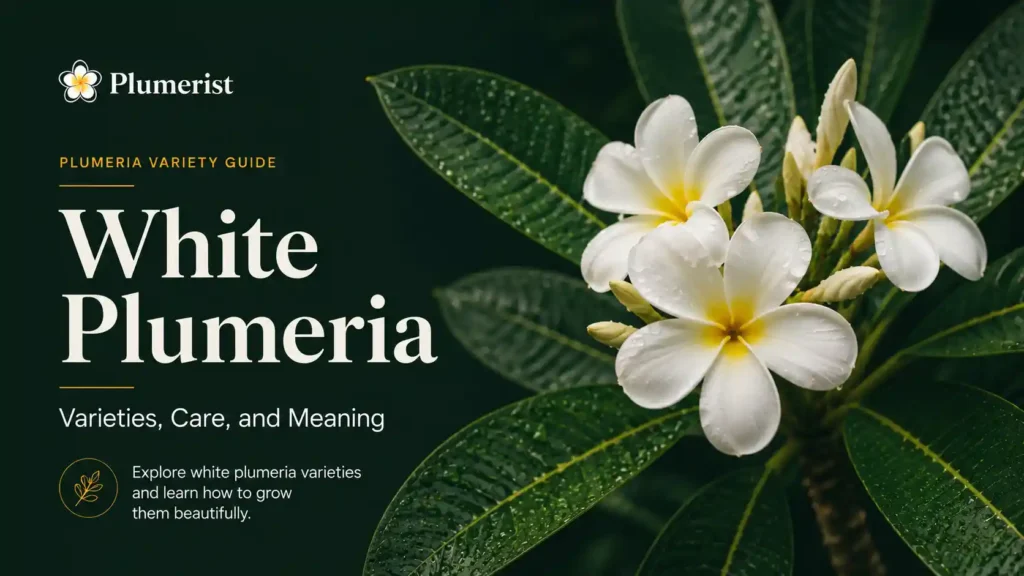
Few flowers say “tropical” quite like a white plumeria. The creamy, pinwheel petals and that heady evening perfume are the signature of a Hawaiian lei, and the reason gardeners in warm climates plant one right by the front door. If you have heard this plant called frangipani, that is the very same flower, “plumeria” and “frangipani” are just two names for the genus Plumeria.
White is the most common color in the group, and often the most fragrant. But “white plumeria” is really a small family of plants rather than one single variety. This guide walks through the main white types, why they smell so good, how to keep one thriving, and what the flower has come to mean. White is only one of the many colors this plant comes in, so if you want the big picture first, our complete guide to plumeria varieties is the place to start.
White Plumeria at a Glance
| Feature | What to expect |
|---|---|
| Flower color | White petals, usually with a yellow or gold center |
| Fragrance | Strong, sweet, jasmine and citrus notes, strongest at night |
| Bloom size | About 2 to 4 inches across, in clusters |
| Bloom season | Late spring to fall (nearly year-round for evergreen types in frost-free areas) |
| Mature height | Small tree, roughly 10 to 20 ft in the ground; far smaller in a pot |
| Leaves | Deciduous in most types; evergreen in Plumeria obtusa |
| Hardiness | USDA zones 9 to 11; grown in pots and overwintered elsewhere |
What Is a White Plumeria?
A white plumeria is any plumeria that blooms in white. The classic look is five broad, overlapping petals that spiral like a pinwheel, pure white at the edges and warming to a yellow throat in the middle. That golden eye is completely normal, if you have ever searched for a “yellow and white plumeria,” this is what you were looking at.
Most white plumerias fall into one of two groups. The deciduous types, bred from Plumeria rubra, drop their leaves and rest through winter. The evergreen type, Plumeria obtusa, holds its glossy leaves and keeps flowering almost year-round wherever frost never reaches it. Both are sold as “white frangipani,” so it helps to know which one you have.
Popular White Plumeria Varieties
A handful of white varieties do most of the work in gardens and lei stands:
- Singapore White (Plumeria obtusa), the iconic evergreen white frangipani. Rounded, glossy leaves, snow-white petals with a small yellow center, and blooms nearly all year in the tropics. The easiest choice if you want flowers for months on end.
- Plumeria alba, the true white frangipani of the Caribbean, with narrow, ribbon-like leaves and intensely fragrant white flowers. A little more cold-sensitive than obtusa.
- Dwarf Singapore White, a compact form of obtusa that stays small and tidy, which makes it a favorite for pots, patios, and courtyards.
Beyond these, growers register dozens of named white cultivars, many differing only in the size of the flower or the depth of that yellow center. For most gardens, one of the three above is the place to start.
Which White Plumeria Should You Grow?
If you want flowers for as much of the year as possible and live somewhere warm, go with Singapore White (obtusa), it is evergreen and the most forgiving. If fragrance is your priority and you do not mind a slightly more delicate plant, Plumeria alba is hard to beat. And if you are working with a balcony, a courtyard, or a single large pot, Dwarf Singapore White gives you the same clean white blooms on a plant that stays small. There is no wrong choice here; it comes down to your climate and your space.
Why White Plumeria Smells So Good
The fragrance is the whole point for a lot of people. White plumerias tend to be the most strongly scented in the genus, with a sweet jasmine-and-citrus perfume that gets noticeably richer after sunset. That evening timing is not an accident, in the wild the flowers are pollinated by night-flying moths, so they save their strongest scent for when those pollinators are active.
It is also why white plumeria is the flower of choice for leis and perfume. The blooms hold their shape and scent for a good while after they are picked, too, which you can read more about in our guide to how long plumeria flowers last.
How to Care for White Plumeria
White plumerias are not fussy, but they do have preferences. Give them as much sun as you can, six hours minimum, more is better, and a light, fast-draining mix so the roots never sit wet. Our breakdown of the best soil for plumeria covers the exact recipe.
Water deeply, then let the top few inches dry before watering again; the most common way to lose a plumeria is overwatering, not underwatering. During the growing season, feed with a high-phosphorus bloom fertilizer to keep the flowers coming, see our notes on feeding plumeria and how much water they actually need through the season.
If you live anywhere that frosts, grow your white plumeria in a container so you can move it. A good pot for plumeria plus a simple winter care routine is all it takes to carry the plant through the cold months. And when you want more of them, white plumerias root readily, our step-by-step on growing plumeria from cuttings will get you there. One note: the evergreen Singapore White likes a touch more warmth and steady moisture than the deciduous types, since it never fully goes dormant.
What White Plumeria Symbolizes
Color shapes meaning with plumeria, and white leans toward purity, new beginnings, and quiet devotion. In Hawaii the white lei is a warm welcome and a mark of celebration; in parts of Asia the flower carries spiritual weight and is planted near temples. If a white plumeria has a personal meaning for you, a wedding, a memory, a fresh start, you are in good company. There is a longer story here, which we unpack in our guide to plumeria symbolism and meaning.
Frequently Asked Questions
Is white plumeria fragrant? Yes, white plumerias are among the most fragrant of all, with a sweet, jasmine-like scent that grows stronger in the evening.
Why is my white plumeria yellow in the middle? That yellow throat is completely normal and part of the classic white plumeria look. The petals are white while the center fades to gold; it is not a sign of a problem.
Is white plumeria evergreen? It depends on the type. Plumeria obtusa (Singapore White) is evergreen and keeps its leaves in frost-free climates, while the more common Plumeria rubra-based whites are deciduous and drop their leaves in winter.
How big does a white plumeria get? In the ground and left unpruned, a white plumeria can reach 10 to 20 feet over many years. In a container, or with regular pruning, it stays much smaller and can easily be kept as a patio-sized tree.
How do I get my white plumeria to bloom more? The big three are sunlight, a high-phosphorus fertilizer, and patience through a warm growing season. Plants that are moved indoors or shaded often stall; give them the sunniest spot you have. Our guide on getting plumeria to bloom goes deeper.
Is white plumeria poisonous to pets? The milky sap can irritate skin and is mildly toxic if eaten, so it is worth keeping curious pets away. We cover this in detail in our article on whether plumeria is toxic to dogs.
Whether you are after that unmistakable lei fragrance, a fuss-free evergreen for a warm garden, or a potted tree to move indoors each winter, a white plumeria earns its spot. Start with a healthy Singapore White or alba, give it sun and sharp drainage, and it will reward you with clusters of scented blooms for years. And when you are ready to explore the other colors, head back to the full plumeria varieties guide, or explore pink, red, yellow, and purple plumeria.