

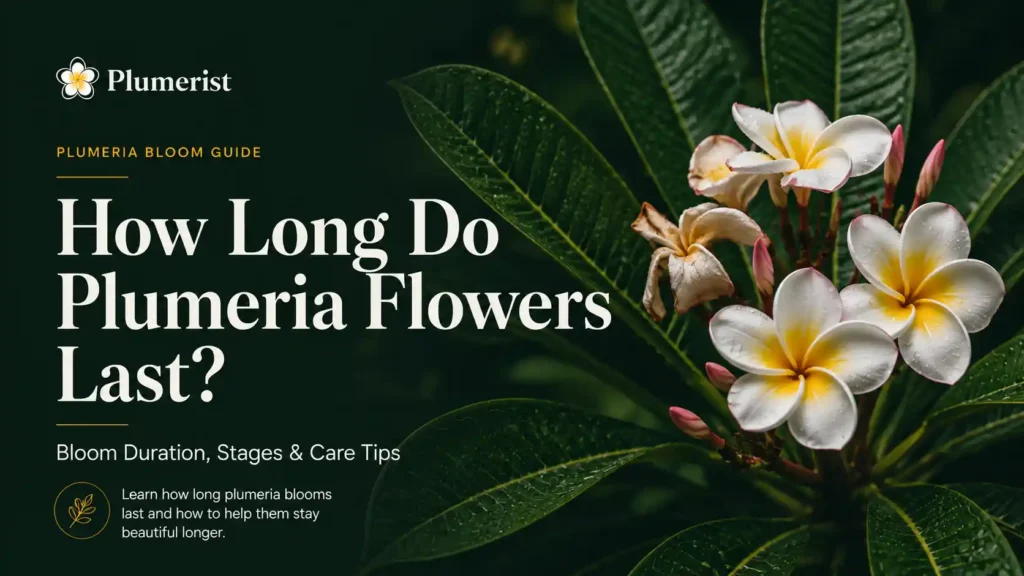
How long do plumeria flowers last depends on what you are counting. An individual flower is a short display, often measured in days. A cluster can keep opening new buds much longer, and the plant’s flowering season is a third timeline.
There is no single verified lifespan that fits every cultivar and setting. A fixed two to five day promise would imply more precision than the evidence supports. Watch the unopened buds and plant condition as well as the oldest petals.
How long do plumeria flowers last at each scale?
| What you count | What the duration means | Useful expectation |
|---|---|---|
| One open flower | Opening until fading, damage or drop. | A short individual display; cultivar and conditions vary. |
| One flower cluster | First open flower until the last active buds finish. | Successive flowers can keep the display going for weeks or longer. |
| The whole plant | Flowering activity across one or more tips during the season. | Months of display are possible, but continuity and timing vary. |
| A picked flower | Keeping quality after removal from the plant. | Handling and storage conditions matter; not the same as the attached flower. |
Different branches can also be at different stages. One finishing cluster does not mean the whole plant has stopped. Likewise, a plant in season does not mean every flower remains open for months.
Individual flowers: keep cultivar differences in view
Plumerias differ in petal texture, keeping quality and tendency to fade. A thicker looking flower is not a precise shelf life guarantee. The same plant can also face different weather during separate displays.
The University of Hawaii’s cultivar reference explicitly treats keeping quality and fading as selection traits. It does not give one universal number of attached flower days for every plumeria. Use the plant’s own repeated observations rather than an absolute species wide countdown.
Distinguish normal fading from fresh damage. Rain, wind, handling or feeding injury can spoil a flower before it would otherwise finish. A single battered bloom is weak evidence that the entire plant is unhealthy.
Clusters last through successive openings
The cluster, or inflorescence, contains buds at different stages. An older flower may fade while nearby buds continue developing. That turnover explains why the display can outlast any one blossom.
Do not cut off an active cluster solely because its first flowers have fallen. Check whether healthy unopened buds remain. Removing the entire stalk ends those buds’ chance to open.
Nor should every cluster be assigned a strict two to four week limit. Flower production differs among plants and conditions. The flowering development guide explains the wider pattern without a fixed universal schedule.
The flowering season is not a worldwide calendar
Plumerias in warmer settings can have a longer opportunity to grow and flower. Container plants with short summers may have a narrower display. Cultivar and the previous growing history also matter.
Calendar examples need their location attached. For example, the RHS growing guide describes a July to October flowering period in Britain. It should not be copied as the flowering calendar for tropical locations or the southern hemisphere.
A three to five month display is therefore not a requirement for every healthy plant. New plants and recently disturbed plants may behave differently. Measure what the plant actually did before judging it against a generalized calendar.
Normal turnover or a problem?
| Observation | What to check | Likely next action |
|---|---|---|
| Old flowers fade while healthy buds open | Leaf and cluster condition remain normal. | Continue routine observation rather than treating every faded petal. |
| Unopened buds repeatedly fail | Weather changes, moisture, pests and physical damage. | Investigate bud failure separately from normal flower aging. |
| Many flowers spoil after a storm | Visible bruising or breakage. | Remove spoiled fallen material and assess remaining buds. |
| Flower loss occurs with a declining plant | Root zone moisture, stem condition and other symptoms. | Address the underlying problem rather than only the petals. |
| No flower cluster ever develops | Origin, maturity and useful light. | Use the no flower diagnostic guide. |
Flowers dropping after they have opened can be normal. Buds dying before they open deserve a different assessment. Our flowering troubleshooting guide begins by separating those cases.
Can care extend the display?
Good care supports the plant’s ability to develop flowers. It does not make an individual blossom permanent. Avoid adding products solely because older petals are reaching the end of their display.
Maintain a suitably sunny position, with acclimation when moving from shade. Address extreme heat or harsh exposure where needed without permanently hiding the plant. Check the root zone as conditions change.
A potting mix or perlite product may help address a genuine media issue. They are not proven flower lifespan treatments. Assess the whole blend as described in the soil guide.
Do not repot a healthy flowering plant just to add an ingredient. Unnecessary disturbance can create another stress. Likewise, feed according to an established need and the product label rather than a petal countdown.
Do not prune after every flowering cycle
Pruning can remove tips and future flowering potential. An automatic postflowering haircut is not established as a way to prolong the next display. Make structural cuts for a clear reason.
The existing pruning shears listing remains available for necessary pruning work. It is not a required tool for extending flower life. Plumerist may earn a commission from qualifying purchases through these affiliate links.
Remove fallen spoiled blooms to keep the area tidy without damaging healthy buds. Handle cut material carefully because milky sap can irritate. Keep it away from children and pets.
How long do plumeria flowers last after picking?
Picking a flower begins a different keeping quality problem from maintaining a growing tree. Handle petals gently and keep them clean and away from hot sun. Damaged flowers should not be expected to store like undamaged ones.
The Hawaii publication describes keeping picked flowers for several days in a plastic bag at 48 to 55 F. That is detached flower storage guidance, not a winter temperature rule for the living plant. It does not establish a guaranteed vase life for every cultivar.
A picked individual bloom also differs from a cut flowering stalk with unopened buds. Do not apply a one to two day vase claim to both without evidence. This guide does not recommend household chemical or nanoparticle mixtures to prolong them.
Measure your plant’s display with a simple record
- Photograph a newly open flower and identify the branch without marking or injuring the petals.
- Record the opening date and the point when it fades or drops.
- Record the first and last openings on that cluster separately.
- Note unusual weather, handling or major care changes.
- Repeat on more than one flower before deciding what is normal for that plant.
This gives three useful records rather than one confusing bloom duration. A home observation is still not a controlled trial. Do not turn one result into a guaranteed cultivar specification.
Flower lifespan questions
Does pollination make a flower open?
No. Pollination is involved in seed production, not the basic requirement for opening a flower. Lack of pollinators is not a reason to hand pollinate to begin a display.
Will extra bloom fertilizer make each flower last longer?
No universal benefit is established for an already adequately supplied plant. Follow the feeding guide and count existing nutrients. Normal flower aging is not a deficiency test.
How long do plumeria flowers last before I should worry?
Use the condition of the whole cluster and plant rather than one exact number of days. Healthy buds continuing to open is different from repeated bud collapse. Investigate the pattern when the wider plant shows problems.
The Plumerist toolkit
The gear we would buy if we were starting over.
As an Amazon Associate, Plumerist earns from qualifying purchases.