

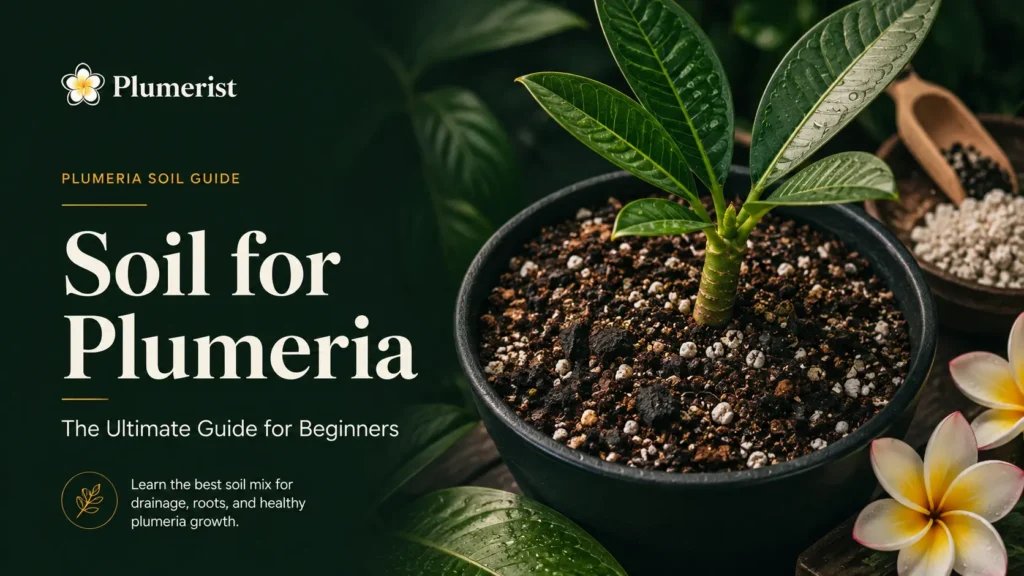
The best soil for plumeria keeps roots supplied with both air and usable moisture. For containers, choose a structured potting mix that drains freely. Do not confuse rapid runoff with a root ball that has been watered evenly.
A bag labeled cactus mix can be a starting point, but its behavior matters more than its name. Pot size, climate and watering all change the result. There is no single component ratio that solves every setting.
This guide separates media choices from nutrient and pH corrections. Some shopping links are affiliate links; Plumerist may earn a commission from qualifying purchases. Products listed here were researched, not personally trialed by Plumerist.
Choose soil for plumeria at each growth stage
| Stage or location | What the root zone needs | What to avoid |
|---|---|---|
| Established container plant | Air spaces, even wetting and enough moisture between waterings. | A large pot of compacted or persistently saturated media. |
| Germinating seeds | Clean, fine and uniform starting media with gentle moisture. | Heavy garden soil, raw scraps and coarse gaps around the seed. |
| Young seedling | A small, manageable root zone that stays moist without becoming waterlogged. | Adult drought cycles or oversized containers. |
| Unrooted cutting | A rooting setup with close control of moisture. | The watering and feeding routine of a leafy established tree. |
| Ground planting | A site that drains adequately through its actual soil profile. | Assuming a pocket of loose mix can fix a wet planting site. |
Do not use the seed starting recipe as a universal mature tree mix. Similarly, a very coarse adult container blend may make seed contact and moisture control difficult. The germination guide covers sowing conditions separately.
What the components actually do
A useful container mix needs structure as well as water retention. Iowa State’s potting media guide explains the different roles of common ingredients. Perlite and vermiculite should not be treated as interchangeable drainage additives.
| Component | Useful role | Limit to consider |
|---|---|---|
| Commercial potting mix | Provides a consistent base; may already contain fertilizer and pH amendments. | Composition and water retention vary between products. |
| Coarse perlite or pumice | Can help maintain air spaces in an appropriate blend. | Does not correct a blocked drainage hole or poor watering decisions. |
| Vermiculite | Holds moisture and nutrients, useful in some starting media. | Not a direct replacement for coarse perlite in a mix that is staying too wet. |
| Peat, coir or suitable bark based ingredients | Contribute water holding and structure in different ways. | Particle size, processing and the whole blend matter. |
| Mature compost | Adds organic matter and a variable nutrient contribution. | May be fine textured or contain substantial salts; do not use unfinished scraps as potting media. |
| Sand or horticultural grit | May add weight or change structure depending on particle size. | Fine sand is not an automatic drainage improvement. |
Peat free is a material choice, not a guarantee of drainage. A peat containing blend is not automatically waterlogged either. Judge the finished medium in your container.
Leaf mold, compost and mineral materials do not have one universal pH. Their source and processing matter. Avoid recipes claiming that a fixed splash of acidic compost will produce a precise final pH.
A small trial before repotting the whole collection
- Read the base mix label. Note ingredients, added fertilizer and any stated pH information.
- Prepare a small trial in the same kind of draining container you intend to use.
- Moisten evenly and let it drain. Check whether water wets the center or channels around dry pockets.
- Check moisture below the surface over the following days in the intended location.
- Adjust the blend if it stays wet unusually long or becomes unmanageably dry. Repeat the trial before committing a valuable plant.
This is a practical comparison, not a laboratory drainage test. It helps reveal whether your proposed mix fits your conditions. An empty trial pot will also dry differently from one filled with an actively growing root system.
Record the ingredients and amounts used. Changing the pot, mix and watering schedule at once makes later problems harder to interpret. Our care guide explains how the moisture decision changes with growth and dormancy.
Commercial mixes and amendments: buy for a purpose
A cactus potting mix is an option to inspect, not proof of a perfect formula. Read the current bag and test its wetting and drying behavior. Do not add more fertilizer automatically if the mix already contains it.
Perlite products can be useful when the blend needs more structure. Check the actual material and grade before ordering. Moisten dusty ingredients before handling and follow their handling directions.
Horticultural grit can add considerable weight. Confirm particle size and composition rather than substituting an unknown building sand. A heavier pot also changes how easily you can move the plant for winter.
A compost bin belongs to a waste recycling system, not an essential plumeria shopping list. Finished compost varies, and a plumeria pot is not the place to finish decomposing kitchen scraps. Buying all these products together is unnecessary.
pH: measure before correcting
Plumeria generally suits slightly acidic conditions, but that does not justify constantly adding acid. Root stress, nutrient availability and leaf color involve more than pH. A yellow leaf cannot tell you which amendment to buy.
For ground soil, use a suitable lab test and its interpretation. For a container mix, ask for a growing media test rather than assuming field soil ranges apply. Tell the lab what the plant is growing in.
Water pH is not the same measurement as potting mix pH. Water alkalinity also influences longer term changes. A single tap water reading cannot describe all the chemistry around the roots.
Used coffee grounds are not a dependable acidifier, and eggshells are not a rapid nutrient correction. Read coffee grounds for plumeria before adding them to change pH. Avoid adjusting a healthy pot because a cheap probe briefly shows an unexpected number.
What the meters can and cannot tell you
The instruments below remain from this guide’s product list. Their uses need clearer limits than a promise of accurate diagnosis. A monitor does not automatically regulate acidity, detect pruning needs or tell you how to force flowers.
Sonkir soil meter
The Sonkir soil meter listing is a product to check for its current model and instructions. Do not rely on an inexpensive multipurpose probe as the sole basis for a pH amendment. We have not verified its accuracy in a plumeria container mix.
Apera pH tester
The Apera pH tester listing requires the correct testing method for its model. A liquid pH instrument should not be pushed into dry soil or left in a pot. Calibration, probe care and sample preparation affect the result.
Apera’s soil slurry instructions describe testing a prepared sample. Container media may require a different agreed sampling method. Use the lab or instrument instructions consistently if comparing readings.
CNYST moisture and pH tester
The CNYST tester listing should be checked for current specifications before purchase. No independent accuracy evidence was established for this guide. Compare moisture indications with the actual root zone rather than treating a dial as an automatic watering command.
Wanfei plant monitor
The Wanfei plant monitor listing is not verified here as a pH testing device. Do not interpret a fertility or conductivity display as a complete nutrient analysis. Check the current manufacturer’s specifications and supported app before buying.
None of these products is mandatory for routine plumeria care. A suitable lab test is more informative when a persistent chemistry problem needs diagnosis. Do not buy an acidifier simply to accompany a new meter.
Repot when the root zone needs attention
Consider repotting when roots are crowded, media structure has deteriorated or wetting and drainage have become unreliable. A calendar reminder can prompt an inspection, but it should not force unnecessary root trimming.
Keep the existing planting depth and support the root ball carefully. Plumeria roots can be brittle. Choose a manageable increase in container space and avoid burying the stem.
Check moisture after repotting rather than immediately repeating the old watering interval. The new mix may behave differently. Note any fertilizer already present before restarting your feeding routine.
Soil for plumeria questions
Can ordinary potting mix work?
Yes, if its structure and moisture behavior suit the plant and container. It may need amendment, or a different product may fit better. The words ordinary and cactus do not establish performance.
Should soil for plumeria dry completely?
Do not keep an established plant saturated, but avoid imposing prolonged drought on active roots. Tiny seedlings need more even moisture than a resting mature tree. Check stage and depth rather than the surface alone.
Does adding gravel at the bottom replace drainage holes?
No. Use a container that allows excess water to leave. A layer of gravel does not provide an outlet in a sealed pot.
The Plumerist toolkit
The gear we would buy if we were starting over.
As an Amazon Associate, Plumerist earns from qualifying purchases.
2 Responses
I live in Arizona and have my first seed pod on my plumeria and would like to know if the seed will grow when harvested I don’t know much about them but I have 4 plants that have made it through many seasons and these are the first pods I have gotten on any of them
Congratulations! Getting your first seed pod is actually pretty exciting. 😊 It usually means your flowers were successfully pollinated, which doesn’t happen all the time.
Yes, the seeds can absolutely grow, but the key is to let the pod mature on the plant until it naturally starts to split open. That can take several months, so patience is important. Once it begins to crack, you can collect the winged seeds and sow them while they’re fresh for the best chance of germination.
Since you’re in Arizona, your warm climate is a big advantage for growing plumeria from seed. Just keep in mind that seedlings won’t be identical to the parent plant. Each one is unique, so you might end up with some interesting flower colors or characteristics.
Good luck, and I’d love to hear how your seedlings turn out!