

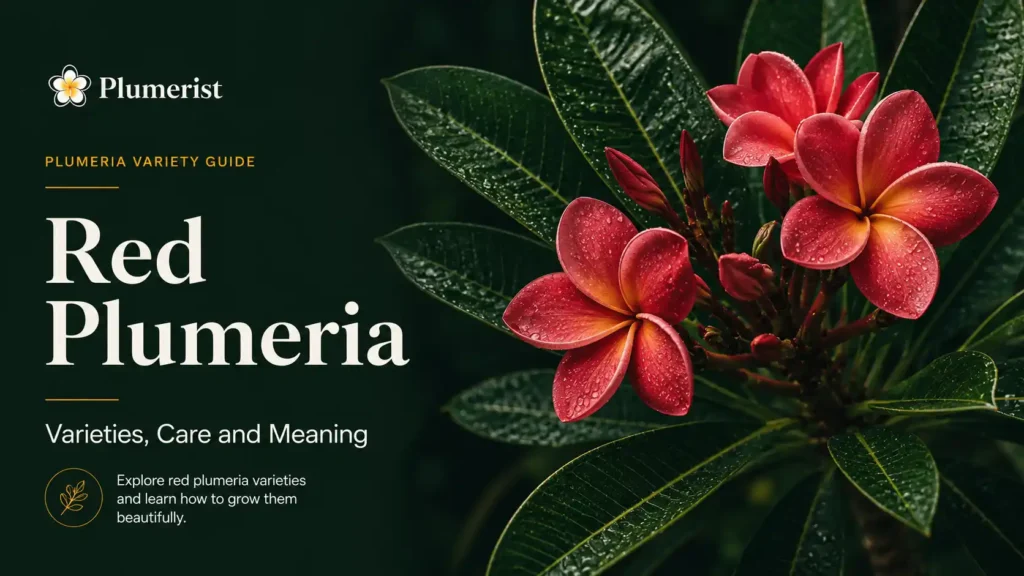
If white plumeria is elegant and pink is romantic, red is the one that walks into the room and demands you look at it.
Red plumeria is pure drama. Deep crimson, velvety scarlet, some so dark they look almost black in the right light. Where a soft pink whispers, a red plumeria basically yells “look at me.” And honestly? I’m here for it.
But red is also a little different from the other colors, in a few ways that are worth knowing before you fall in love and buy one. So let’s get into what “red plumeria” actually covers, the varieties to look for, how to grow one, and a couple honest things nobody tells you.
Red Plumeria at a Glance
Quick version for the skimmers:
| Thing | The short answer |
|---|---|
| Colors | Crimson, scarlet, deep red, near black reds, red with yellow center |
| Fragrance | Present, but often lighter than the whites (more on that below) |
| Bloom size | Roughly 2 to 4 inches, in clusters |
| Bloom season | Late spring through fall |
| Mature size | Small tree, or much smaller in a pot |
| Hardiness | Warm climates (zones 9 to 11), or grown in pots elsewhere |
What Counts as a “Red” Plumeria?
Anything in the red family, and there’s more range here than you’d think.
On one end you’ve got bright, cheerful scarlet and cherry reds, often with a sunny yellow throat that makes the red pop even harder. In the middle sit the classic deep crimson and true reds. And on the far end you’ve got the showstoppers, the deep, dark, almost black reds that plumeria collectors go absolutely wild for.
There’s also a big overlap zone where red blends into pink, giving you those rich rose reds and magentas. If your “red” leans a bit pink, that’s normal, and you might also like my guide to pink plumeria.
Almost all red plumeria are Plumeria rubra, the deciduous species behind basically every color. So your red will drop its leaves and rest through winter. Totally normal. If the species stuff is new to you, the full plumeria varieties guide lays it all out.
Popular Red Plumeria Varieties
There are loads of named reds, but a few come up a lot:
Scott Pratt. Probably the most famous dark red out there. Deep, rich, almost black red blooms that collectors love. If you want that dramatic near black look, this is the name people chase.
Cerise types. Bright, punchy cherry reds that are easier to find and just plain cheerful.
Red with a yellow eye. Tons of red cultivars carry that golden center, and the contrast is gorgeous. “Kauka Wilder” is a classic in the red pink zone.
Like always, don’t stress too much about the exact name. If you find a healthy red in a shade you love, grab it. They all grow the same way, so you’re really just choosing a flower.
A Few Honest Things About Red Plumeria
Here’s the stuff I wish more guides were upfront about.
Reds are often a little less fragrant. This isn’t a hard rule, but as a general trend, the deep reds tend to trade some of that knockout scent for their bold color. Many are still nicely fragrant, just not as intense as a white alba. So if scent is your absolute top priority, know that going in.
The darkest reds can be slower and pricier. Those near black beauties like Scott Pratt are in high demand and sometimes grow a touch less vigorously than an easy yellow. Nothing scary, just don’t expect a bargain bin price on the rare dark ones.
The color shifts with the weather. Reds often look their deepest and richest in cooler spring and fall temperatures, and can look a little more washed out in the flat heat of midsummer. Same plant, different vibe depending on the season. So don’t panic if your red looks less intense in a July heatwave.
None of this should scare you off. Red plumeria are stunning and 100 percent worth growing. I just like you knowing what you’re signing up for.
Red or Pink? Which Should You Get?
People ask me this one a lot, so here’s my quick gut check.
Go red if you want drama and boldness, a plant that’s the clear star of the whole garden. Red is passion and energy. It’s the flower that makes visitors stop mid sentence and ask what on earth it is.
Go pink if you want something softer and sweeter, a little more romantic, and usually with a stronger, fruitier scent to go with it.
Can’t decide? Grow both. They need identical care, they interplant beautifully, and a deep red next to a soft pink honestly looks incredible. If the gentler route is calling you, here’s my full guide to pink plumeria.
How to Care for Red Plumeria
Good news, and you probably saw this coming: a red plumeria wants the exact same things as every other plumeria.
Give it all the sun you can, six hours minimum and more is better. Plant it in a mix that drains fast, because soggy roots are the enemy. My best soil for plumeria guide has the recipe I use.
Water deep, then let it dry out before the next drink. I’ll keep repeating this because it’s the big one: overwatering kills way more plumeria than underwatering ever will. Here’s the full breakdown on plumeria water requirements.
Feed it through the growing season with a fertilizer that’s high in phosphorus to keep those red blooms coming. My notes on feeding plumeria walk through the schedule.
And if you get frost, grow your red in a pot so you can bring it in, and give it a simple winter care routine once it goes dormant.
Want more of that exact red? Grow it from a cutting, not seeds. A cutting is a clone, so you get the same red every time, while seeds are a total gamble. Here’s how to grow plumeria from cuttings.
What Does a Red Plumeria Mean?
If pink is sweet romance, red turns the dial all the way up.
Red plumeria is tied to passion, deep love, energy, and desire. It’s the bold, intense end of the love spectrum, the flower for big feelings rather than gentle ones. It also carries a general sense of vitality and life, which fits, because a red bloom genuinely looks alive.
There’s a rich cultural backstory to plumeria across Hawaii and Asia, and I dug into all of it in the guide to plumeria meaning and symbolism.
Frequently Asked Questions
Is red plumeria the same as red frangipani? Yep. “Plumeria” and “frangipani” are just two names for the same plant, so a red frangipani is a red plumeria. More on that in plumeria vs frangipani.
Are red plumeria fragrant? Usually yes, but often a bit lighter than the whites. The deep reds in particular tend to have a gentler scent, so if fragrance is your main goal, a white might suit you better.
What is the darkest red plumeria? Cultivars like Scott Pratt are famous for their deep, almost black red blooms. They’re the ones collectors hunt for.
Will red plumeria seeds grow red flowers? Probably not. Seeds are a genetic mix and rarely match the parent, so you could get anything. For a guaranteed red, grow from a cutting.
Why does my red plumeria look less red in summer? Reds often deepen in cooler weather and can look a little washed out in extreme heat. It’s normal, and the color usually richens back up as temperatures ease in fall.
Bottom line, if you want a plumeria with pure drama and passion, red is the one. Just go in knowing the deep reds trade a bit of scent for that bold color, give it sun and sharp drainage like any plumeria, and it’ll put on a show for years. Ready to explore more? Head back to the full plumeria varieties guide, or check out its softer cousins, pink plumeria and classic white plumeria.