

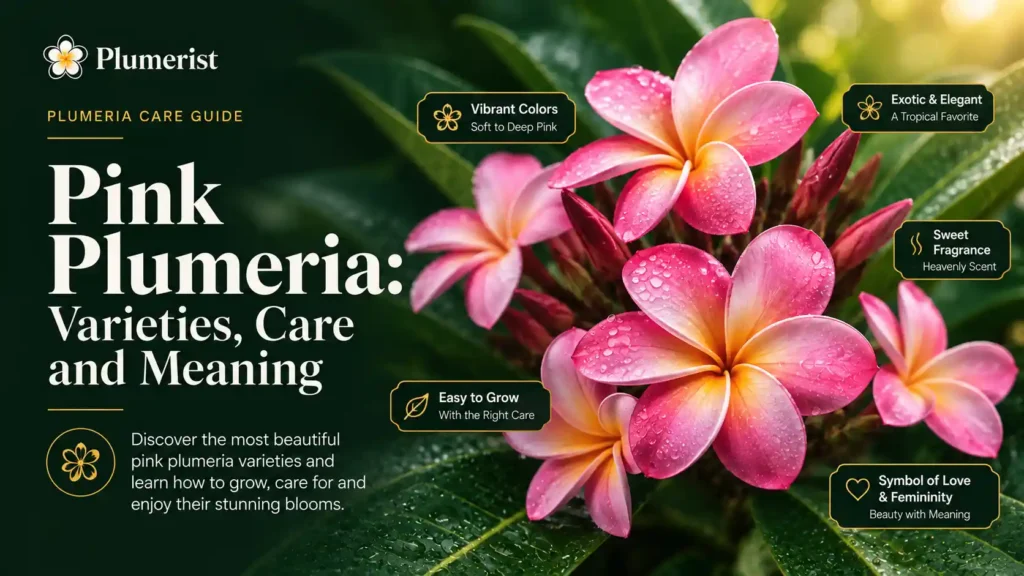
Pink plumeria might be my favorite color of the whole bunch. And I don’t say that lightly, because I love a good white one too.
But there’s just something about that pink. It ranges from the softest, most delicate blush all the way to a loud, in your face hot pink, and every shade in between somehow looks like a tropical sunset in flower form. No wonder it’s one of the most popular plumeria colors in home gardens.
Here’s the thing though. “Pink plumeria” isn’t one plant. It’s a whole family of them. So in this guide I’ll walk you through the range of pinks you’ll run into, the standout varieties, how to keep one happy, and what that pink flower actually means. Let’s go.
Pink Plumeria at a Glance
For the skimmers, here’s the quick version:
| Thing | The short answer |
|---|---|
| Colors | Blush, rose, coral, hot pink, often with a yellow throat |
| Fragrance | Sweet, sometimes with rose or peach notes |
| Bloom size | Roughly 2 to 4 inches, in clusters |
| Bloom season | Late spring through fall |
| Mature size | Small tree, or way smaller in a pot |
| Hardiness | Warm climates (zones 9 to 11), or grown in pots elsewhere |
What Counts as a “Pink” Plumeria?
Basically any plumeria whose petals land somewhere in the pink range. And that range is huge.
On the soft end you’ve got pale blush and baby pinks, the kind that look almost watercolor. In the middle you get true rose and coral shades. And on the far end you’ve got hot pinks and deep pink reds that practically glow.
Most pink plumeria also have that signature golden yellow throat in the center, which makes the pink pop even harder. If you’ve ever searched for something like “pink and yellow plumeria,” that’s just a normal pink with its yellow eye doing its thing.
Almost all of these pinks are Plumeria rubra, by the way, which is the deciduous species that gives us basically every color. So your pink plant will drop its leaves and rest in winter. Totally normal. If that’s new to you, my plumeria varieties guide breaks down the whole species thing.
Popular Pink Plumeria Varieties
There are a ton of named pink cultivars, but a few show up again and again:
Kauka Wilder. A classic. Bright rosy pink with a big yellow center. Bold and hard to miss.
Daisy Wilcox. Softer, prettier pink with a lovely form. A favorite for people who like the gentler shades.
Candy Stripe. Exactly what it sounds like, pink and white striping that looks almost painted on.
Penang Peach. That gorgeous in between zone where pink meets peach and coral. One of my personal favorites, honestly.
Don’t get too hung up on chasing a specific name though. If you find a healthy pink plumeria in a shade you love, grab it. They all grow the same way, so the flower is really the only thing you’re choosing.
Do Pink Plumeria Smell Good?
Oh yeah.
Pink plumeria are nicely fragrant, and the fun part is the scent isn’t always the same jasmine sweetness you get from the whites. A lot of pinks lean into rosy or even peachy, fruity notes, which makes sense given the peach and coral tones in the flowers.
Like all plumeria, the scent gets stronger in the evening, because these flowers are built to attract night flying moths. So if you really want to enjoy it, go stand next to your plant after sunset. That’s when it shows off.
How to Care for Pink Plumeria
Good news: a pink plumeria wants the exact same things as every other plumeria. No special treatment.
Give it as much sun as you can. Six hours minimum, and honestly more is better. These are full sun plants and they sulk in shade.
Plant it in a mix that drains fast so the roots never sit in water. Regular potting soil holds too much moisture, so I use a grittier blend, which I break down in my best soil for plumeria guide.
Water deep, then back off. Let the top few inches dry out before you water again. I’ll say it louder for the people in the back: the fastest way to kill a plumeria is overwatering, not underwatering. If you want the full breakdown of how much they actually need through the seasons, I covered it in plumeria water requirements.
Feed it during the growing season with a fertilizer that’s high in phosphorus to keep those pink blooms coming. Here are my notes on feeding plumeria.
And if you catch frost where you live, grow it in a pot so you can move it, and give it a simple winter care routine once it goes dormant.
Want more of the same pink? Easy. Pink plumeria root readily from cuttings, and since a cutting is a clone, you get the exact same pink every time. Here’s how to grow plumeria from cuttings.
How to Get a More Vivid Pink
Quick tip, because a lot of people don’t realize this.
The intensity of a pink plumeria isn’t fixed. The exact same plant can bloom softer or deeper depending on how you grow it.
More sun usually means richer color. A plant baking in full sun tends to throw deeper, more saturated pinks, while one stuck in part shade often looks washed out and pale. So if your pink is looking a little sad and faded, sun is the first thing I’d check.
Cooler nights deepen it too. A lot of growers notice the same variety looks more vivid in spring and fall, when nights are cooler, than in the flat heat of midsummer. Nothing you can control, but good to know so you don’t panic when the color shifts a bit through the season.
A well fed plant blooms better, period. Starving plants make weak, pale flowers. Keep up the feeding and you’ll see the difference in the color.
And give a young plant a season to find itself. First year blooms are often lighter than what the plant does once it’s mature and settled in.
What Does a Pink Plumeria Mean?
Color changes the meaning with plumeria, and pink is the romantic one.
Pink plumeria is usually tied to love, grace, affection, and new romance, which is probably why it shows up so often in weddings and celebrations. Softer pinks lean sweet and gentle. Bolder pinks lean passionate. Either way, it’s the flower you reach for when the vibe is love.
There’s a much deeper cultural story behind plumeria across Hawaii and Asia, and I unpacked all of it in the guide to plumeria meaning and symbolism.
Frequently Asked Questions
Is pink plumeria the same as pink frangipani? Yep. “Plumeria” and “frangipani” are two names for the same plant, so a pink frangipani is just a pink plumeria. More on that in plumeria vs frangipani.
Why does my pink plumeria have a yellow center? Totally normal. Most pinks have a golden yellow throat, and it actually makes the pink look richer. Not a problem at all.
Are pink plumeria fragrant? Yes, and often with a rosy or peachy twist on the usual sweet plumeria scent. Strongest in the evening.
Will pink plumeria seeds grow pink flowers? Probably not. Seeds are a genetic gamble and rarely match the parent. If you want a guaranteed pink, grow from a cutting instead of seeds.
How big does a pink plumeria get? Left in the ground it can become a small tree, but in a pot or with regular pruning it stays nicely compact.
Bottom line, if you want a plumeria that brings romance, warmth, and a serious sunset energy to your garden, pink is a fantastic pick. Grab a shade you love, give it sun and sharp drainage, and it’ll reward you for years. And when you’re ready to explore the other colors, head back to the full plumeria varieties guide or check out its opposite, the classic white plumeria.