
Close your eyes and picture a plumeria. A Hawaiian lei, a beach, that whole tropical postcard vibe.
I’d bet money the flower you’re picturing is yellow and white.
That’s because yellow plumeria is basically the face of the whole genus. It’s the classic, the one on every travel brochure, the sunny bloom that smells like a vacation. And here’s a little secret I’ll get into below: it’s also probably the easiest plumeria you can grow. So if you’re new to all this, you might want to pay extra attention.
Let’s break down the yellows: the range, the star varieties, how to care for one, and what that cheerful flower actually means.
Yellow Plumeria at a Glance
The quick version:
| Thing | The short answer |
|---|---|
| Colors | Soft butter yellow to deep gold, usually with white edges |
| Fragrance | Sweet and strong, classic plumeria scent |
| Bloom size | Roughly 2 to 4 inches, in clusters |
| Bloom season | Late spring through fall, and heavily |
| Mature size | Small tree, or much smaller in a pot |
| Hardiness | Warm climates (zones 9 to 11), or grown in pots elsewhere |
What Counts as a “Yellow” Plumeria?
Pretty much any plumeria where yellow is the main event.
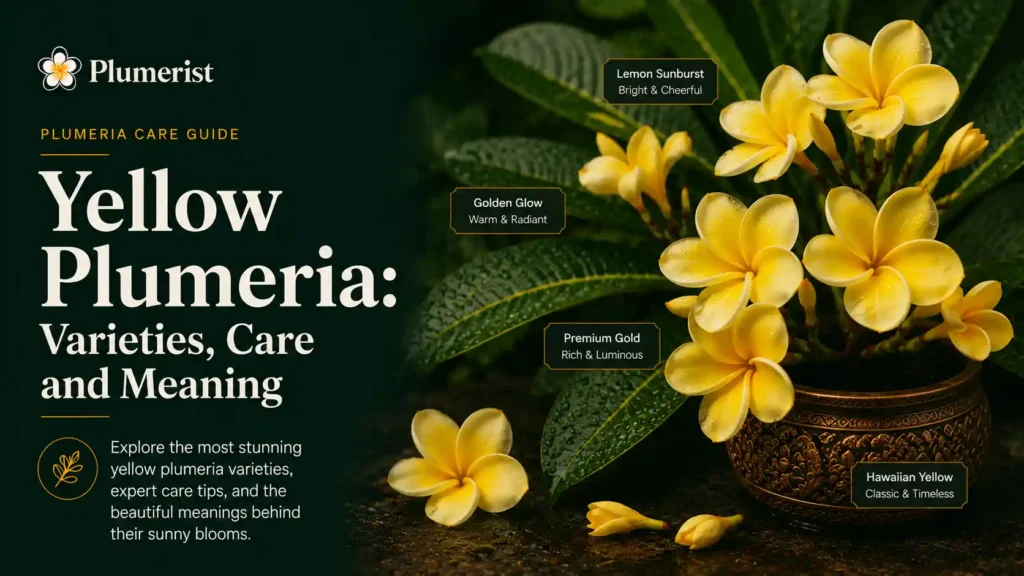
The classic look is petals that are golden yellow in the center and fade to creamy white at the edges. That’s the iconic lei flower right there. Some varieties are a soft, pale butter yellow all over. Others are a rich, deep gold that almost glows.
Because so many white plumeria also have yellow centers, there’s a big overlap zone. If you’ve searched “white and yellow plumeria,” that’s exactly this: a mostly white bloom with a strong golden throat, or a mostly yellow bloom with white edges. Same beautiful thing, and you can see the flip side in my white plumeria guide.
Almost all yellow plumeria are Plumeria rubra, the deciduous species behind nearly every color, so yours will drop its leaves and rest in winter. Normal. The plumeria varieties guide covers the species side if you want the full picture.
Popular Yellow Plumeria Varieties
A couple of yellows are so common and so loved that you’ll run into them everywhere:
Celadine. This is the one. The classic bright yellow and white Hawaiian lei flower, sweetly scented, and famously tough and prolific. If someone hands you a plumeria in Hawaii, odds are good it’s Celadine. It’s also sometimes just called “Common Yellow,” which tells you how widespread it is.
Aztec Gold. Deeper and more golden than Celadine, and an absolute machine at blooming. If you want richer yellow and tons of flowers, this is your pick.
Beyond those two you’ll find loads of named yellows, but honestly, Celadine and Aztec Gold are where I’d point most people. They’re gorgeous, easy, and easy to find.
Why Yellow Is the Best Beginner Plumeria
Okay, here’s that secret I promised.
If you’ve never grown a plumeria before, start with a yellow. Specifically a Celadine or a common yellow.
Here’s why. The classic yellows are the workhorses of the plumeria world. They tend to be more vigorous, hardier, and more forgiving than a lot of the fancy rare colors. They root fast from cuttings, they establish quickly, and they bloom their heads off without much fuss. Those delicate collector colors can be a little more temperamental. The everyday yellows just want to grow.
So while a near black red might be the trophy plant, a yellow is the one that actually builds your confidence and gets you hooked. That’s genuinely where I’d start a beginner every single time.
How to Care for Yellow Plumeria
Same core routine as every plumeria, and yellows are extra forgiving about it.
Give it full sun, six hours minimum and more is better. Plant it in a mix that drains fast so the roots never sit soggy. Here’s my best soil for plumeria recipe.
Water deep, then let it dry before watering again. Say it with me one more time: overwatering is the number one plumeria killer, not underwatering. The full seasonal breakdown is in plumeria water requirements.
Feed it during the growing season with a fertilizer that’s high in phosphorus to keep the blooms coming, though honestly a healthy yellow needs very little encouragement to flower. My feeding plumeria notes have the schedule.
If you get frost, grow it in a pot and give it a simple winter care routine once it goes dormant.
And when you want more (you will), yellows root super easily from cuttings, and a cutting clones the parent so you get the same sunny bloom every time. Here’s how to grow plumeria from cuttings.
Getting the Most Blooms From Your Yellow
Yellows are already heavy bloomers, but if you want an absolute flower factory, here’s the short list.
Sun is everything. More sun equals more flowers, full stop. A yellow baking in all day sun will out bloom a shaded one every single time. If yours isn’t flowering much, this is almost always the reason.
Feed it right. A fertilizer high in phosphorus during the growing season fuels blooms. Too much nitrogen does the opposite, giving you lots of leafy green growth and fewer flowers, so skip the generic lawn feed.
Don’t drown it. Soggy roots stress the plant and stall flowering. Let it dry between waterings and it’ll thank you with more blooms, not fewer.
Give it warmth and a little patience. Plumeria flower when they’re warm, happy, and established, so a young plant might take a season to really hit its stride. Once it does, hang on.
Want the full playbook on maximizing flowers? I covered it in how to get plumeria to bloom.
What Does a Yellow Plumeria Mean?
Yellow is the happy one.
Yellow plumeria is tied to friendship, joy, positivity, and good energy. It’s less about romance and more about warmth, sunshine, and celebrating people you care about. Which fits perfectly, because it’s the traditional flower of the welcome lei, that whole “so glad you’re here” feeling in flower form.
There’s a deeper cultural story behind plumeria across Hawaii and Asia, and I unpacked all of it in the guide to plumeria meaning and symbolism.
Frequently Asked Questions
Is yellow plumeria the same as yellow frangipani? Yep. “Plumeria” and “frangipani” are two names for the same plant, so a yellow frangipani is a yellow plumeria. Here’s more on plumeria vs frangipani.
What is the most common yellow plumeria? Celadine, often just called Common Yellow. It’s the classic yellow and white Hawaiian lei flower, and it’s everywhere for good reason.
Are yellow plumeria fragrant? Very. Yellows have that sweet, classic plumeria scent, and Celadine in particular is known for smelling wonderful, especially in the evening.
Is yellow plumeria good for beginners? The best, honestly. The common yellows are vigorous, hardy, and bloom easily, which makes them the most forgiving plumeria to learn on.
Will yellow plumeria seeds grow yellow flowers? Not reliably. Seeds are a genetic gamble and rarely match the parent. For a guaranteed yellow, grow from a cutting.
Bottom line, if you want the quintessential plumeria, the sunny lei flower that smells amazing and practically grows itself, yellow is a fantastic choice. It’s the one I’d hand a total beginner without hesitation. Give it sun and sharp drainage and it’ll reward you fast. Ready for more colors? Jump back to the full plumeria varieties guide, or check out its cousins, white plumeria, pink plumeria, and bold red plumeria.