

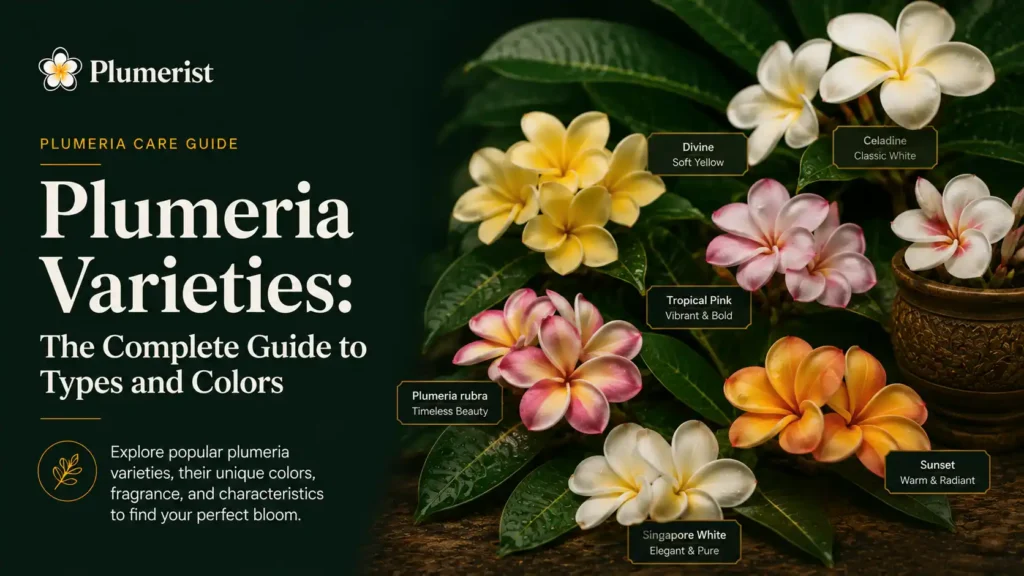
So you want a plumeria. Great choice.
Then you start actually shopping, and… whoa. White ones, yellow ones, ones that look like somebody spray painted a sunset on them, a thing called “Bridal Bouquet,” and a whole wall of Latin names. It’s a lot.
Here’s the good news.
There are really only a handful of plumeria you need to know about. Everything else is just a remix of those. Once you get the basic map in your head, that nursery table stops being overwhelming and starts being fun.
In this guide I’ll break down the entire plumeria family the way it actually makes sense: by species, by color, and by size. I’ll show you how to tell what you’re looking at, how new varieties get created, what to watch out for when you buy, and which one I’d grab if I were standing there with you. Grab a coffee. This is the big one.
The 3 Ways to Think About Plumeria
Quick heads up before we dive in.
There are three ways people sort plumeria, and honestly you’ll end up using all of them:
By species. The botanical starting point. This tells you the big stuff, like leaf shape and whether the plant keeps its leaves in winter.
By color. Let’s be real, this is how most of us actually shop. The flower is the whole point.
By size and habit. Big tree or compact little thing? Evergreen or does it go bald every winter? This is the part that affects how you care for it.
Keep those three in mind and the hundreds of named varieties suddenly feel way less scary.
Plumeria Species: The Foundation
Almost every plumeria you’ll ever meet comes from one of these four. Learn these and you’re basically fluent.
Plumeria rubra is the workhorse. It’s the parent of the huge majority of garden varieties, and it’s the one responsible for that crazy color range, everything from white to yellow to pink to red. It’s also deciduous, which is a fancy way of saying it drops its leaves and takes a nap every winter. If you buy a colorful named plumeria, it’s almost certainly a rubra.
Plumeria obtusa, aka Singapore plumeria, is the evergreen one. Rounded glossy leaves, mostly white flowers with a little yellow eye, and the best part: it keeps its leaves and keeps blooming almost all year in warm climates. If you’re greedy for flowers (no judgment, same), this is your guy.
Plumeria alba is the true white frangipani from the Caribbean. Skinny ribbon like leaves, and a scent that honestly might be the best in the whole genus. It’s a touch more sensitive to cold, so keep that in mind.
Plumeria pudica, sold as “Bridal Bouquet,” is the quirky one, and I mean that lovingly. Weird spoon shaped leaves, stays semi evergreen, blooms while it’s still young, and it’s nearly thornless. The white flowers only have a light scent, but it pumps out so many of them that nobody really cares.
There are a few rarer species floating around too, like P. stenopetala with its twisty narrow petals, but those four cover basically everything you’ll find for sale.
Plumeria Species at a Glance
If you’re a skimmer (I am), here’s the whole thing in one table:
| Species | Leaves | Typical color | Fragrance | Evergreen? | Best for |
|---|---|---|---|---|---|
| Rubra | Pointed, deciduous | Every color | Strong | No | Color lovers |
| Obtusa (Singapore) | Rounded, glossy | White, yellow eye | Medium | Yes | Year round blooms |
| Alba | Narrow, ribbon like | White | Very strong | No | Fragrance chasers |
| Pudica (Bridal Bouquet) | Spoon shaped | White | Light | Semi | Easy landscape plant |
Screenshot that and you basically have a cheat sheet for the nursery.
Plumeria by Color
Okay, the fun part.
Color is how most people choose, so here’s the lineup. As we publish the full guide for each color, its name below turns into a link.
White is the most common and usually the most fragrant. The classic lei flower. I already went deep on this one, so start with the full guide to white plumeria if that’s your vibe. Big names here: Singapore White and alba.
Yellow is that cheerful, super Hawaiian look. Usually white edged petals melting into a golden middle. Think cultivars like “Aztec Gold” and “Celadine.” If you want the flower that screams “tropical vacation,” this is it. I went deep on it in my full yellow plumeria guide.
Pink covers a massive range, from the softest baby blush all the way to loud hot pink. It’s one of the most popular colors in home gardens, and I get why. Cultivars run from delicate “Puu Kahea” pinks to punchy hot pinks. The whole spectrum is in my pink plumeria guide.
Red is the drama queen. Deep crimson, velvety, impossible to ignore. “Kauka Wilder” is the classic, and there are some near black reds out there that plumeria nerds go a little feral over. More on the dark ones in my red plumeria guide.
Rainbow and multicolor types blend pink, yellow, and orange in a single bloom, sometimes with a red rim, so no two flowers look the same. “Jeannie Moragne” is a stunner in this group. These are the ones that stop people in their tracks.
Purple is the one I’d side eye a little. True purple or blue plumeria basically doesn’t exist. What gets sold as “purple” is really a deep magenta or wine shade. Still gorgeous. Just not actually violet, so don’t feel cheated when it shows up looking more merlot than grape. I cleared up the whole myth in my purple plumeria guide.
One thing worth knowing: a plumeria’s color can look slightly different depending on sun, temperature, and the plant’s age. A young plant’s first blooms are sometimes a bit washed out compared to what it’ll do once it’s established. So give a new variety a season before you judge it.
How New Plumeria Varieties Get Created
Ever wondered where all these named varieties come from? Quick behind the scenes, because it explains a lot.
New plumeria are born two ways.
Seed hybridizing. When bees (or breeders) cross two plants, the seeds carry a random mix of both parents. Plant a hundred seeds and you might get a hundred slightly different flowers. Every now and then one is a knockout, so the grower names it, and boom, a new cultivar is born. This is why there are literally thousands of them.
Grafting. This is the trick behind those “rainbow” plants you see with three different flower colors on one tree. That’s not one magical variety. It’s a grower grafting cuttings of three separate cultivars onto a single rootstock. Cool party trick, and totally legit, just know what you’re buying so you’re not confused when one branch does its own thing.
Why does this matter to you? Because it leads straight into the single most common mistake new growers make. Which is…
Seed Grown vs Cutting Grown (Read This Before You Buy Seeds)
Here’s a mistake I see constantly.
Somebody falls in love with a specific plumeria, buys a pack of its seeds online, plants them, and expects the same flower. Then two years later they’re confused because the blooms look nothing like the photo.
The reason goes back to that hybridizing thing. Plumeria seeds do not grow true to the parent. Each seed is a genetic gamble, a mix of two plants, so you truly have no idea what color or form you’ll get until it blooms. Sometimes that’s exciting. Usually it’s just a random pink.
If you want an exact variety, you buy a cutting, not seeds. A cutting is a clone of the parent, so it blooms the same color, guaranteed. Growing from cuttings is genuinely easy too, and I walk through the whole thing in growing plumeria from cuttings.
Seeds are still fun if you like surprises and don’t mind waiting three or so years for the reveal. If you’re curious about the pods and how seeds actually form, I covered that in plumeria seed pods. Just go in knowing the deal: seeds for adventure, cuttings for a specific variety.
Plumeria by Size and Habit
Color gets you excited. Size keeps you from planting a future 20 foot tree next to your front door. Ask me how I know people do this.
Standard trees are what most rubra types turn into, roughly 10 to 25 feet if you plant them in the ground and never touch them. Good news: a little pruning keeps them way smaller, and you can even keep a plumeria small on purpose if space is tight.
Dwarf and compact types, like Dwarf Singapore White, stay naturally small and tidy. Perfect for pots, patios, and tiny courtyards. If you’re a container grower, start here.
Evergreen vs deciduous is the habit that actually matters for care. The evergreen ones (obtusa and pudica) hang onto their leaves and want steady warmth. The deciduous rubra types drop everything and go dormant in winter, which changes how you water and overwinter them. My winter care guide covers both so nobody panics in November.
A Few Cultivars Worth Knowing
If you’re browsing a nursery, these names pop up over and over:
Aztec Gold. Golden yellow, blooms like crazy, very easy. My pick for a first plant.
Celadine. The classic bright yellow and white Hawaiian lei flower.
Kauka Wilder. Bold pink red with a yellow center.
Jeannie Moragne. Big, softly blended rainbow blooms.
Bridal Bouquet (pudica). Pure white, flowers almost year round in warm spots.
There are literally thousands more registered cultivars, but these are the reliable crowd pleasers. Start here and you won’t be disappointed.
How to Tell Which Plumeria You Have
Bought a plant with no label? Inherited one? Happens all the time. Here’s how to make an educated guess.
Check the leaves first. Rounded, thick, super glossy leaves usually mean obtusa (Singapore). Long, narrow, ribbon like leaves point to alba. Weird spoon or fiddle shaped leaves are a dead giveaway for pudica. Broad, pointed leaves that drop in winter? Classic rubra.
Then the flower. Color, obviously, but also look at the shape. Are the petals broad and overlapping, or narrow and spaced out? Is there a yellow throat? How big is the bloom?
Then the nose. Give it a sniff, ideally in the evening when the scent peaks. A knockout fragrance leans white rubra or alba. A faint scent on a super floriferous white plant leans pudica.
Real talk though: pinning down the exact named cultivar of a mystery plumeria is nearly impossible, even for experts, because so many look alike. Getting it down to the species is realistic. The exact cultivar name usually isn’t, so don’t drive yourself nuts over it.
What to Look For When Buying a Plumeria
A few things I’d check before handing over money, whether you’re buying a plant or a cutting.
If it’s a cutting, ask if it’s rooted or unrooted. Rooted is easier and faster. Unrooted is cheaper and totally doable, it just takes patience and a bit of nerve your first time.
Squeeze the stem gently. It should feel firm. Soft, wrinkly, or mushy spots are a red flag for rot, and rot is the main thing that kills these plants.
Look for a tip cutting (a piece with a growing tip on the end) if you can. They tend to establish and branch a little faster in my experience.
Buy from someone who labels their plants. Sounds obvious, but a seller who actually knows their cultivars is way less likely to hand you a mystery “red” that blooms pink.
Get those basics right and you’ve dodged 90 percent of the beginner headaches.
How to Choose the Right Plumeria
Don’t overthink it. Match the plant to your life:
Want flowers for most of the year and live somewhere warm? Go evergreen Singapore (obtusa).
Is scent your main thing? Grab a white rubra or alba and thank me later.
Short on space or growing in a pot? Pick a dwarf.
Just obsessed with a certain color? Honestly, grab any healthy rubra in that shade. They all grow pretty much the same way, so buy the flower you love.
And if you’re brand new to all this, a Singapore White or an “Aztec Gold” is about as forgiving as plumeria gets. That’s genuinely where I’d start you.
Do Different Varieties Need Different Care?
Short answer: nope, and thank goodness.
Nearly every plumeria wants the same handful of things. Tons of sun. A light mix that drains fast (here’s my go to recipe for the best soil for plumeria). Water that’s careful, not constant, because the number one way I’ve seen people kill these things is loving them to death with the hose. And a fertilizer that’s high in phosphorus during the growing season to keep the blooms coming, which I break down in my notes on feeding plumeria.
The one real difference is dormancy.
The evergreen types (obtusa, pudica) never fully shut down, so they like steady warmth and moisture all year. The deciduous rubra types drop their leaves and want way less water through winter. That’s basically it.
For the full routine start to finish, no matter which variety you land on, check out how to grow plumeria.
What the Colors Mean
Quick fun tangent, because color isn’t just looks.
White leans toward purity and fresh starts. Pink is love and grace. Yellow is friendship and good vibes. There’s a whole cultural backstory here that I find genuinely cool, and I dug into it in the guide to plumeria meaning and symbolism.
FAQ
How many types of plumeria are there? Only a handful of true species, mainly rubra, obtusa, alba, and pudica. But breeders have turned those into thousands of named cultivars in just about every color you can picture.
What’s the most fragrant plumeria? The whites, especially Plumeria alba and white rubra types. Their scent really cranks up in the evening, which is my favorite time to go stand next to one.
Which plumeria stays evergreen? Plumeria obtusa (Singapore) and Plumeria pudica (Bridal Bouquet) keep their leaves in frost free climates. The common rubra types are deciduous and go bare in winter.
Which plumeria is best for pots or small spaces? Dwarf varieties like Dwarf Singapore White. They stay compact and are happy in containers.
Will plumeria grow true from seed? Nope. Seeds are a genetic mix of two parents, so they don’t match the parent plant. Want a specific variety? Buy a cutting, which is a clone and blooms the same every time.
How long until a plumeria blooms? A cutting can bloom in its first or second year. A seed grown plant usually takes around three years, sometimes more. Patience, my friend.
Are purple or blue plumeria real? Not really. There’s no truly blue plumeria, and “purple” ones are more of a deep magenta or wine color than actual violet. Pretty? Absolutely. Grape colored? Nope.
Here’s the thing I love about plumeria. Whatever variety catches your eye, they nearly all grow the same forgiving way. So you get to choose purely on the flower that makes you happy and trust that the same sun, sharp drainage, and seasonal feeding will keep it thriving. Pick the color or species that speaks to you, and dig into each one through the guides linked above.