

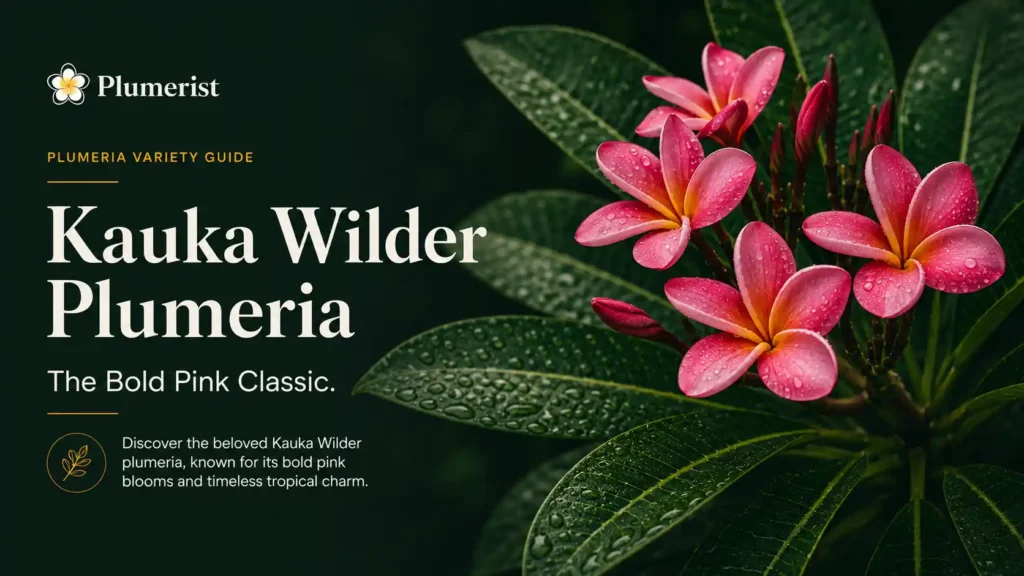
Kauka Wilder is one of those plumeria names that comes up constantly, and once you’ve seen the flower, you get why. It’s a bold, warm pink with a big glowing yellow center, and it flowers like it means business. If you want a classic, eye catching pink that’s also easy to grow, this is a variety worth knowing.
Let me walk you through what Kauka Wilder actually looks like, how it smells, and how to keep one happy.
Kauka Wilder at a Glance
| Thing | The short answer |
|---|---|
| Color | Bold, warm rosy pink with a large bright yellow center |
| Flower size | Large, around 3 inches across |
| Fragrance | Strong and lovely, with a fruity note |
| Blooming | Heavy and prolific, late spring through fall |
| Species | A cultivar of Plumeria rubra, so it’s deciduous |
| Mature size | Small tree, roughly 15 to 20 ft, smaller in a pot |
| Hardiness | Warm climates (USDA zones 10 to 11), or grown in pots elsewhere |
What Kauka Wilder Looks Like
This is a bold one, and that’s the appeal. The flowers are a rich, warm pink that leans toward rosy coral, with a big, bright yellow center that really lights up the middle of each bloom. The contrast between that warm pink and the glowing yellow eye is what makes Kauka Wilder so recognizable and, honestly, so photogenic.
The blooms are on the larger side, around 3 inches across, with full rounded petals and that classic pinwheel shape, and they show up in generous clusters at the branch tips. It’s not a shy, pastel pink. Kauka Wilder is a confident, saturated color that stands out from across the yard, which is exactly why it’s been a favorite for so long.
The Fruity Fragrance
Good looks are only half of it. Kauka Wilder is also strongly fragrant, and the scent has a lovely fruity quality to it rather than the sharper citrus of some yellows. It’s sweet, rich, and gets stronger in the evening like all plumeria, so it’s a fantastic pick to plant near a doorway, patio, or path where you’ll actually catch that perfume. If scent is a big deal for you, Kauka Wilder delivers on both color and smell.
Why Kauka Wilder Is a Classic
Some varieties are popular because they’re rare. Kauka Wilder is popular because it’s just plain good.
It’s a prolific bloomer, flowering heavily from late spring through fall, and it’s a vigorous, reliable grower that doesn’t ask for anything special. Add in that bold color and strong fruity scent, and you get a variety that’s beautiful, fragrant, and genuinely easy, which is a rare trifecta. That combination is why it’s been a staple pink for decades. If you’re building out a collection of pink plumeria, Kauka Wilder is close to a must have.
Where It Fits in the Pink Family
Pink plumeria run from soft baby blush all the way to loud hot pink, and Kauka Wilder sits at the bold, warm end of that range, tipping toward coral and rose thanks to that reddish warmth in the petals. So if you love a punchy, saturated pink rather than a delicate pastel, this is your variety. For the full spectrum of pinks and how they compare, my pink plumeria guide has the rundown, and if you find yourself drawn to the warmer, redder end, the red plumeria guide is worth a look too.
How to Care for Kauka Wilder
Good news: Kauka Wilder wants the standard plumeria care, and it’s a forgiving, easygoing variety. Give it full sun, six hours minimum and more is better, since sun powers all those blooms and keeps the color rich. Plant it in a fast draining mix so the roots never sit wet, which my best soil for plumeria guide covers.
Water deeply, then let it dry out before the next round, because overwatering is the top plumeria killer. The full schedule is in plumeria water requirements. Through the growing season, feed a high phosphorus bloom fertilizer to keep the heavy flowering going, per my feeding plumeria notes.
As a deciduous Plumeria rubra, Kauka Wilder will drop its leaves and go dormant in winter, which is normal. It’s cold sensitive, so if you get frost, keep it in a pot and follow a simple winter care routine while it rests. Want to squeeze out even more flowers? My guide on getting plumeria to bloom has the details.
Growing Kauka Wilder From Cuttings
Like every named plumeria, Kauka Wilder is grown from cuttings, not seeds. A cutting is a clone, so it grows up as a true Kauka Wilder with that exact bold pink and yellow bloom, while a seed would be a genetic gamble that rarely matches the parent. Take a cutting, let the cut end callus over for a couple of weeks, and pot it in fast draining mix. It roots readily, which is another reason this classic is so widespread. Full steps in my plumeria cuttings guide.
Frequently Asked Questions
What color is Kauka Wilder plumeria? A bold, warm rosy pink that leans toward coral, with a large bright yellow center. It’s a saturated, eye catching pink, not a soft pastel.
Is Kauka Wilder plumeria fragrant? Yes, strongly. It has a rich, sweet, fruity scent that gets stronger in the evening.
Is Kauka Wilder a good plumeria for beginners? It’s a great pick. It’s vigorous, forgiving, and a prolific bloomer, so it rewards new growers with lots of flowers.
How big does Kauka Wilder plumeria get? In the ground it can reach around 15 to 20 feet over time, but it stays much smaller in a pot or with pruning.
Is Kauka Wilder a Plumeria rubra? Yes, it’s a rubra cultivar, so it’s deciduous and drops its leaves in winter like most colorful plumeria.
Bottom line, Kauka Wilder is a classic for a reason: bold warm pink, a glowing yellow eye, a rich fruity scent, and it blooms its head off without much fuss. If you want a pink that makes a statement and smells amazing, this is one of the best. Give it sun and sharp drainage and it’ll reward you all season. Want to see how it stacks up? Head to the pink plumeria guide or the full plumeria varieties rundown.