
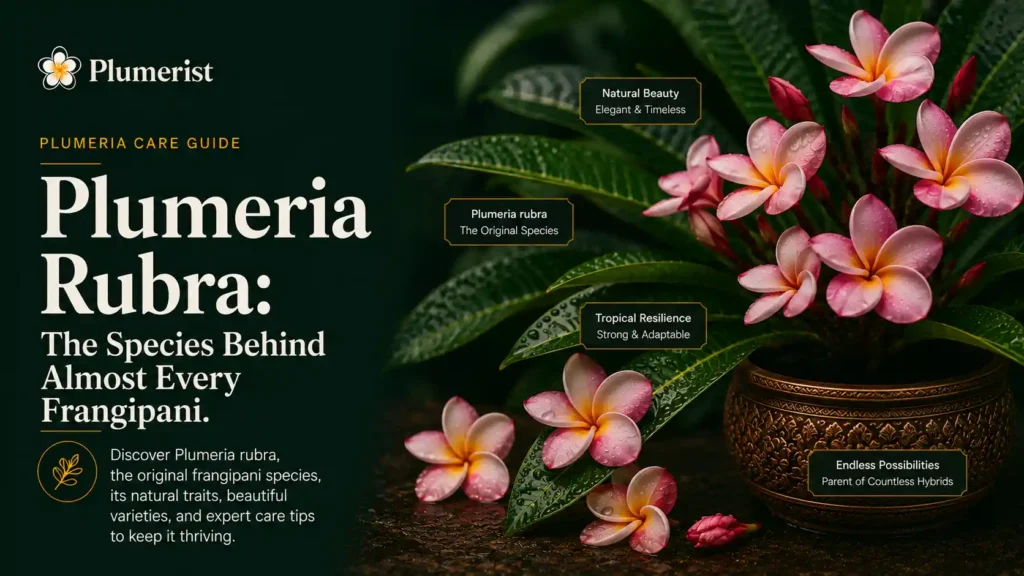
Here’s a fun little secret. If you own a plumeria that flowers in pink, red, yellow, orange, or some wild sunset blend of all three, you almost certainly own a Plumeria rubra. You just might not have realized it had a formal name.
Plumeria rubra is the workhorse of the whole genus. It’s the species behind nearly every colorful frangipani in gardens around the world, the parent of thousands of named cultivars, and the reason plumeria comes in such a ridiculous range of colors in the first place. So while the color guides on this site are all about the flowers, this one is about the plant those flowers actually grow on.
Let me walk you through what Plumeria rubra really is, how to tell you’ve got one, the colors it throws, how it stacks up against the other species, and how to keep one happy.
Plumeria Rubra at a Glance
| Thing | The short answer |
|---|---|
| Species | Plumeria rubra, family Apocynaceae (the dogbane family) |
| Native to | Mexico, Central America, and northern South America |
| Leaves | Large and pointed, and deciduous (drops them in winter) |
| Colors | The whole rainbow: white, yellow, pink, red, orange, and multicolor |
| Fragrance | Strong and sweet, with rose, citrus, and a hint of spice |
| Bloom season | Late spring through fall |
| Mature size | Small tree, roughly 15 to 25 ft in the ground, much smaller in a pot |
| Hardiness | Warm climates (USDA zones 10 to 11), or grown in pots elsewhere |
What Is Plumeria Rubra?
Plumeria rubra is one of around a dozen species in the genus Plumeria, and it’s far and away the most important one for us gardeners. It belongs to the dogbane family (Apocynaceae), and it’s native to a big chunk of the Americas, stretching from Mexico down through Central America and into Colombia and Venezuela.
Fun bit of trivia: the word rubra means red in Latin, which is honestly a bit of a mislabel, because the species comes in basically every color under the sun. Early botanists named it off a red flowered form they happened to see first, and the name just stuck, even though white and yellow rubras are every bit as common.
You’ll hear it called a pile of other names too. Frangipani is the big one. Across a lot of Asia it’s known as the temple tree, planted around temples and wrapped up in all sorts of spiritual meaning. In Mexico it’s cacaloxochitl. Same plant, a dozen names. If the whole plumeria versus frangipani thing has ever confused you, I untangled it over in plumeria vs frangipani.
Here’s why rubra matters so much. Almost every colorful plumeria you’ll ever buy, and pretty much every famous named cultivar out there, traces back to this one species. It’s the genetic base for the entire plumeria color rainbow. So when people talk about “plumeria,” nine times out of ten, this is the plant they mean.
How to Identify a Plumeria Rubra
Two dead giveaways, and the best part is you can spot both without knowing a single cultivar name.
First, the leaves are pointed. Rubra leaves are big, up to a foot and a half long, and they taper to a clear point at the tip. If you’re holding a leaf that ends in a sharp point, you’re almost certainly looking at a rubra. The main lookalike, obtusa, has rounded leaf tips instead, which I’ll get into below.
Second, it goes bare in winter. Plumeria rubra is deciduous, so it drops all its leaves and stands there as a cluster of bare, chunky stems through the cool months. New growers see this and quietly panic, convinced the plant has died. It hasn’t. It’s just napping. Come spring it leafs right back out and blooms like nothing happened. A plumeria that drops its leaves in winter is a rubra, or a rubra hybrid, full stop.
Put those two together, pointed leaves plus that annual winter striptease, and congrats, you’ve identified your species.
The Colors of Plumeria Rubra
This is the fun part, and honestly the whole reason rubra is such a big deal.
Because this single species carries the genes for the entire plumeria color range, one rubra can look completely different from the next. The classic look is that pinwheel bloom, white or yellow in the middle fading out to pink at the edges, but that’s just the jumping off point. Here’s the rundown, with a full guide for each color:
- White is the most common shade and often the most fragrant of the lot.
- Yellow is the classic sunny Hawaiian lei flower, and the easiest for beginners.
- Pink runs all the way from soft blush to loud, in your face hot pink.
- Red brings the deep, dramatic crimsons and the near black show stoppers.
- Purple (really a deep magenta, since true purple isn’t a real thing) covers the moody wine shades.
And then you’ve got the rainbow and multicolor rubras, the absolute show offs that blend pink, yellow, and orange into a single flower so no two blooms look quite the same. Those are all rubra as well. For the big picture on how every color and type fits together, start with the plumeria varieties guide.
Plumeria Rubra vs the Other Species
Rubra isn’t the only plumeria out there. Three other species show up in gardens fairly often, and knowing the difference will save you a lot of head scratching at the nursery. Quick comparison first, then I’ll break down each matchup.
| Species | Leaves | Evergreen? | Flowers |
|---|---|---|---|
| Plumeria rubra | Large, pointed | No, deciduous | Every color, most fragrant |
| Plumeria obtusa | Rounded, glossy tips | Yes, in warm climates | White and pink only |
| Plumeria alba | Long, narrow, lance shaped | Deciduous | White with a yellow center |
| Plumeria pudica | Spoon or fiddle shaped | Yes | White, blooms nearly year round |
Rubra vs Obtusa (Singapore White)
This is the mixup that trips people up the most, since obtusa is the other really common one. The tell is the leaves. Obtusa, the Singapore White frangipani, has rounded, blunt leaf tips and hangs onto its glossy leaves year round in warm spots, while rubra has pointed leaves and drops them in winter. Obtusa also only does white and pink, so if you’ve got a bright red or orange bloom in front of you, it’s a rubra, no question. Heads up though: a lot of nursery plants are actually rubra and obtusa hybrids, which is why you’ll sometimes see slightly rounded leaves on a plant that only half drops its foliage.
Rubra vs Alba
Plumeria alba is the true white frangipani of the Caribbean. Its calling card is the foliage, which is long, narrow, and lance shaped, really different from rubra’s broad pointed leaves. Alba only blooms white with a yellow eye, and it’s a touch more cold sensitive than rubra. So if your white plumeria has skinny, strappy leaves, you might have an alba on your hands rather than a white rubra.
Rubra vs Pudica
Plumeria pudica is the oddball of the bunch, and honestly kind of a fantastic beginner plant. It’s got these unmistakable spoon or fiddle shaped leaves, it stays evergreen in warm climates, and it blooms white almost nonstop, which is how it earned the nickname Bridal Bouquet. The one catch is that pudica has little to no fragrance, so if scent is a big deal for you, stick with rubra. But if you just want a mountain of white flowers and none of that winter bare stick phase, pudica is worth a look.
How to Care for Plumeria Rubra
Good news: rubra care is the standard plumeria playbook, and it’s really not fussy once you nail the basics.
Sun. Give it as much as you possibly can. Six hours minimum, and more is always better. Rubra is a full sun plant through and through, and it sulks and quits flowering if you park it in shade.
Soil. Fast draining is the entire game here. These plants hate wet feet, so skip the regular potting mix and go with a gritty, sharp draining blend instead. I break down my exact recipe in best soil for plumeria.
Water. Water deep, then let the top few inches dry out completely before the next round. I’ll say it louder for the folks in the back: overwatering kills way more plumeria than underwatering ever will. The full seasonal breakdown lives in plumeria water requirements.
Feeding. Through the growing season, feed with a fertilizer that’s high in phosphorus, the middle number on the bag, something like a bloom formula. That fuels flowers instead of just leafy green growth. My feeding plumeria notes have the schedule.
Winter. Since rubra is deciduous, it naturally goes dormant and drops its leaves once things cool off. If you get frost where you live, grow it in a pot so you can move it somewhere sheltered, and follow a simple winter care routine while it rests. Cut way back on water while it’s leafless, it barely needs any.
Growing Plumeria Rubra From Cuttings
Here’s the best thing about rubra: it clones ridiculously easily from cuttings, which is exactly how you get more of a color you’ve fallen for.
Take a cutting about a foot or two long, let the cut end dry out and callus over for a couple of weeks (do not skip this, a fresh wet cut will rot on you), then pot it up in that same fast draining mix. Rubra roots readily, and an established cutting will often bloom within its first year, which is kind of wild for a tree. My full walkthrough is in how to grow plumeria from cuttings.
And this part is important: rubra does not grow true from seed. Seeds are a total genetic scramble, so a seed pulled from a red flower could grow up absolutely any color. If you want a specific look, always go with a cutting, never seeds.
Common Plumeria Rubra Problems
A healthy rubra is a tough plant, but a few things trip people up.
Overwatering. The number one killer, every single time. Soft, squishy, or blackening stems almost always mean too much water and not enough drainage. When in doubt, water less.
Plumeria rust. Those little orange, powdery bumps on the undersides of the leaves are a fungus called plumeria rust, and rubra is especially prone to it in humid, wet weather. It looks gross but it’s rarely fatal. Rake up fallen leaves and give the plant decent airflow.
No flowers. Nearly always a sun problem. A rubra that won’t bloom is usually not getting enough light, or it’s being overfed with a high nitrogen fertilizer that pushes leaves at the expense of flowers. I put together a whole guide on fixing exactly this in how to get plumeria to bloom.
Stem borer and pests. Keep an eye out for scale, mealybugs, and the plumeria stem borer, a nasty little grub that tunnels right into the stems. If a branch is oozing and feels hollow, cut it out before it spreads.
Is Plumeria Rubra Toxic?
Worth a quick heads up. Like the rest of the genus, rubra has a milky white sap (latex) running through its stems and leaves. That sap can irritate your skin and eyes, and it’s mildly toxic if eaten, though not the dramatic horror story some seed listings make it out to be. Just wash your hands after pruning and keep curious pets and little kids from chewing on it. I go deeper on the pet side of things in whether plumeria is toxic to dogs.
What Does Plumeria Rubra Symbolize?
Given that temple tree nickname, it’s no surprise rubra carries a ton of meaning. Across Hawaii it’s the flower of the lei, a symbol of welcome and celebration. Across parts of Asia it’s planted around temples and tied to devotion, the afterlife, and the sacred. And because the flower shows up in so many colors, the meaning shifts with the shade, everything from love to friendship to remembrance. There’s a rich backstory here, and I dug into all of it in plumeria meaning and symbolism.
Frequently Asked Questions
Is Plumeria rubra the same as frangipani? Pretty much. Frangipani is just a common name for plumeria, and rubra is the species behind most colorful frangipani. More on the naming in plumeria vs frangipani.
Why is it called rubra if it isn’t always red? Rubra means red in Latin, and the species was named off an early red flowered form. The name stuck even though it blooms in every color.
Is Plumeria rubra evergreen or deciduous? Deciduous. It drops all its leaves and goes dormant in the cool season, then leafs back out in spring. Bare stems in winter are completely normal, not a death sentence.
How big does a Plumeria rubra get? In the ground it can reach 15 to 25 feet over many years. In a pot, or with regular pruning, it stays much smaller and easy to manage.
What’s the difference between Plumeria rubra and obtusa? Rubra has pointed leaves and is deciduous, with flowers in every color. Obtusa has rounded leaves, stays evergreen in warm climates, and only blooms white and pink.
Will Plumeria rubra seeds grow the same flower? No. Rubra doesn’t grow true from seed, so seedlings are a color gamble. For a specific flower, grow from a cutting.
Bottom line, Plumeria rubra is the plant doing most of the heavy lifting in the whole plumeria world. If you’ve fallen for those colorful, fragrant, pinwheel blooms, this is almost certainly the species you’re dealing with. Give it sun, sharp drainage, and a break on the watering, forgive it for going bare every winter, and it’ll pay you back with years of that unmistakable tropical color. Ready to pick your shade? Head back to the full plumeria varieties guide, or jump straight into white, pink, red, yellow, or purple plumeria.