

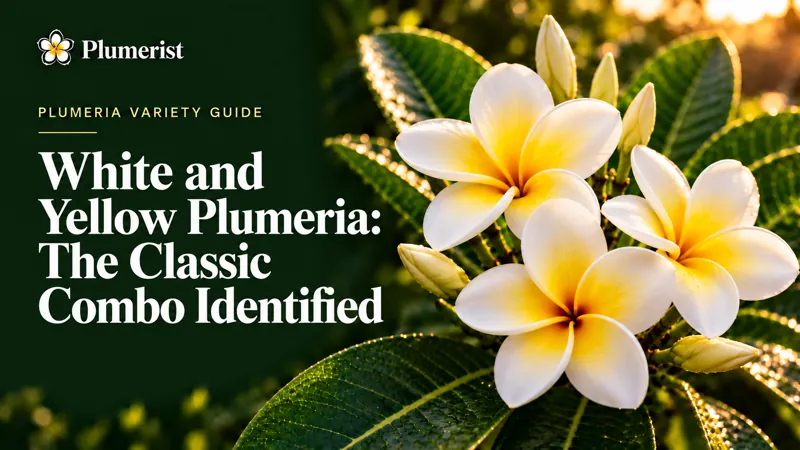
You are standing under a tree covered in flowers that are mostly white. A soft yellow blush sits right at the center of each one. The scent is heavy and sweet, and you want a name for it.
A plumeria white and yellow like this is almost certainly one of a small handful of well known varieties. The ratio of white to yellow on the petal narrows it down fast.
Why Plumeria White and Yellow Is the Classic Combo
This color pattern shows up more than any other in the genus. Early cultivated forms leaned white with a yellow throat. Breeding since then pushed hard toward pinks, reds, and oranges instead.
The white and yellow look never went out of fashion, though. It is also the pattern most associated with traditional Hawaiian leis, which keeps demand for it high everywhere plumeria is grown.
Botanists group plumeria into a handful of species, and the white and yellow look actually spans two of them. Plumeria obtusa and Plumeria alba both naturally produce this pattern, while most of the pink, red, and bicolor hybrids trace back to Plumeria rubra instead. That split explains why leaf shape ends up being such a reliable clue later on.
The Most Likely Candidate: Singapore Plumeria
Say the white dominates and the yellow is a soft, buttery patch at the throat. You are most likely looking at the Singapore type, sold as Singapore Plumeria or Singapore White. The petals are rounded and slightly overlapping, giving the bloom a full, waxy look.
Unlike most plumeria, obtusa often stays evergreen in warm climates. It can flower nearly year round instead of just spring through fall. Broad, glossy leaves with rounded tips are the quickest way to confirm this identification.
A Close Second: Plumeria Alba
Plumeria alba is the other strong candidate for a plumeria white and yellow bloom. Its flowers are smaller and narrower than obtusa’s. The scent leans lighter and more citrus forward too.
Leaf shape is the real giveaway here. Alba has long, narrow, lance shaped foliage instead of obtusa’s rounded leaves. Alba also drops its leaves in cooler weather, while obtusa often does not.
When Yellow Dominates Instead: Celadine and Common Yellow
Sometimes a plumeria white and yellow flower is actually the reverse ratio, mostly yellow with a white edge. That points to Celadine, the classic lei yellow, also sold as Common Yellow, Common Cream, or Hawaiian Yellow. Growers report these names cluster around very similar looking plants, and records on how distinct each one truly is stay inconsistent.
Celadine carries a strong lemon scent and elongated petals. That is a different look from the rounder, waxier obtusa bloom. If yellow clearly outweighs white on your flower, this cluster of names fits better.
Telling Them Apart at a Glance
| Trait | Plumeria obtusa | Plumeria alba | Celadine |
|---|---|---|---|
| Color ratio | Mostly white, yellow center | Mostly white, faint yellow | Mostly yellow, white edge |
| Leaf shape | Broad, rounded tip | Long, narrow, lance shaped | Elongated, typical rubra |
| Habit | Often evergreen | Deciduous | Deciduous |
| Scent | Sweet, full | Light, citrus leaning | Strong lemon |
Cultural Meaning of a White and Yellow Bloom
A plumeria white and yellow flower is the variety most closely tied to traditional lei making in Hawaii. Its long vase life and durability under stringing make it a practical choice, not just a pretty one. Petals stay intact for days after picking, which matters when a lei needs to survive an entire event.
The same white and yellow color pairing carries separate meaning in South and Southeast Asia, where plumeria is planted at temples and associated with devotion. Our guide to plumeria symbolism in Hinduism and Buddhism covers that side of the story in more detail.
How Heat and Sun Change the Look
The yellow patch on any of these varieties can shrink or spread depending on heat and light. Hot, sunny weather often deepens and expands the yellow zone. Cooler weather or shade can leave a flower looking almost pure white.
That means the same tree can look a little different from one bloom flush to the next. Judge a plumeria white and yellow identification on shape and leaf traits, not on a single photo taken in one season.
Flower age plays a role too. A bloom that just opened often shows a brighter, more concentrated yellow patch than the same flower a few days later, once it has been exposed to sun and starts to fade.
Growing Notes for Any of These Varieties
All three varieties described here share similar basic needs. They want full sun, fast draining soil, and a break from heavy watering once temperatures drop. Our complete care instructions cover the fundamentals that apply across nearly every cultivar.
None of these three is considered fussy or hard to grow. The identification question is almost always the harder part. Obtusa tends to branch a little more densely than alba, which can make it feel slower to gain height even though its overall growth rate is similar.
Scent strength can vary with humidity and time of day, so smell a flower in the evening for the truest read. Morning blooms sometimes seem fainter simply because the air has not warmed up yet.
Buying Tip: Verify Before You Buy
Nursery tags are not always reliable, especially for common varieties sold in bulk. A tag reading Singapore White does not guarantee true obtusa parentage, since sellers sometimes use the name loosely for any white flowered seedling. Ask about leaf shape and bloom habit before trusting a label alone.
If a specific named cultivar matters to you, buy from a specialist grower rather than a general garden center. Our full cultivar catalog is a good next stop for browsing beyond just white and yellow types.
Photos on a listing page can also mislead, since lighting and camera settings shift how yellow appears. Ask the seller directly about parentage or origin if the name matters more to you than the general look.
Why the Ratio Matters More Than the Name
Plumeria color shifts with heat, sun exposure, and flower age. A photo alone rarely settles the question for certain. Petal shape, leaf shape, and whether the plant drops its leaves in winter are more reliable clues than color proportion by itself.
For general background on each color family, see our guide to yellow plumeria and our guide to white plumeria. If your bloom sits between two of these descriptions, it may simply be an unnamed seedling. Plenty of plumeria in home gardens grew from seed and were never assigned a cultivar name at all.
The Plumerist toolkit
The gear we would buy if we were starting over.
As an Amazon Associate, Plumerist earns from qualifying purchases.
Frequently Asked Questions
What is the most common plumeria white and yellow variety?
Plumeria obtusa, sold as Singapore Plumeria, is the variety most people mean when they describe a mostly white flower with a soft yellow center.
How do I tell obtusa from alba?
Leaf shape is the fastest clue. Obtusa has broad, rounded leaves, while alba has long, narrow, lance shaped foliage.
Is Celadine the same as a plumeria white and yellow flower?
Not quite. Celadine usually shows more yellow than white, the reverse ratio of the classic white with a yellow center look.
Does a white and yellow plumeria smell different from other colors?
Often yes. These varieties tend to lean sweet or citrus in scent, though individual plants still vary a fair amount.
Can two different plumeria varieties look nearly identical?
Yes, especially between closely related cultivars sold under different trade names. Leaf shape and growth habit are more reliable than flower color alone.
Do white and yellow plumeria varieties need different care?
Not really. Obtusa, alba, and Celadine all want full sun and fast draining soil, with only small differences in leaf drop timing between them.