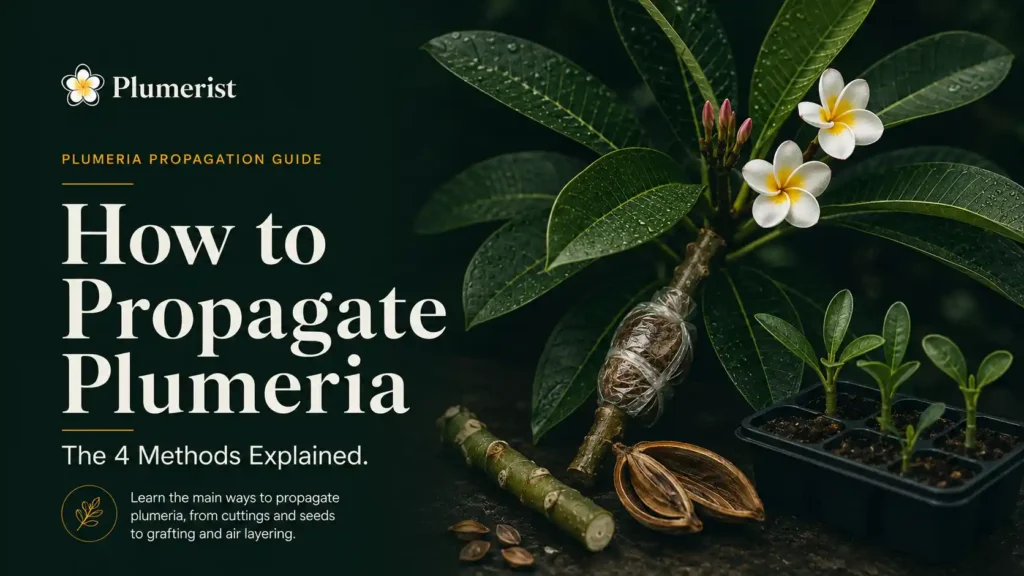
Plumeria propagation starts with one choice: do you want to preserve a particular plant or grow something genetically different? Use vegetative material for a named cultivar. Choose seed when variation is part of the goal.
A cutting must make roots, a seed must germinate, and a graft must form a working union. Those are different jobs. Giving all three the same watering routine creates avoidable problems.
Choose a plumeria propagation method by the result you want
| Your goal | Suitable starting point | What must happen next |
|---|---|---|
| Preserve a named cultivar on its own roots | Healthy stem cutting from a correctly identified plant | The cutting develops a functioning root system. |
| Grow seedlings or explore variation | Viable seed with an honest record of its source | Germination, seedling growth and eventual flowering reveal the result. |
| Keep a selected scion on another plant’s roots | Compatible healthy rootstock and scion | The joined tissues form a functioning graft union. |
| Have flowers sooner with fewer propagation steps | An established, correctly labeled plant | Allow it to settle; buying size does not guarantee a bloom date. |
Start with the goal rather than the cheapest listing. A packet labeled with a beautiful cultivar name does not provide clones of that cultivar. A rooted plant and an unrooted stick also represent very different amounts of work.
Cuttings preserve a selection, but rooting still comes first
A stem cutting carries the donor’s genetic identity. That makes it useful when the exact selection matters. However, growing conditions still affect how its flowers and overall plant develop.
Choose healthy material with a traceable name if you want a named cultivar. A cutting from an unidentified tree remains unidentified. Propagation cannot authenticate a seller’s label.
The broad sequence is to prepare suitable stem material, allow the cut base to dry, and provide a draining rooting medium. Warmth and stability matter. Constantly wet media are not a shortcut to roots.
The RHS propagation guidance describes dried bases on ripe, leafless stem tips. It does not make a fixed daily watering schedule part of the method. Cutting size and preparation belong to a complete rooting procedure, rather than a universal recipe for every piece of wood.
Support a tall cutting so movement does not repeatedly disturb its base. Use a container with drainage, and avoid an enormous volume of wet mix around a small rooting area. The potting medium guide explains why the whole mix and container matter.
Small leaves or a flower cluster can begin before a cutting has a useful root system. Treat them as growth observations, not permission to water like a mature tree. Look for roots without repeatedly lifting or tugging the cutting.
If the stem starts to shrink, use the wrinkled cutting checks before reaching for more water. Wrinkles, firmness and color need to be considered together. None gives a complete diagnosis alone.
Seed creates a new individual, not a guaranteed cultivar
Seedlings can differ from their parents in flower traits and growth. Some resemble a parent, but resemblance does not make them the same cultivar. Keep the seed source and sowing date rather than assigning a cultivar name prematurely.
Seed is useful when you enjoy observing variation or want to raise several plants. It requires space and patience beyond emergence. Keeping every seedling until flowering can become a bigger commitment than sowing the packet suggests.
The seed germination guide owns sowing through emergence. After that, the seed to flowering guide follows the longer journey. A seedling needs a routine suited to its small roots, rather than the prolonged dryness of a large resting tree.
Do not use floating alone to declare a seed alive or dead. Nor should a seller’s seed color photograph become a promised result. Judge success at each stage: emergence, healthy leaves, continued roots and later flowers.
Grafting joins two plants without blending their flowers
A scion is the selected shoot piece. The rootstock supplies the established lower plant and roots. Their tissues must connect before the scion can depend on that system.
Grafting can preserve a selected cultivar on suitable roots or put different selections on separate branches. It does not mix their genes into a new flower color. Each scion keeps its own identity.
This method adds a joining problem that an ordinary rooted cutting does not have. Choose it for a clear purpose. Practicing with replaceable material is sensible before cutting a valuable, irreplaceable tip.
Use the grafting preparation and alignment guide for the procedure and aftercare. A loose union, a dried scion or declining rootstock needs investigation. More bloom fertilizer cannot repair missing tissue contact.
Where air layering fits
Air layering aims to make roots on a branch while it remains attached to the donor. It is another vegetative approach, rather than seed propagation. It also wounds and ties up part of an existing plant.
It is not necessary to try every method before choosing one. For a straightforward first attempt, suitable stem material is usually easier to manage than an attached rooting package. A difficult cultivar or valuable specimen deserves advice specific to that plant and method.
Keep establishment separate from flowering
Rooting, graft union formation and flowering are separate milestones. A flower on a new cutting is not evidence of a strong root system. Equally, a healthy seedling can grow for years before its first flowers.
Published timelines differ. Wisconsin’s plumeria reference gives one to three years for cuttings to flower and three or more for seedlings. The first flowering timeline explains earlier possibilities and why neither range guarantees your plant’s date.
Do not try to force flowers by withholding necessary water, chilling a plant or stacking phosphorus products. First establish the plant. Then assess light, warmth, maturity and cultivar behavior.
Plumeria propagation checks before you start
- Record what you have: seed, an unrooted cutting, a rooted plant or a scion.
- Check identity, condition and where the material came from.
- Choose a warm, protected workspace and a stable container with drainage.
- Label the date and method so you can assess progress rather than guess.
- Keep suspect material apart, and clean tools between plants.
- Decide how you will confirm the relevant establishment milestone.
Wear gloves when cutting and keep sap away from skin and eyes. Work on a secure surface with a sharp tool directed away from your body. Discarding unsafe material can be better than repeatedly cutting an unsuitable piece.
After roots become established, adjust water to actual activity and drying. The growth stage watering guide covers that handoff. Keep feeding modest and appropriate to existing nutrients rather than adding a tonic to every new pot.
Questions about choosing a method
What is the easiest plumeria propagation method?
For many home growers with suitable healthy material, a stem cutting is the practical starting point. Seeds suit a different goal. Grafting adds alignment and union care, so it is not automatically the easier rescue.
Will every cutting of a named cultivar look identical?
It preserves the donor’s genetic selection, provided the donor was correctly identified. Environment and plant condition still influence appearance. A cutting cannot correct a mistaken label.
Should I feed an unrooted cutting to speed it up?
No fertilizer makes up for absent roots or a poor rooting environment. Check medium, stability and conditions first. Once established, move into the ongoing care routine without piling on extra products.
The Plumerist toolkit
The gear we would buy if we were starting over.
As an Amazon Associate, Plumerist earns from qualifying purchases.