

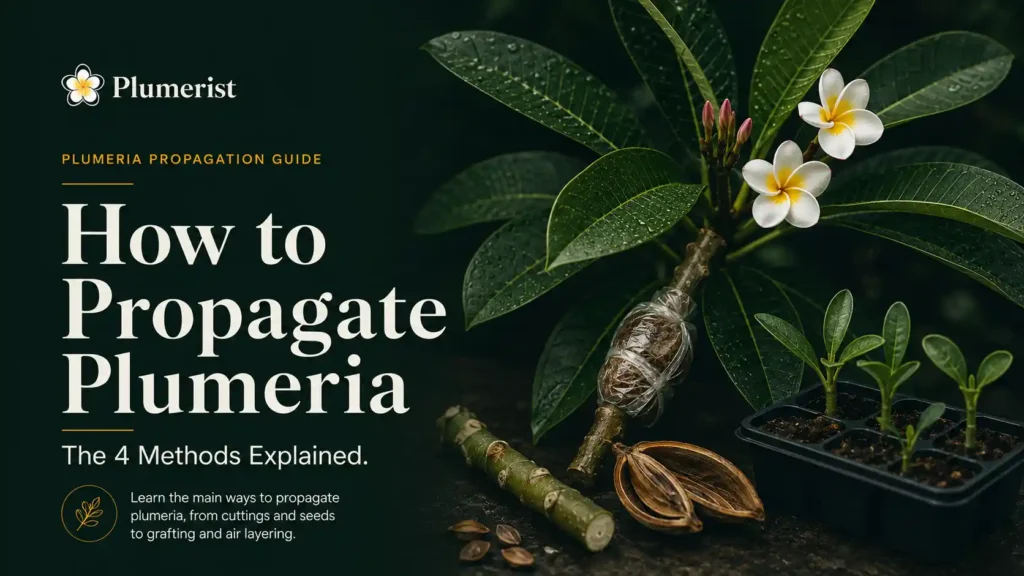
Here’s some good news to kick things off: plumeria are one of the easier plants to propagate. Once you know your options, making more of these tropical beauties is genuinely simple, and it’s a great way to fill your garden or share cuttings with friends without spending a dime.
There are a few different ways to do it though, and they’re not all created equal. So in this guide I’ll walk you through the four propagation methods, when to use each one, and which I’d reach for. Think of this as your map. For the deep how to steps on the main methods, I’ll point you to the full guides as we go.
Plumeria Propagation Methods at a Glance
| Method | Best for | Difficulty | Time to bloom |
|---|---|---|---|
| Cuttings | Getting an exact copy of a plant, fast and easy | Easy | Often within a year |
| Seeds | A fun surprise or breeding new colors | Easy but slow | 2 to 3 years |
| Grafting | Combining varieties or reviving a weak plant | Advanced | Varies |
| Air layering | Rarely needed with plumeria | Moderate | Varies |
The Four Ways to Propagate Plumeria
Almost everyone uses one of the first two methods, but it’s worth knowing all four so you can pick the right tool. Here’s the quick overview, then I’ll break each one down.
Cuttings are the go to, hands down. Seeds are the fun, slow gamble. Grafting is the advanced trick for combining varieties. And air layering is a method that technically works but you almost never need with plumeria. Let’s get into it.
Method 1: Cuttings (The Easy Winner)
If you only learn one method, make it this one. Propagating from cuttings is by far the most popular way to make more plumeria, and for good reason.
A cutting is just a piece of stem you cut off, let dry out, and pot up so it grows roots and becomes a whole new plant. The huge advantage is that a cutting is a clone of the parent, so you get the exact same flower, color, and scent. That’s why every named variety is sold as a cutting. Plumeria root readily this way, and a cutting will often bloom within its first year, which is remarkably fast.
The basic flow is simple: take a cutting about a foot or two long, let the cut end callus over for a couple of weeks so it doesn’t rot, then pot it in a fast draining mix and be patient with the watering. I walk through every step in detail in my full guide on how to grow plumeria from cuttings, so start there if this is your plan.
Method 2: Seeds (The Slow Surprise)
Growing plumeria from seed is a totally different experience, and it comes with one big catch you need to understand.
Plumeria seeds do not grow true to the parent. Because plumeria cross pollinate, a seed is a genetic mix, so the flower you eventually get is a surprise, and it almost never matches the plant the seed came from. That makes seeds useless if you want a specific variety, but exciting if you love a mystery or you’re trying to breed a brand new color.
The other catch is time. A seed grown plumeria usually takes about 2 to 3 years to flower, versus under a year for a cutting. Seeds come from the long pods the plant makes after a flower is pollinated, and there’s a whole process to collecting and using them, which I cover in my guide to plumeria seed pods. So go the seed route for the adventure, not for a specific flower.
Method 3: Grafting (The Advanced Trick)
Grafting is where things get fun for the plumeria nerds. It means joining a piece of one plumeria (the part you want to grow) onto the rootstock of another, so they fuse and grow as one.
Why bother? Two big reasons. First, grafting lets you grow several different varieties on a single tree, so you can have a plant that blooms in multiple colors at once, which is a genuinely cool party trick. Second, it can rescue a weak or slow variety by putting it onto strong, vigorous roots. The downside is that grafting takes more skill and patience than just poking a cutting in a pot, so it’s really a method for once you’ve caught the plumeria bug and want to level up.
Method 4: Air Layering (Usually Skip It)
Air layering is a technique where you get a branch to grow roots while it’s still attached to the parent plant, then cut it off once it’s rooted. It works on a lot of woody plants, and it technically works on plumeria too.
But here’s the honest truth: you rarely need it. The whole appeal of air layering is for plants that are hard to root from a normal cutting, and plumeria root from cuttings so easily that air layering is usually just extra effort for no real payoff. I’m mentioning it so you know it exists, but for almost everyone, a simple cutting is the smarter choice.
Which Method Should You Choose?
Let me make this easy with a quick decision guide.
Want an exact copy of a plant you love, fast? Take a cutting. This is the answer for 90 percent of people, full stop.
Love a surprise, or want to try breeding a new color? Grow from seed, and pack your patience for the 2 to 3 year wait.
Already hooked and want a multicolor tree or to save a struggling variety? Learn grafting.
Thinking about air layering? Probably don’t bother, just take a cutting instead.
For the vast majority of growers, cuttings are the right call, so if you’re not sure, start there. My plumeria cuttings guide has the full step by step.
Frequently Asked Questions
What is the easiest way to propagate plumeria? Cuttings, no contest. They’re simple, root readily, clone the parent exactly, and often bloom within the first year.
Can you propagate plumeria from a leaf? No. Unlike some succulents, plumeria won’t grow from a leaf. You need a stem cutting, seeds, or grafting.
Do plumeria grow true from seed? No. Seeds are a genetic gamble and rarely match the parent flower. For a specific variety, always use a cutting.
How long until a propagated plumeria blooms? A cutting often blooms within its first year, while a seed grown plant usually takes 2 to 3 years.
Can you propagate plumeria in water? People try it, but plumeria root best in a fast draining soil mix rather than water, since sitting in water invites rot. The method I trust is in my cuttings guide.
Bottom line, propagating plumeria is easier than you’d think, and for almost everyone the answer is a simple cutting: fast, reliable, and a perfect clone of the plant you love. Save seeds for the adventure, grafting for when you want to show off, and skip air layering entirely. Ready to actually do it? Head to my full guide to growing plumeria from cuttings, or browse the plumeria varieties guide to decide what to propagate next.