

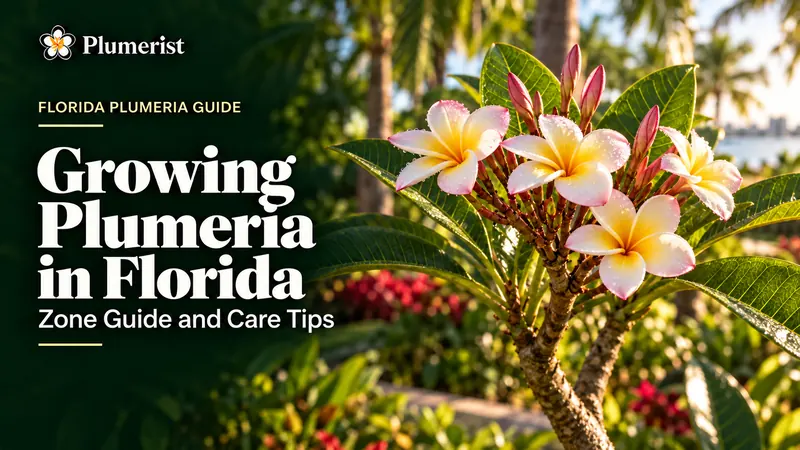
Can plumeria grow in Florida? Yes, especially in warm sites with suitable drainage, but the answer changes when you ask about leaving it in the ground. North Florida, a protected Central Florida garden and a South Florida coastal yard face different cold risks.
Rain is not automatically the enemy, and Florida is not automatically frost free. Check how water leaves the root zone and how you will respond to cold. Those choices matter more than declaring the state ideal or unsuitable.
Can plumeria grow in Florida in the ground?
| Location or site | Ground growing decision | Container advantage |
|---|---|---|
| Warm South Florida site | Often a practical landscape option if drainage, space and exposure suit the plant. | Retains flexibility for an unusually cold event or an unsuitable planting area. |
| Protected Central Florida site | Possible with explicit acceptance of cold damage risk. | Allows moving the plant instead of relying entirely on its microclimate. |
| North Florida and the Panhandle | Outdoor winter exposure is a major constraint. | Makes seasonal protection possible if the plant remains manageable. |
| Low, wet or stormwater collecting site anywhere | Solve drainage or choose another location before planting. | Provides a separate growing medium, but the pot still needs an outlet. |
These are broad planning distinctions, not exact frost boundaries. Look up your location and assess the actual yard. A warm city average does not describe a cold low spot at the edge of that city.
UF/IFAS’s Florida plumeria guide identifies warm tropical locations as the best landscape fit and discusses protected Central Florida sites with residual risk. It also recommends containers farther north. A favorable microclimate is an opportunity, not a survival guarantee.
Choose between roots in the ground and a movable pot
A young plant in a container gives you time to assess the site before making a permanent choice. Check drainage after substantial rain and observe cold exposure. Do not transplant simply because the tree reaches a particular height.
A ground grown tree needs space for its eventual canopy and roots. Its future size depends on the selection and conditions. A universal four foot clearance is not an adequate mature spacing rule.
For containers, plan weight, doorway clearance and a sheltered destination. A large immovable pot loses much of its protection advantage. The container setup guide covers the practical checks.
Can plumeria grow in Florida’s summer rain?
Yes, when the root environment drains and the plant’s needs are met. A rainstorm and persistent saturation are different conditions. Check the medium and drainage instead of moving every plant at the first shower.
Empty trapped runoff from saucers and decorative planters. Watch for irrigation running on top of rainfall. A pot standing in a puddle does not gain drainage merely because its base has holes.
In the ground, evaluate the wider site rather than filling one hole with a special mix. A fixed one foot mound or a handful of gravel does not establish where excess water will go. The soil and drainage reference separates media choices from site drainage.
There is also a difference between a summer leafy plant and a leafless resting one during cool rain. Match protection and watering to activity. The root zone watering guide explains how to assess that demand.
Keep useful sun without creating an exposure shock
Plumeria needs bright, useful light for healthy growth and flowering. Introduce stronger sun progressively after nursery shade or indoor storage. A hot wall does not improve every Florida site simply because it faces south or west.
Check heat around the pot and how well air moves through the planting. Leave room for inspection and safe access. Do not turn airflow advice into an assumption that it prevents every disease.
Warm weather alone does not guarantee a flower date or heavier bloom than another state. Cultivar, maturity, root health and light still matter. An established healthy plant has a different starting point from a newly rooted stick.
Florida rust needs identification and sanitation
Rust is a recognized plumeria problem in Florida. Look for the characteristic underside pustules rather than naming every yellow or spotted leaf rust. Other pests and injuries can produce overlapping symptoms.
Collect fallen affected leaves and keep the area reasonably clean. Avoid stripping a plant of all usable foliage simply because some leaves are marked. The rust identification and management guide owns the detailed response.
If considering a pesticide, use the exact product label for the plant, pest and site. No preventive homemade spray calendar is supplied here. Check new growth and actual pest activity rather than treating old scars repeatedly.
Cold protection still belongs in a Florida plan
Avoid relying on a county label or years without damage to rule out an exceptional cold event. The USDA hardiness map explanation distinguishes long term average minima from the coldest temperatures a location might experience. Check the forecast for the event in front of you.
Prepare a suitable protected location for movable plants. Measure its overnight temperature where the plants sit. A garage, patio or greenhouse is not automatically warm enough simply because it has walls or a roof.
Use the winter care guide for growth state distinctions and protection limits. Many plants rest and lose leaves, but not every warm protected plant becomes fully dormant. Avoid a blanket rule of no light and no water until spring.
If cold damage occurs, do not immediately assume that dark leaves mean a dead trunk. The freeze recovery decision guide distinguishes uncertain injury from active deterioration. No single firmness check guarantees survival.
Wind and coastal exposure are separate checks
Plumeria branches can break, so do not describe the tree as storm proof. Move or secure manageable containers before conditions become unsafe. Plan access around the canopy and avoid tying it where the support itself becomes hazardous.
Established plants can tolerate some coastal exposure, but salt tolerance is not permission to leave roots in seawater or standing floodwater. Consider drainage and contamination after a flood separately from routine rain. Seek local advice when a plant has been submerged or badly damaged.
A new transplant still needs careful establishment. Coastal rainfall does not automatically meet its root zone needs, and extra freshwater does not justify keeping roots saturated. Inspect the actual site and plant.
Feeding follows growth, not a statewide end date
Check active growth and nutrients already in the medium before feeding. Florida’s climate can support a long growing period, but every plant does not need identical applications through those months. Follow the exact fertilizer label and your setup.
The feeding guide accounts for those inputs. Heavy rain is not a reason to replace nutrients blindly with a stronger dose. Review the medium, root function and product history first.
Keep a record of winter exposure, rain related wetness and actual growth. That makes your Florida location more useful to understand than a borrowed calendar. The ongoing care guide ties these observations together.
Florida growing questions
Can plumeria grow in Florida without winter protection?
Some warm sites support it outdoors for years, but universal protection free survival cannot be promised. Plan for an unusual event as well as an average winter. Farther north, a manageable container is a useful option.
Does humid weather guarantee more flowers?
No. Humidity is not a flowering treatment. Evaluate the plant’s light, maturity, root health and cultivar rather than expecting Florida weather to settle everything.
Should I add sand to every planting hole?
No. Evaluate the soil and whole site first. An amended pocket does not automatically fix drainage beyond the hole.
The Plumerist toolkit
The gear we would buy if we were starting over.
As an Amazon Associate, Plumerist earns from qualifying purchases.