

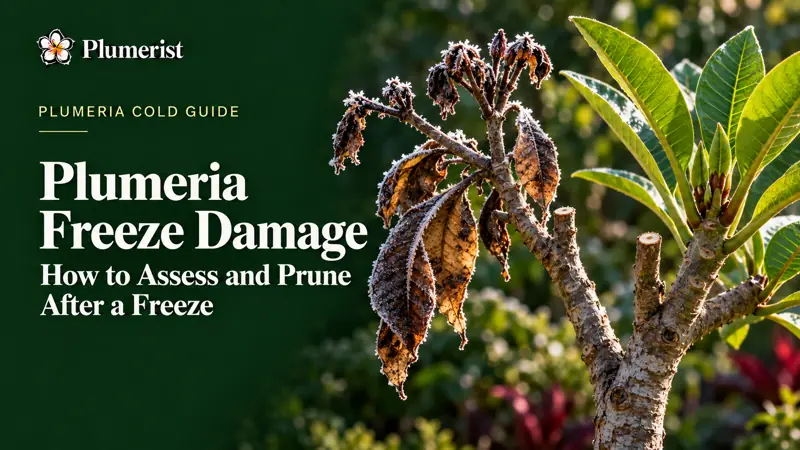
Deciding how to prune plumeria after freeze damage starts with separating uncertain injury from tissue that is collapsing or unsafe. Dark leaves do not prove that every branch is dead. Protect the plant, inspect it and avoid cutting its whole structure on the first morning.
Waiting is useful when the survival boundary is unclear. It is not a reason to ignore a hazardous branch or spreading wet deterioration. Those situations need a different response.
Sort the damage before picking up pruners
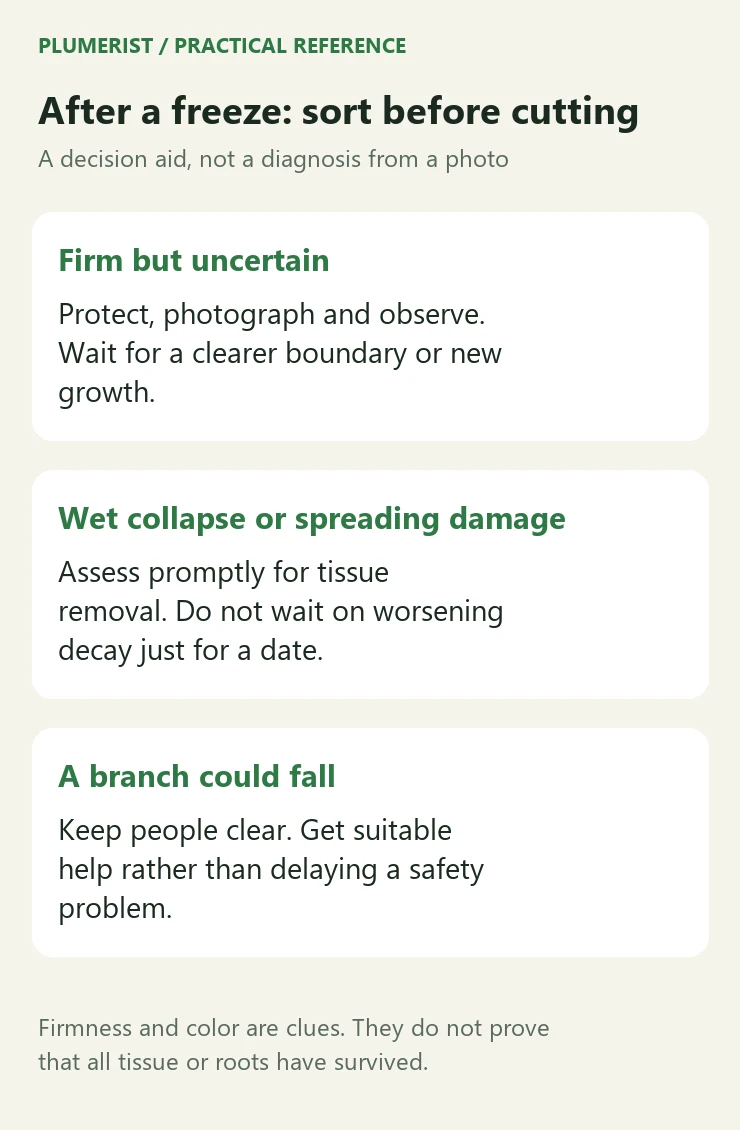
| Situation | Initial response | Reason |
|---|---|---|
| Dark leaves but firm, stable stems | Protect and observe before structural pruning. | Leaves can be lost while some stems remain viable. |
| Uncertain tip or stem injury | Photograph and watch for a clearer boundary or new growth. | Cold injury can become apparent later. |
| Wet collapse or damage spreading along tissue | Assess promptly for removal and possible decay. | Waiting for a calendar date may allow deterioration to continue. |
| Cracked, hanging or unstable limb | Keep people clear and get suitable help. | Safety takes priority over routine pruning timing. |
UC IPM’s cold injury guidance recommends delaying routine pruning until dead tissue is identifiable, preferably after new growth begins. It also recognizes hazardous limbs as an exception. This is more useful than assuming every plant needs the same number of waiting days.
Protect what remains before the next cold night
Move a manageable container into suitable protection before another event. Check the actual temperature of the shelter. A roof keeps some weather off but does not guarantee that a garage or patio stays warm.
Use the winter protection guide to match the arrangement to the plant. Frost cloth has limits during prolonged or severe cold. Do not improvise with fuel burning heaters or unsafe lights beneath a cover.
Let frozen material thaw without bending or squeezing it repeatedly. Photograph affected areas from the same angle over time. The date, weather exposure and previous condition help explain what you are seeing.
Use firmness, color and sap as clues
Gently compare the affected area with nearby tissue. Increasing mushiness, wet collapse, a widening lesion or an unpleasant odor is concerning. A dry dark tip and a spreading wet lesion should not automatically receive the same response.
Firmness alone cannot prove that all inner tissue or roots survived. Likewise, softness can have more than one cause. The soft stem assessment covers that wider question.
Do not puncture the plant to look for white sap or bend branches to test them. Those checks cause new wounds and do not establish a complete diagnosis. White tissue at one cut is also not a guarantee about the rest of the plant.
When deteriorating tissue should not wait until spring
If a damaged section is becoming wet, soft and progressively worse, assess it promptly. Small accessible sections may require removal before the usual shaping season. If the boundary is unclear or the trunk is involved, seek experienced local help.
UF/IFAS’s tropical plant cold guidance separates waiting for spring growth from the need to address discolored, soft tissue. That exception does not turn every slightly yielding branch into proven rot. Check the whole pattern and its progression.
Cold injury and subsequent decay can overlap. Do not name a particular fungus from a dark patch. The root, collar and stem guide explains why damage location and root inspection may matter.
How to prune plumeria after freeze damage is confirmed
Use a sharp tool suited to the branch and clean it between suspect cuts or plants. Protect skin and eyes from the milky sap. Support the piece being removed so its weight does not tear the remaining stem.
- Identify the affected section and a realistic boundary before cutting.
- For a small accessible tip, remove damaged material carefully without repeatedly shortening healthy branches.
- Inspect the exposed section for remaining damaged or deteriorating tissue.
- If more removal is necessary, use controlled cuts rather than a fixed extra inch or two.
- Keep the remaining plant stable and protect the wound from unnecessary wetting.
- Record what was removed and monitor the remaining tissue.
The aim is to retain sound material while removing confirmed damage. There is no universal cutting depth. If the remaining stem is extensively affected, there may be little suitable tissue left to save.
Large branches and trunk damage are not simply bigger versions of a small tip job. Their weight and position can make removal dangerous. Use appropriate professional help rather than cutting overhead from an unstable ladder.
Confirmed freeze damage
Separate uncertain injury from deteriorating tissue before pruning.
Fiskars bypass pruner
Use a clean, sharp tool for confirmed damage. Do not cut every dark branch immediately; assess its condition and safety first.
Check price on AmazonAs an Amazon Associate, Plumerist earns from qualifying purchases.
Do not make caulk or paint the default treatment
Ordinary pruning cuts generally do not need a wound dressing. Minnesota’s pruning reference explains the general principle and specific exceptions for other tree diseases. Those exceptions are not a reason to coat plumeria cuts automatically.
A household sealant, lime paste or kitchen powder is not a verified universal rescue. No fixed rule that every wound over an inch must be sealed is supported here. Keep the cut clean and inspect how the remaining tissue develops.
Care for the surviving roots and foliage
Check moisture once the root zone has thawed and conditions allow assessment. A plant that lost most of its leaves may use much less water. Do not continue its previous leafy summer schedule without checking.
Equally, freeze injury does not mean every plant must stay completely dry for months. Consider remaining roots, actual activity and drying. The growth stage watering guidance applies after damage too.
Do not fertilize a cold, declining plant to force a quick comeback. Resume an appropriate feeding routine when conditions and active growth justify it. Existing nutrients still count.
Protect newly exposed tissue from a sudden change to harsh sun. Avoid additional shaping cuts while assessing recovery. Unnecessary pruning removes more stored material and potential flowering tips.
Watch for recovery without promising a deadline
Continued healthy growth is encouraging. A firm base alone is not a guarantee that the plant will reshoot, and one failed tip does not prove every branch is lost. Monitor the root zone and remaining stems over time.
If a grafted plant shoots below its union, that growth belongs to the rootstock. It may not reproduce the flowers of the lost scion. Keep labels and branch identity in mind before declaring the cultivar saved.
A completely collapsing base or extensive damaged roots makes recovery less likely. A genuinely healthy separate section may be a propagation option, but suspect tissue can carry problems into another attempt. Review the propagation choices before treating every pruned piece as a usable cutting.
There is no reliable three week damage deadline or guaranteed single season rebuild. Keep observing rather than repeatedly recutting from impatience. For repeat events, the Texas protection plan shows why the next season’s logistics matter.
Questions about pruning after cold damage
Can I learn how to prune plumeria after freeze damage from a photo?
A clear photo can help document the pattern, but it cannot confirm internal condition or functioning roots. Include the exposure history and changes over time. Get local diagnostic help when the decision is unclear.
How do I decide how to prune plumeria after freeze damage on a large limb?
Assess safety before choosing a cut. An unsupported limb can tear or fall, and trunk damage may change stability. Use qualified help where size, height or uncertainty makes the job unsafe.
Can I prevent every future freeze loss with a cover?
No. Match protection to the event and the site, and choose a movable setup if necessary. The care reference keeps routine maintenance separate from emergency recovery.
The Plumerist toolkit
The gear we would buy if we were starting over.
As an Amazon Associate, Plumerist earns from qualifying purchases.