

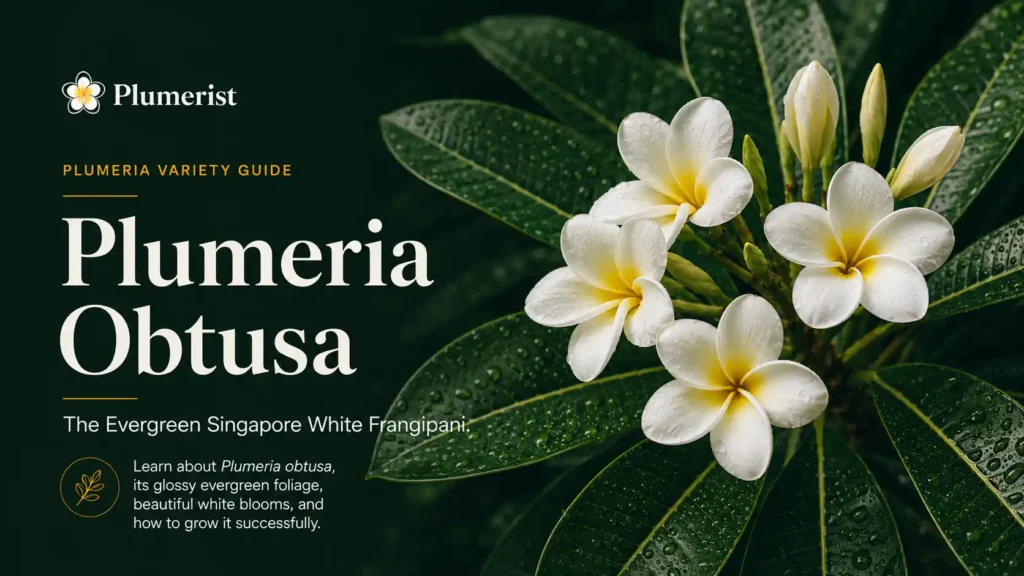
Every plumeria guide eventually has to talk about the one that breaks the rules, and this is it. Plumeria obtusa, better known as the Singapore White, is the frangipani that doesn’t drop its leaves and doesn’t take the winter off.
While almost every other plumeria stands around as a cluster of bare sticks through the cool months, obtusa hangs onto its glossy green leaves and, in a warm enough spot, just keeps on flowering. That right there is the whole appeal. If you want a plumeria that stays lush and blooms for most of the year, the Singapore White is the one to know.
Let me walk you through what obtusa actually is, how to spot one, how it stacks up against the usual deciduous plumeria, and how to keep one thriving.
Plumeria Obtusa at a Glance
| Thing | The short answer |
|---|---|
| Species | Plumeria obtusa, family Apocynaceae (the dogbane family) |
| Also called | Singapore White, Singapore frangipani, blunt leaf frangipani |
| Native to | The West Indies (Bahamas, Greater Antilles) and parts of Central America |
| Leaves | Dark green, glossy, rounded at the tip, and evergreen |
| Flowers | Creamy white with a yellow center, softly fragrant |
| Bloom season | Nearly year round in warm, frost free climates |
| Mature size | Roughly 8 to 15 ft, often kept much smaller |
| Hardiness | Tender: USDA zones 10 to 11, protect below about 40F |
What Is Plumeria Obtusa?
Plumeria obtusa is one of the handful of true plumeria species, and it’s the most important evergreen one by a mile. It belongs to the same dogbane family (Apocynaceae) as the rest, and it’s native to the West Indies, think the Bahamas and the Greater Antilles, plus a stretch of southern Mexico, Belize, and Guatemala.
The name is actually a handy little clue. Obtusa means blunt in Latin, a nod to the rounded, blunt tips on its leaves. Once you know that, identifying one gets a whole lot easier.
You’ll almost always see it sold as Singapore White, or just Singapore, since it’s wildly popular across Southeast Asia and got strongly tied to the region. Same plant. If the whole plumeria versus frangipani naming thing ever trips you up, I sorted it out in plumeria vs frangipani.
How to Identify Plumeria Obtusa
Two things give obtusa away, and neither one requires you to be a plant nerd.
The leaves are rounded and glossy. Where most plumeria have long leaves that taper to a sharp point, obtusa leaves are dark green, thick, shiny, and blunt at the tip, almost like the end got rounded off. That leathery, polished look is very obtusa.
It stays green. This is the big one. Obtusa is evergreen in any climate that stays warm, so while the deciduous plumeria around it go bare and dormant for winter, obtusa keeps its leaves and carries right on. A plumeria that flat out refuses to drop its leaves in the cool season is almost certainly an obtusa.
Put those together, rounded glossy leaves that stick around all year, and you’ve found your Singapore White.
Plumeria Obtusa vs Rubra: The Big Difference
Most plumeria you’ll ever meet are Plumeria rubra, the deciduous species behind the entire color rainbow. Obtusa is the other one you really need to know, and the two are easy to tell apart once you see them side by side.
| Trait | Plumeria obtusa | Plumeria rubra |
|---|---|---|
| Leaves | Rounded, glossy tips | Long and pointed |
| Winter | Evergreen, keeps its leaves | Deciduous, drops its leaves |
| Colors | White, and some pink | The whole rainbow |
| Bloom length | Nearly year round in the tropics | Late spring through fall |
| Cold tolerance | More tender | Tougher, rides out cold by going dormant |
The short version: if it’s got rounded leaves and stays green, it’s obtusa. If it’s got pointed leaves and goes bare in winter, it’s a rubra. And if you’re looking at a bright red or orange bloom, it’s definitely a rubra, because obtusa only does white and soft pink.
Popular Plumeria Obtusa Varieties
A few obtusa types show up again and again:
- Singapore White. The classic. Snow white pinwheel flowers with a small yellow eye, glossy evergreen leaves, and that famous long bloom season. This is the one most people mean when they say Singapore.
- Dwarf Singapore White. A compact version that stays small and tidy, usually just a few feet tall. Perfect if you want the same clean white blooms on a plant that fits a patio or a pot.
- Dwarf Singapore Pink. Same compact, evergreen habit, but the white flowers pick up a soft pink blush around the edges. Really pretty, and just as easy to grow.
If you’re tight on space or planning to grow in a container, honestly one of the dwarfs is where I’d point you. They hand you all the obtusa perks in a plant that won’t try to take over the yard.
Why People Love the Singapore White
So why go obtusa over a colorful rubra? A few real reasons.
The blooms basically never quit. In a warm, frost free spot, a happy Singapore White flowers for most of the year instead of the few months you get out of a deciduous type. For nonstop flowers, nothing else in the genus really competes.
The foliage looks good the whole year. There’s no bare stick phase and no explaining to visitors why your “dead” plant is actually fine. Those glossy leaves stay handsome even between flushes of bloom.
And the dwarfs are genuinely easy to grow in a pot. Compact, evergreen, and neat, they’re one of the simplest plumeria to keep on a patio or by a doorway. If you’re going the container route, my guide to the best pots for plumeria covers what to plant them in.
How to Care for Plumeria Obtusa
Here’s some relief: obtusa care is the same core plumeria playbook as everything else, with a couple of tweaks because it never goes dormant.
Sun. Full sun, six hours minimum and more is better. It’ll take a bit of light shade, but you get the best blooms out in the open.
Soil. Fast draining, always. A gritty, sharp draining mix keeps the roots from ever sitting wet. My best soil for plumeria guide has the exact blend I use.
Water. Water deep, then let the top few inches dry out before the next round. Here’s the obtusa tweak though: because it stays awake and leafy all year, it wants steadier moisture than a deciduous plumeria that fully shuts down in winter. Don’t leave it bone dry for long stretches. The full seasonal breakdown is in plumeria water requirements.
Feeding. Through the growing season, feed with a high phosphorus bloom fertilizer to keep the flowers coming. Since obtusa can bloom nearly year round in warm climates, it really appreciates regular feeding. My feeding plumeria notes have the schedule.
Warmth. This is the one to really burn into your memory. Obtusa likes it warm and does not have the deciduous plants’ winter survival trick, which I’ll get into right now.
The One Big Warning: Cold
Time for the honest catch with obtusa: it’s more cold sensitive than the deciduous plumeria, and you need to plan around that.
A deciduous rubra survives a cool winter by dropping its leaves and going fully dormant, basically hibernating as a bare stick until spring. Obtusa doesn’t do that. It stays awake and leafy, which means it has no dormancy to fall back on when the temperature crashes. It really does not want to see frost, and it starts sulking once things drop toward 40F.
So if you live anywhere that gets cold, grow your obtusa in a pot and move it somewhere warm and bright before the first cold snap. Keep it above 40F, ease off the water while growth slows, and treat it more like a tender houseplant for the winter than a plant you can leave outside to sleep it off. My winter care routine walks through the details. Just remember obtusa needs a gentler, warmer version of it than a rubra does.
Growing Plumeria Obtusa From Cuttings
Like the rest of the genus, obtusa clones easily from cuttings, so you can turn one Singapore White into several. Take a cutting about a foot or two long, let the cut end dry and callus over for a couple of weeks so it doesn’t rot, then pot it up in that same fast draining mix. It roots readily and you’ll usually get flowers before too long. Full walkthrough in how to grow plumeria from cuttings. And as always, skip seeds if you want a specific look, because plumeria don’t grow true from seed.
Is Plumeria Obtusa Toxic?
Quick heads up, same as every plumeria. Obtusa has a milky white sap that can irritate skin and eyes and is mildly toxic if eaten. Nothing to lose sleep over, just wash your hands after pruning and keep pets and little kids from chewing on it. More on the pet angle in whether plumeria is toxic to dogs.
What Does Plumeria Obtusa Symbolize?
One of obtusa’s common names is the Singapore graveyard flower, which sounds grim but points to something rather lovely. Across parts of Asia the tree gets planted at temples and cemeteries as a symbol of immortality and the afterlife, precisely because it’s evergreen and blooms almost endlessly. Life that just keeps going, basically. There’s a rich story behind plumeria symbolism across Hawaii and Asia, and I dug into all of it in plumeria meaning and symbolism.
Frequently Asked Questions
Is Plumeria obtusa evergreen? Yes, and that’s its whole claim to fame. In warm, frost free climates it keeps its glossy leaves all year instead of going bare like the deciduous plumeria.
Is Singapore White the same as Plumeria obtusa? Basically, yes. Singapore White is the most popular obtusa, so the two names get used interchangeably. Every Singapore White is an obtusa.
What’s the difference between Plumeria obtusa and rubra? Obtusa has rounded glossy leaves, stays evergreen, and blooms white nearly year round. Rubra has pointed leaves, drops them in winter, and comes in every color.
Does Plumeria obtusa bloom all year? In a warm, frost free spot, pretty much. It flowers for most of the year, far longer than a deciduous plumeria’s few months.
Is Plumeria obtusa hard to grow? Not really, the care is standard plumeria stuff. The main catch is that it’s more cold sensitive, so it needs protection from frost and cool weather. If yours won’t flower, my guide to getting plumeria to bloom helps.
Why won’t my obtusa drop its leaves in winter? It’s not supposed to. Obtusa is evergreen, so hanging onto its leaves through winter is completely normal, not a problem.
Bottom line, if the bare stick winter look isn’t for you and you want a plumeria that stays green and flowers for most of the year, Plumeria obtusa is your answer. Just respect its one real weakness, the cold, and keep it warm through winter. Give it sun, sharp drainage, and a little frost protection, and the Singapore White will pay you back with glossy leaves and fragrant white blooms almost nonstop. Want to see how it fits with the rest of the family? Head back to the full plumeria varieties guide, or explore the classic white plumeria and soft pink shades it’s related to.