

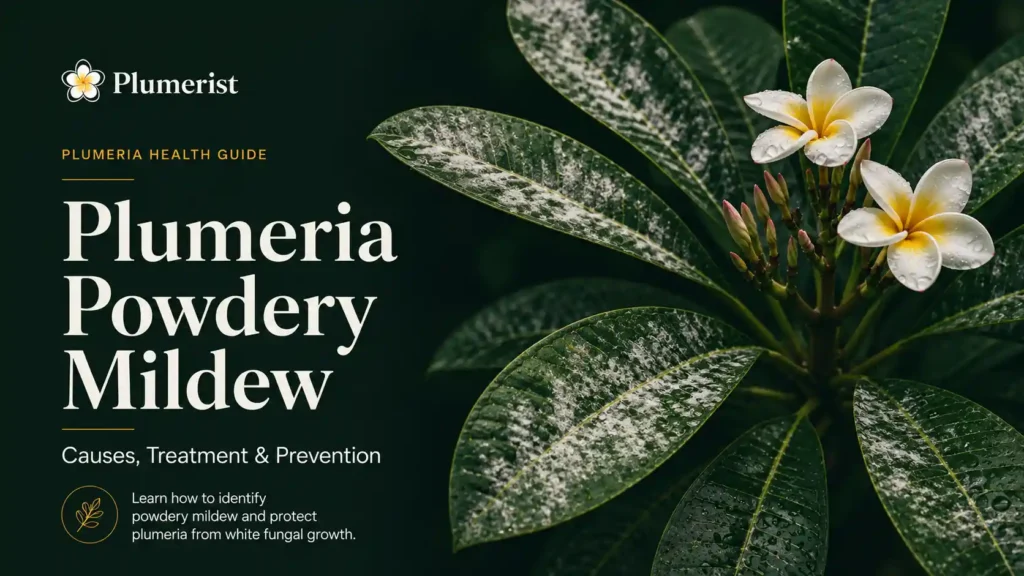
Powdery mildew on plumeria is a possible cause of a spreading white coating, but a white leaf is not enough to confirm it. Check for residue and insects first. Treatment makes sense only when it matches the problem.
Once mildew is likely, the decision is about severity and fresh growth. A few stable patches need a different response from distortion spreading across a vulnerable plant. Neither situation calls for mixing every available remedy together.
Confirm the pattern before treating powdery mildew on plumeria
Look for powdery or feltlike growth on leaves and tender shoots. Compare both surfaces and check whether patches expand. Distorted young tissue can accompany an infection, but it is not unique to mildew.
A 2017 disease report on Plumeria pudica confirmed a mildew infection using laboratory examination and inoculation. That is evidence that this host can be affected. It does not establish that every white patch on every plumeria is the same fungus.
Mineral deposits, spray films and waxy pests remain alternatives. The white spot comparison guide is the starting point when the cause is uncertain. A wipe test alone cannot distinguish all of them.
Humid air and wet leaves are different
Powdery mildew does not need a film of water on foliage to infect. A plant can therefore develop it without repeated overhead watering. Describing the disease simply as leaves staying wet gives the wrong explanation.
UC IPM’s ornamental mildew guidance explains this moisture distinction and the influence of shade and moderate temperatures. Free water can inhibit many mildew spores. That does not make keeping a plumeria continuously wet a sensible cure.
Roots still need suitable moisture and air. A leafy active plant and a resting leafless one use water differently. Keep following the growth stage watering reference while addressing the foliage.
Likewise, forcing a plant into extreme heat is not a disease treatment. Strong sun can injure unacclimated leaves and exposed stems. Improve placement gradually, using the sunlight and acclimation guide.
Decide whether intervention is warranted
| Current condition | Reasonable next step | Evidence to track |
|---|---|---|
| A few stable patches; plant otherwise growing | Verify the diagnosis, improve spacing and monitor. | Whether patches expand or new leaves become affected. |
| Fresh growth repeatedly coated or distorted | Review diagnosis and growing conditions; consider a labeled treatment. | New growth quality and disease spread. |
| Severe decline, wet collapse or a failing base | Investigate other or additional problems promptly. | Roots, stem condition and the wider pattern. |
| White marks appeared just after a spray | Consider deposits or chemical injury before another application. | Timing, product history and the exact affected surfaces. |
There is no universal percentage of white leaf area that decides treatment for every plumeria. Consider plant size, vigor, damage and progression. A photograph taken before intervention helps make the next comparison meaningful.
Do not assume that mildew explains a mushy trunk or every lost bud. Multiple issues can coexist. Keep substantial stem decline separate from a surface disease decision.
Improve the growing setup first
Space containers so leaves are not packed tightly together. Remove nearby obstructions to useful light where that is practical. Avoid drastic pruning simply to create airflow through a small plant.
Collect fallen affected foliage and keep the area clean. Remove badly affected material selectively rather than stripping all leaves. A growing plumeria still needs usable foliage.
Review feeding rather than adding a bloom booster to compensate for disease. Excess inputs do not replace sound roots or suitable light. The feeding decision guide accounts for fertilizer already present in the medium.
Check plants near the affected specimen, especially newly purchased material. Keep inspection tools clean. Monitoring neighboring plants is useful, but spraying every unrelated species automatically is not justified.
Preventive and existing infection treatments are not interchangeable
Some fungicides mainly protect uninfected tissue. Others can suppress an early existing infection. Buying a product described as a fungicide does not establish that it will remove the coating already present.
For powdery mildew on plumeria, check the exact label for ornamental use, the growing site and mildew control. Product concentration and application interval matter. A commercial nursery recommendation is not automatically a home garden instruction.
Horticultural oils can be options for some early infections when the label permits their use. Sulfur products are generally preventive rather than a cleanup treatment for established patches. Plant sensitivity and previous sprays can make either unsuitable.
Never combine or closely alternate oil and sulfur by guesswork. The interval and temperature restrictions on the actual labels govern use. A general reference to two weeks or 90 F is not permission to ignore a stricter label.
Avoid spraying a heat stressed or water stressed plant with an oil merely because mildew is visible. Protect people and nearby plants according to the product instructions. Keep a record of the product, date and conditions.
Why a kitchen recipe is not the default
Baking soda and potassium bicarbonate are different materials. Neither becomes a suitable plant treatment just because it appears in a household recipe. Concentration, formulation and the condition of the leaf affect injury risk.
Dish detergent is not a substitute for a formulated insecticidal soap. Kitchen oils are not interchangeable with labeled horticultural products. Do not add detergent to improve coverage unless the product instructions specifically support that addition.
Wisconsin’s mildew management reference recommends considering plant injury and testing a product on limited foliage before broader use. That general precaution does not override a label restriction. A small test cannot make an unsuitable use appropriate.
Judge results by what happens next
Old damaged areas may remain visible even after the disease is controlled. Check fresh leaves and whether new patches develop. Repeated treatments aimed only at making an old leaf spotless can do more harm than good.
If the pattern worsens despite an appropriate response, revisit the diagnosis. Deposits and pest wax can persist through a mildew treatment. The mealybug reference helps when distinct cottony colonies remain.
For wider decline, use the stem symptom assessment and examine the root environment. Continue suitable routine care rather than treating every setback as a need for stronger fungicide. The care reference keeps those decisions connected.
Mildew treatment timing
Confirm mildew and assess progression before choosing a treatment.
Bonide sulfur plant fungicide
Sulfur is preventive, not a cleanup for an existing coating. Use only when the exact label permits it; observe oil, heat and plant sensitivity restrictions.
Check price on AmazonAs an Amazon Associate, Plumerist earns from qualifying purchases.
Common questions
Does powdery mildew on plumeria spread to every nearby plant?
No. Powdery mildew fungi have different host ranges, so proximity does not mean all plant species are equally susceptible. Inspect nearby plants and identify their symptoms before deciding on treatment.
Will powdery mildew on plumeria always stop flowering?
No such guarantee is justified. Severe injury may affect plant performance, but bloom loss has several possible causes. Record the actual damage rather than assuming one patch explains the entire season.
The Plumerist toolkit
The gear we would buy if we were starting over.
As an Amazon Associate, Plumerist earns from qualifying purchases.