

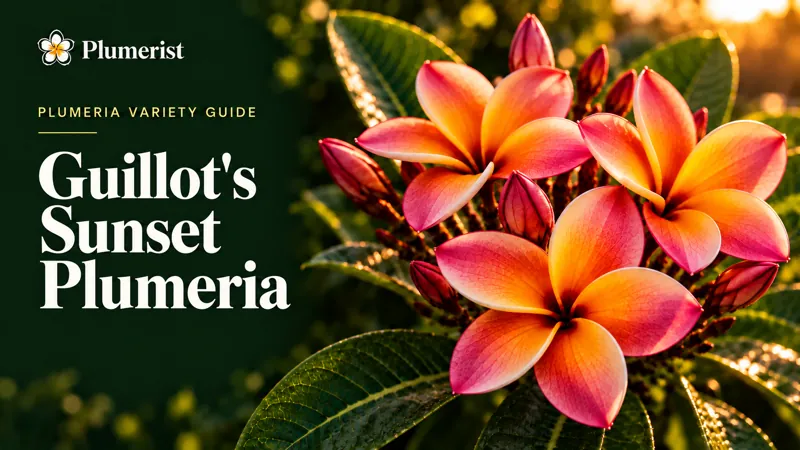
Guillot sunset plumeria is a Plumeria rubra cultivar discovered by the hybridizer Bud Guillot. It is also sold under the alternate name Angelica. Its flowers blend dark pink and orange in a warm gradient, which is exactly why the sunset name stuck.
Bud Guillot found many well known plumeria varieties over decades of hands on selection. This cultivar was reportedly his first discovery. Growers today generally trust that story, though a precise discovery year is not consistently documented across sources.
That kind of gap is common with older cultivars from before formal registration became standard practice. The plant itself is well documented even where the exact history is not.
Bud Guillot’s name shows up across a number of long standing California plumeria collections. His introductions tend to share a reputation for vigor and reliable blooming rather than extreme rarity. That pattern holds true here as well.
What Guillot Sunset Plumeria Looks Like
Flowers open around 3 inches across. Petals are wide, oval, and rounded at the tip, overlapping heavily against one another. Dark pink bands run along the outer edges of each petal.
Those bands fade into a large orange center. A distinct dark red line runs down the middle of every petal, adding contrast to the overall blend. Petal texture is notably heavy, which helps flowers hold their shape after cutting.
The fragrance is a mild, sweet rose scent rather than an intense perfume. Keeping quality is generally excellent once flowers are picked for leis or arrangements. Bloom clusters tend to be full and generous on a mature tree.
Growth Habit and Bloom Pattern
This cultivar has a reputation as a very vigorous grower. It puts on size quickly once established. That speed is a big part of why nurseries often recommend it to beginners.
Growth is not especially compact, though. A mature tree needs real space to spread out fully. Bloom season follows the typical rubra pattern through the warm months of the year.
Landscapers in warm climates often use it as a focal point tree given its size and bloom volume. In cooler regions, growers keep it in a large container that gets moved indoors for winter. Either approach works as long as the space matches its growth rate.
Strengths Growers Report
- Vigorous, fast growth that suits beginners and impatient gardeners alike.
- Reliable, generous blooming once the tree matures.
- Excellent keeping quality for cut flowers and leis.
- Distinctive dark pink and orange coloring that stands out in a garden.
- Wide, consistent availability compared to rarer sunset toned cultivars.
Weaknesses Worth Knowing
Guillot sunset plumeria is not a compact grower. It demands more space than many smaller named cultivars. Left unpruned, it can dominate a small yard within a few seasons.
It is also one of the older, more common named cultivars in circulation. Collectors chasing rarity may find it less exciting than newer, harder to find introductions. Like other Plumeria rubra selections, it remains susceptible to rust in humid climates too.
Its fragrance, while pleasant, is also on the milder side. Growers who prioritize a strong perfume above all else may find themselves wanting more.
Color consistency can also shift with growing conditions. A tree grown in cooler weather or partial shade may show duller orange tones than one grown in full, hot sun. Consistent sun exposure produces the most reliable, vivid coloring.
How It Compares to Other Sunset Toned Cultivars
| Trait | Guillot’s Sunset | Other sunset toned cultivars |
|---|---|---|
| Growth habit | Vigorous, not compact | Varies, some more compact |
| Fragrance | Mild, sweet rose | Often stronger, varies widely |
| Availability | Common, widely stocked | Ranges from common to rare |
Guillot’s Sunset represents just one entry in a much larger group. For the fuller picture of that category, see the broader sunset toned color family it belongs to.
Gardeners specifically chasing pure orange tones rather than a pink and orange blend have another option. They may prefer cultivars leaning further toward straight orange instead.
Care Notes and Availability
This cultivar needs the same fundamentals as any Plumeria rubra selection. It wants full sun, well draining soil, and steady feeding during the growing season. For a complete rundown, see general feeding and watering needs that apply here too.
Because it grows so vigorously, staying ahead of pruning routines suited to a fast spreading tree saves real work later. Buyers curious how its scent compares to stronger smelling relatives can check which cultivars carry a more intense perfume.
Guillot sunset plumeria is widely available through specialty nurseries and cutting sellers. It is more common than many rarer named hybrids in the same color range.
To see where it fits among the wider catalog of documented varieties, browse the full range of named plumeria cultivars grown today. Prices tend to stay moderate given how easily it propagates.
That affordability is part of why it remains a frequent recommendation for new growers starting a collection. A beginner can plant this cultivar with reasonable confidence in the outcome.
Container growers should plan for its vigor from the start. A pot that feels generous in year one can feel cramped by year three given how quickly the tree fills in.
Winter dormancy follows the same rules as other rubra cultivars in marginal climates. Cut back watering once leaves begin dropping in fall. Hold off on fertilizer until new growth resumes the following spring.
The Plumerist toolkit
The gear we would buy if we were starting over.
As an Amazon Associate, Plumerist earns from qualifying purchases.
Frequently Asked Questions
Who discovered guillot sunset plumeria?
Bud Guillot, a hybridizer known for finding several notable plumeria cultivars, is credited with this one. It is reportedly his first discovery, though the exact year is not consistently documented.
Is Angelica the same plant?
Yes. Angelica is an alternate trade name used for the same cultivar in some nursery listings.
Does it stay small?
No. It is a vigorous grower that needs regular pruning to stay a manageable size in most home gardens.
How fragrant is this cultivar?
Its scent is a mild, sweet rose fragrance. It is pleasant but noticeably less intense than some of the strongest smelling plumeria cultivars.
Is it a good choice for beginners?
Yes. Its vigorous growth and reliable blooming make it one of the more forgiving choices for someone new to growing plumeria. Its tolerance for minor care mistakes adds to that appeal.