

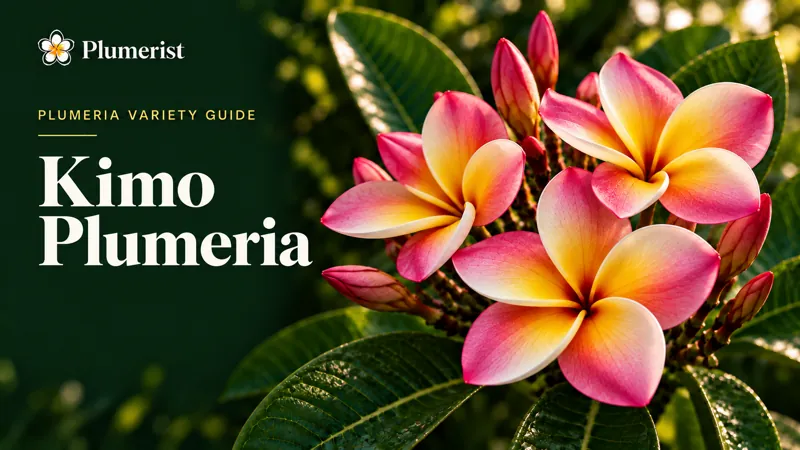
Ted Chinn named this plumeria after his own father, Kimo. That personal story is part of why Kimo plumeria still carries real weight among Hawaiian growers today.
It is registered with the Plumeria Society of America under registration number 118. That gives it a documented, traceable identity rather than a vague trade name.
Here is what the plant actually looks like and how it performs in the garden.
What Kimo Plumeria Looks Like
The flowers run about 3 inches across, with wide, round petals that overlap heavily. That overlap gives the bloom a full, dense look rather than a loose, open one.
The color is a strong orange and yellow base. Moderate pink bands run through it on both the front and back of the petals, and it is a warm, sunny combination that reads as classic Hawaiian plumeria.
The leaves are notably long for the genus, often reaching 13 to 14 inches. That gives mature plants a lush, substantial look even before the blooms open.
Fragrance and Keeping Quality
Kimo plumeria has a strong, sweet fragrance with a subtle lemon or lime undertone. It is a fuller scent than many named cultivars, without tipping into anything sharp or medicinal.
Growers also praise its keeping quality. The blooms hold their shape and color well after picking.
That matters if you plan to cut Kimo plumeria for a lei or an arrangement, since a lot of tropical flowers wilt fast once removed from the plant.
Documented History, With a Few Gaps
The breeder and the family story behind the name are both on record. That is more than many named plumeria cultivars can claim.
What is missing is a confirmed introduction year, since that detail does not appear in the sources I checked. If you see a specific year attached to a Kimo plumeria listing, treat it as an estimate rather than a documented fact.
The parts that do hold up are the breeder, the name origin, and the registration number. That is a solid paper trail as named plumeria go, especially compared with the many rainbow named cultivars whose backstories are murkier.
Bloom Timing and Color Shifts
Like most Plumeria rubra hybrids, Kimo blooms heavily from late spring through fall. Individual flowers cluster at the branch tips in generous bunches once the plant matures.
Heat also affects the look of the bloom. Growers report that the orange tones intensify in hot weather, while cooler stretches let the pink banding show through more.
That means two photos of Kimo plumeria taken in different seasons can look noticeably different. Neither one is wrong, it is simply the same flower responding to the weather.
Size and Growth Rate
Kimo plumeria grows at a fairly typical pace for a named Plumeria rubra cultivar, neither notably fast nor notably slow. Expect a modest, well branched tree rather than a compact dwarf.
Those long leaves add real visual bulk as the plant matures, so it can look larger than its actual height would suggest. It stays manageable in a large pot for many years if you prune it occasionally, which also keeps the canopy from getting too dense to bloom well.
Honest Strengths and Weaknesses
- Strength: a well documented cultivar with a real breeder and registration on record.
- Strength: strong fragrance with a pleasant citrus undertone.
- Strength: excellent keeping quality, which makes it a solid pick for leis and bouquets.
- Weakness: color balance shifts with heat, so a single photo does not tell the full story.
- Weakness: it is common and widely propagated, so it is not the pick for a collector chasing something rare.
- Weakness: like other Plumeria rubra cultivars, it drops its leaves and needs a full winter rest.
Growing Kimo Plumeria
Care follows the standard Plumeria rubra playbook. Give it full sun and fast draining soil, as covered in my care fundamentals.
Water it deeply, then let it dry out before watering again. Because it is deciduous, expect it to drop its leaves and rest through the cold months.
My cold season routine walks through protecting it if your area sees frost. Most growers propagate Kimo from cuttings rather than seed, since a cutting guarantees the same flower and scent as the parent.
My guide on how to take a cutting properly covers that process step by step.
Kimo in Hawaiian Plumeria Culture
Naming a plumeria after a family member is a genuine Hawaiian tradition, not just a marketing choice. My guide to plumeria in Hawaiian culture covers that broader history.
Because the blooms hold up so well after cutting, Kimo shows up often in leis and arrangements. My plumeria flower bouquet guide has tips for cutting and displaying blooms like these.
How Kimo Compares to Similar Cultivars
If the orange and yellow tones are what drew you in, my orange plumeria guide rounds up other cultivars in that same warm color family.
For the pink banding specifically, my pink and yellow plumeria guide covers cultivars where that combination is the main event, not just an accent.
Both comparisons are worth reading if you like Kimo but want to see the full range of options before you settle on one plant.
The Plumerist toolkit
The gear we would buy if we were starting over.
As an Amazon Associate, Plumerist earns from qualifying purchases.
Frequently Asked Questions
Who is Kimo plumeria named after?
Ted Chinn named it after his own father, Kimo. It carries Plumeria Society of America registration number 118.
What color is Kimo plumeria?
A strong orange and yellow base with moderate pink bands on both sides of the petals. The balance can shift a bit with heat.
Is Kimo plumeria fragrant?
Yes. It has a strong, sweet scent with a subtle lemon or lime undertone.
Is Kimo plumeria good for leis?
Very good. Growers praise its keeping quality, so the blooms hold their shape and color well after picking.
Is Kimo plumeria rare?
No. It is a popular, widely propagated cultivar, which makes it easy to find compared with true collector varieties.
How big does Kimo plumeria get?
It grows at a typical pace for a named cultivar, forming a modest, well branched tree. It also does well long term in a large container.
Kimo plumeria earns its long standing popularity honestly. It has a documented history, a strong scent, and blooms that hold up well once cut.
It is not the pick for a collector chasing rarity, but it is a dependable, well loved choice for almost everyone else. Between the family story and the reliable performance, it earns its long running popularity fairly.
For the wider lineup, my big variety roundup is worth a look next.