

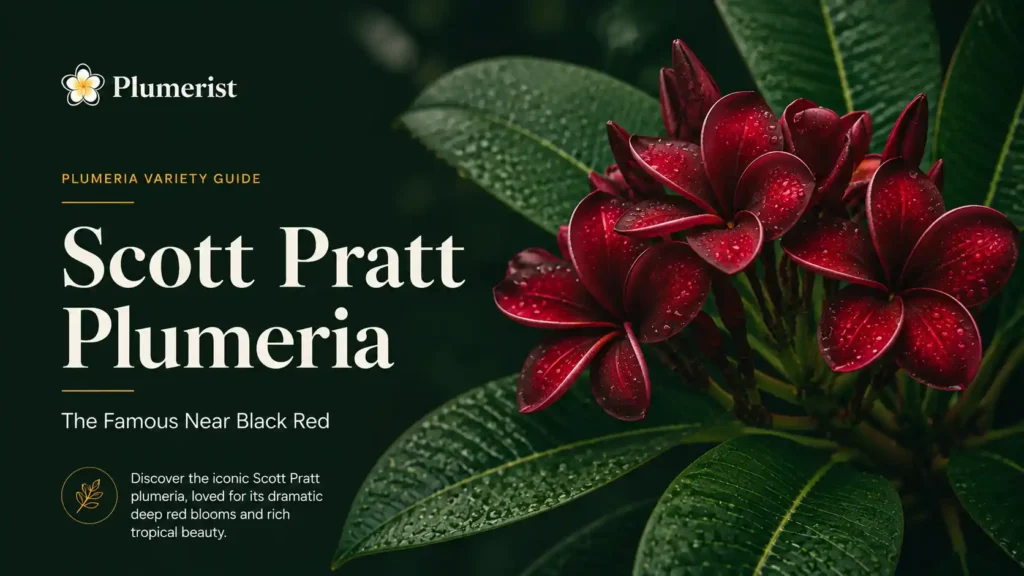
If you’ve been down the plumeria rabbit hole for more than five minutes, you’ve heard the name Scott Pratt. It’s the one collectors whisper about, the dark red so deep it looks almost black. If you want serious drama in your garden, this is the plumeria that delivers it.
So let me walk you through what makes Scott Pratt special, what those famous flowers actually look like, and the honest truth about growing one.
Scott Pratt at a Glance
| Thing | The short answer |
|---|---|
| Color | Velvety dark red with a near black center and radiating dark lines |
| Flower size | On the smaller side, around 2.5 inches across |
| Fragrance | Light, a slight spicy scent that strengthens once picked |
| Claim to fame | One of the darkest, most dramatic reds in the hobby |
| Species | A cultivar of Plumeria rubra, so it’s deciduous |
| Hardiness | Warm climates (USDA zones 10 to 11), or grown in pots elsewhere |
What Scott Pratt Looks Like
This is where Scott Pratt earns its reputation. The flowers are a rich, velvety dark red, and at the heart of each bloom sits a deep, almost black center with darker lines that radiate outward across the petals. Flip a flower over and you’ll often see a moody reddish brown band on the back too.
The petals are narrow with rounded tips and only moderate overlap, so the blooms have a slightly starry, elegant shape rather than a fat round pinwheel. They’re a touch smaller than average, around 2.5 inches, but honestly the drama of that color makes up for the size. In the right light, Scott Pratt reads as one of the darkest, most gothic looking plumeria you can grow, which is exactly why people are obsessed with it.
What About the Fragrance?
Here’s the honest bit, and it’s a pattern with a lot of the deep reds. Scott Pratt is only lightly fragrant. There’s a subtle, slightly spicy scent, and interestingly it tends to get a bit stronger after the flowers are picked, but this is not a knock your socks off perfume plant.
So if fragrance is your number one priority, know that going in. The deep reds like Scott Pratt trade some of that classic plumeria scent for their showstopping color. If you want maximum perfume, a white or a classic yellow will serve you better, but if it’s drama you’re after, Scott Pratt wins. For more on how scent varies across the genus, my red plumeria guide gets into it.
Why Collectors Chase Scott Pratt
So what’s the big deal? Simple: it’s one of the darkest reds out there, and dark reds are the trophies of the plumeria world.
That near black, velvety look is genuinely uncommon, and it photographs like a dream. Scott Pratt has become a kind of benchmark, the name people reach for when they want that deep, dramatic red in their collection. It’s the plumeria that makes visitors stop, tilt their head, and ask what on earth it is. If you love the moody, gothic end of the flower spectrum, this is a bucket list variety.
Is Scott Pratt Hard to Grow?
Good news and a small caveat. The good news: Scott Pratt wants the exact same care as any other plumeria, so there’s nothing exotic to learn. The small caveat: like a lot of the rare dark reds, it can be a little less vigorous and a bit pricier than an easygoing yellow, and the dark reds often look their deepest and richest in the cooler temperatures of spring and fall, softening a touch in intense summer heat.
None of that should scare you off. It’s not a difficult plant, it’s just a special one. Give it what every plumeria wants and it’ll reward you with those unreal dark blooms.
How to Care for Scott Pratt
Standard plumeria playbook, so if you’ve grown any plumeria you already know this. Give it full sun, six hours minimum and more is better, since sun drives the blooms and helps that dark color develop. Plant it in a fast draining mix so the roots never sit wet, which my best soil for plumeria guide covers.
Water deeply, then let it dry out before the next round, because overwatering is the top plumeria killer. The full schedule is in plumeria water requirements. Through the growing season, feed a high phosphorus bloom fertilizer to fuel flowering, per my feeding plumeria notes.
As a deciduous Plumeria rubra, Scott Pratt will drop its leaves and go dormant in winter, which is normal. It’s cold sensitive, so if you get frost, keep it in a pot and follow a simple winter care routine while it rests. Want to push more blooms? My guide on getting plumeria to bloom has the details.
Growing Scott Pratt From Cuttings
Because it’s a named cultivar, Scott Pratt is grown from cuttings, never seeds. A cutting is a clone, so you get that exact dark red bloom, while a seed would be a total genetic gamble that almost never matches the parent. That’s actually why the good dark reds can be a bit harder to find and cost a little more, since every true Scott Pratt traces back to cuttings of the original. Take a cutting, let the end callus for a couple of weeks, and pot it in fast draining mix. Full steps in my plumeria cuttings guide.
Frequently Asked Questions
What color is Scott Pratt plumeria? A velvety dark red with a near black center and dark lines radiating across the petals. It’s one of the darkest reds you’ll find.
Is Scott Pratt plumeria fragrant? Only lightly. It has a subtle spicy scent that gets a little stronger after picking. Like most deep reds, it trades fragrance for its bold color.
Why is Scott Pratt so popular with collectors? Because that near black, velvety red is rare and dramatic. Dark reds are the trophies of the plumeria world, and Scott Pratt is one of the benchmarks.
Is Scott Pratt hard to grow? Not really. The care is the same as any plumeria. It can be a touch less vigorous and pricier than a common yellow, but it’s not difficult, just special.
Is Scott Pratt a Plumeria rubra? Yes, it’s a rubra cultivar, so it’s deciduous and drops its leaves in winter like most colorful plumeria.
Bottom line, if you want the moodiest, most dramatic red in the neighborhood, Scott Pratt is a dream. Just go in knowing it trades a bit of scent for that unreal dark color, give it sun and sharp drainage like any plumeria, and enjoy having one of the hobby’s most sought after blooms. Want to explore more? Check out the full red plumeria guide or the complete plumeria varieties rundown.