

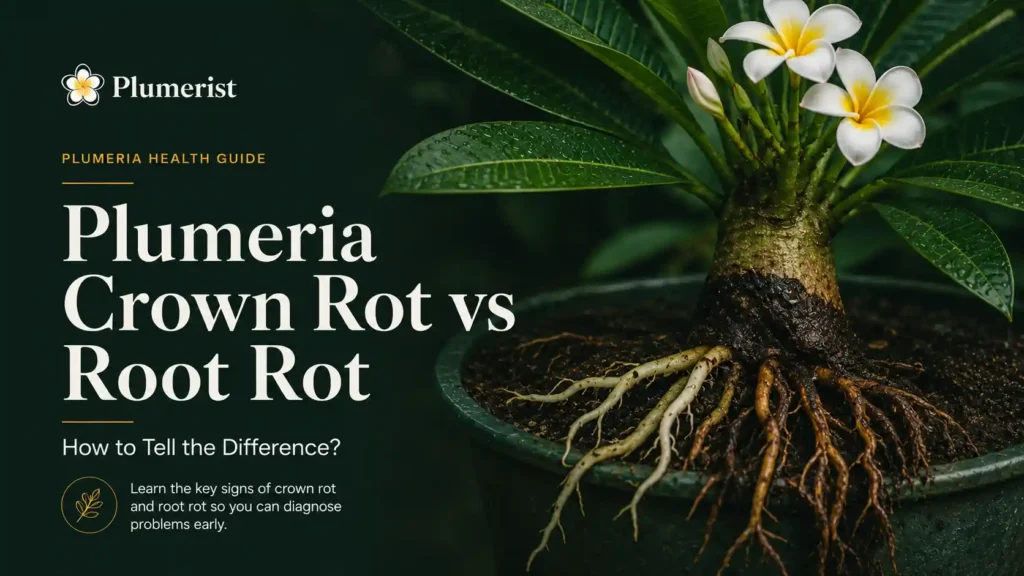
Comparing plumeria crown rot vs root rot starts with anatomy. Roots sit below the growing medium; the root collar is where they meet the stem. Crown or collar rot affects that basal area, not the leafy top of the tree.
Both problems can occur together. Softness and wilting can suggest damage, but they cannot identify a pathogen or show which direction an infection traveled. Check the plant’s condition before choosing a treatment.
Plumeria crown rot vs root rot at a glance
| Area | Possible evidence of damage | What it does not prove |
|---|---|---|
| Roots below the mix | Soft or decaying tissue, loss of healthy roots, outer tissue slipping away | The pathogen, the original cause, or whether every root is affected |
| Root collar near the soil line | Soft, discolored or deteriorating tissue around the stem base | That damage began above the roots or will spread only upward |
| Upper stem or branch tip | Localized softening, collapse or tissue death | That the root collar is involved |
The Wisconsin plant disease guide uses root and crown rot as broad disease terms for damaged roots and lower woody tissue. Different organisms and growing problems can produce similar symptoms. This article is a triage guide, not a laboratory diagnosis.
Do not confuse the root crown with the canopy
Gardeners also use “crown” for the leafy upper part of a tree. In this root disease discussion, it means the basal transition around the roots and stem. That distinction prevents a soft upper tip being mislabeled as root collar rot.
For damage higher on a branch, compare the stem symptom guide. If the entire plant is declining, use the broader rescue checklist as well. Several problems can be present at once.
Start with the pot and recent history
Check whether the mix is still wet well below the surface. Look for blocked drainage, a full saucer or an outer pot holding water. Note recent cold exposure, transplanting and changes in watering.
Wilted leaves do not automatically mean thirst. Damaged roots may be unable to supply a leafy plant even when the mix is wet. Adding more water in that situation can worsen the conditions around the roots.
A wrinkled stem is not a diagnosis either. Compare growth state, root condition and whether the tissue is progressively collapsing. Avoid repeated squeezing that damages an otherwise intact stem.
When root inspection is justified
Consider inspection when decline continues alongside persistently wet mix, instability or visible basal damage. For a movable plant, support the root ball and ease it out carefully. Do not pull on branches or strip healthy roots just to look.
Look for tissue condition rather than color alone. Root color varies with age and the growing medium. Firm roots should not be removed simply because they are not white.
Photograph the base and roots before making changes. Those views can help a local extension service or plant clinic. If you may submit a sample, ask the clinic what to keep before cutting everything away.
What you can change immediately
- Stop leaving the container in standing water. Confirm that runoff has somewhere to go.
- Protect the plant from additional cold and rain when practical. Keep it in suitable light without suddenly exposing stressed tissue to harsh sun.
- Separate suspect material from other pots and tools. Do not reuse contaminated growing medium on another plant.
- Assess how much firm root and stem tissue remains. Recovery depends on the remaining plant, not simply the disease label.
If repotting is appropriate, use fresh, freely draining medium and a pot suited to the remaining roots. Keep the established root collar at the surface rather than burying the stem. Do not add a layer of soil to hide basal damage.
Our container soil guide explains mix choices. The existing cactus and succulent mix listing is a shopping reference. A bag label alone does not establish how a mix will drain in your container.
Cutting and chemical treatment have limits
Do not carve into a sound trunk because it feels slightly wrinkled. Removing damaged tissue is a judgment based on location and how much healthy tissue remains. Deep basal damage may leave little that can be saved.
Clean tools between plants and after contact with diseased tissue. The existing pruning tool listing is retained for tool comparison. Sharpness and sanitation matter more than a promise that one purchase cures rot.
Do not automatically dip surviving roots in rooting hormone. The existing rooting hormone listing is a propagation product reference, not a rot cure. Use any product only for its labeled purpose.
Likewise, a generic fungicide powder is not a diagnosis or a universal solution. The UC IPM disease guidance explains that confirming Phytophthora requires appropriate laboratory testing. Do not assume every decayed root contains that organism.
Crown or root rot
A soft base or mushy roots, usually from soil that stays wet too long.
Hoffman organic cactus & succulent mix
Cut away rotten tissue and repot into a fast-draining cactus mix.
Check price on AmazonAs an Amazon Associate, Plumerist earns from qualifying purchases.
Can a healthy branch be saved?
Sometimes a plant with severe basal damage still has firm branches suitable for propagation. That is a separate attempt to preserve living material, not proof the original root system will recover. Avoid retaining tissue with visible decay.
Use the cutting propagation instructions for that process. Keep suspect cut pieces and tools away from healthy plants. An expensive cultivar can justify professional diagnosis before major cuts.
Recovery and prevention
Adjust watering to the remaining roots, foliage, temperature and mix. A badly reduced root system cannot use water like an established leafy plant. There is no reliable universal two week recovery schedule.
A moisture meter may be a supplementary check, but do not treat one reading as a diagnosis. Observe actual drainage and moisture deeper in the pot too. Stop feeding while resolving serious root stress.
For future prevention, avoid prolonged saturation and planting too deeply. Check drainage after heavy rain and before winter storage. A healthy plant can still develop problems, so routine observation remains useful.
What plumeria crown rot vs root rot cannot tell you
The comparison tells you which tissue appears affected. It cannot promise recovery or establish that one condition is always easier to fix. Extent, cause and growing conditions matter.
If you are researching plumeria crown rot vs root rot while the plant is rapidly collapsing, seek local help with clear photos. Do not lose time cycling through unrelated sprays. Correct the wet conditions and preserve evidence for diagnosis.
The Plumerist toolkit
The gear we would buy if we were starting over.
As an Amazon Associate, Plumerist earns from qualifying purchases.