

What does plumeria smell like? Many flowers are described as sweet and floral, with citrus, fruity or spicy notes depending on the plant. There is no single scent shared at the same strength by every plumeria.
If a flower reminds you of a particular holiday, another plant with the same colors may still disappoint. Flower identity, development and the conditions of the comparison matter. Your own preference matters too.
What does plumeria smell like in ordinary words?
A scent description is a comparison, not a list of ingredients. Lemonlike means the aroma reminds someone of lemon. It does not mean the flower contains lemon juice or will smell identical to a citrus blossom.
| Description you may hear | What the observer is communicating | Useful follow up question |
|---|---|---|
| Sweet floral | A rich flower aroma without a more specific comparison. | Is it noticeable nearby, or only close to the flower? |
| Citrus or lemon | A brighter citruslike impression. | Is that note dominant or part of a broader floral scent? |
| Spicy | An impression compared with spice or carnation. | Which comparison makes sense to the person describing it? |
| Fruity or creamy | A resemblance such as ripe fruit or a soft rounded aroma. | Is this a personal description or a documented cultivar observation? |
| Faint | Little aroma was noticed in that observation. | Was it one flower, one time or a repeated comparison? |
Two people can agree that a flower is strongly scented while choosing different words for it. One may focus on sweetness and another on a sharp note underneath. That disagreement does not automatically mean one has the wrong plant.
It becomes useful to record both the impression and the circumstances. A label such as strongest or classic is less informative without those details. Prefer a specific description to a claim that everyone will love it.
Real flowers emit a mixture
A 2019 study of Plumeria rubra scent identified numerous volatile compounds and investigated the pathway for phenylethyl alcohol. It helps explain why fragrance is more than one chemical. The sampled plant is not a complete scent map of every cultivar.
Laboratory identification also differs from a human smell comparison. A chemical’s proportion in one collected sample is not a rating of how far a garden plant carries its scent. Different compounds can contribute differently to perceived aroma.
A 2024 analysis of collected plumeria flowers used headspace sampling under defined laboratory conditions. Its procedure included warming samples in vials. That measurement should not be presented as the smell of every living flower at the surrounding garden temperature.
Neither study supplies a universal winner for the most fragrant cultivar. Neither establishes that extra fertilizer makes an individual flower smell stronger. Use the research for what it measured.
Color is not a reliable scent shopping rule
White and yellow plumerias include well known fragrant selections. That does not make every pale flower stronger than every pink or red one. A color photograph cannot tell you the scent of an unidentified plant.
Some studies examine relationships between color forms and scent chemistry. Such findings do not justify a universal color ranking across all cultivated plumerias. They also do not mean that color and scent can never have a biological association.
If your question is what does plumeria smell like before buying, ask for the actual cultivar and its source. The documented fragrance shortlist connects named examples with reported notes. It keeps those descriptions separate from a guaranteed personal experience.
Does it always smell strongest after sunset?
People often notice plumeria fragrance in the evening, but avoid making that a rule for every plant. Observation time, flower development and surroundings can change the comparison. One weak afternoon impression is not a complete assessment.
Try the same plant on more than one occasion and at different times. Record what you notice rather than expecting a compulsory evening peak. Do not compare an old flower on one plant with a newly open cluster on another and call it a fair test.
A sheltered position and an open windy position also present different smelling conditions. That does not prove that humidity always traps scent or dry air always weakens the plant’s production. Keep perceived aroma and emission claims separate.
A simple observation routine
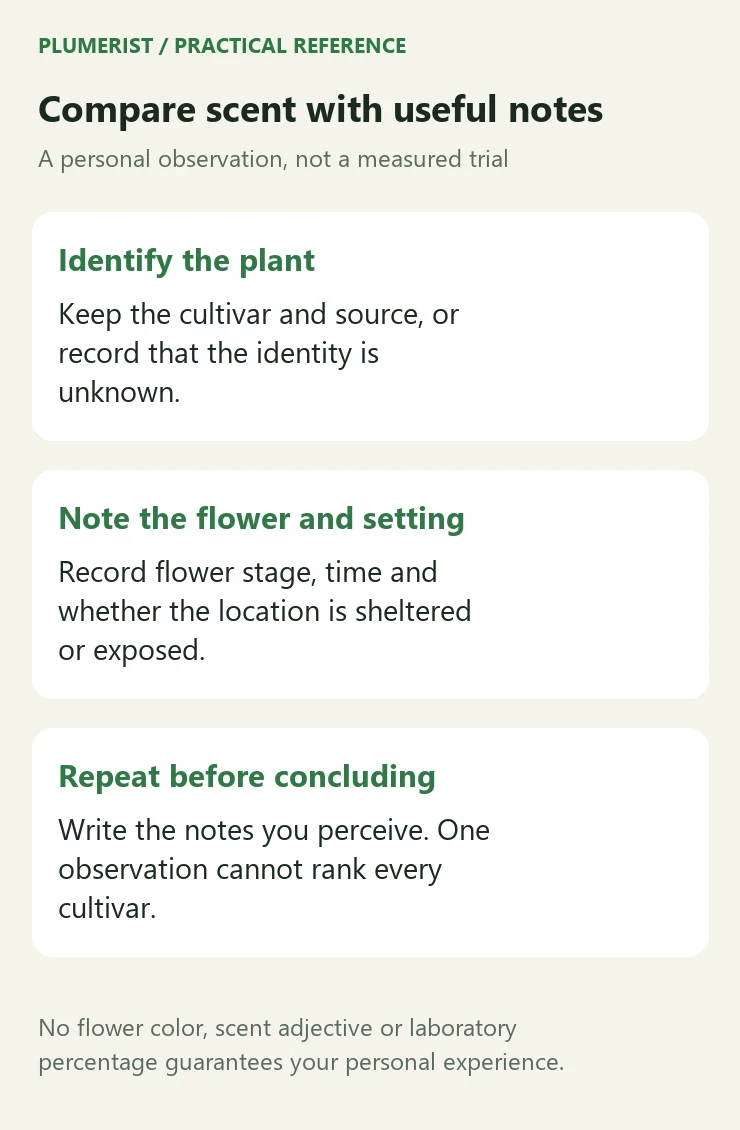
| Record | Keep it specific | Avoid |
|---|---|---|
| Plant identity | Cultivar name and source, or unknown. | Identifying a cultivar from fragrance alone. |
| Flower condition | Open flower, older flower or developing bud. | Treating all stages as equivalent. |
| Conditions | Time, approximate weather and sheltered or exposed setting. | A universal claim from one sniff. |
| Your impression | Dominant note and whether it was faint or easily noticed nearby. | An invented numerical strength score. |
| Repeat observation | A second dated note on the same identified plant. | Changing the description to match a seller’s wording. |
Enjoy the aroma without pressing a flower against your face. Avoid disturbing bees or other insects on the plant. Keep broken stems and their milky sap away from skin and eyes.
If comparing several plants, pause between them and write brief notes. You do not need a formal rating scale to discover a preference. These are personal observations, not a controlled fragrance trial.
Why a perfume may not match the flower you remember
A product labeled plumeria or frangipani can represent a perfumer’s interpretation. It may emphasize a floral, creamy or fruity aspect alongside other notes. The name alone does not specify how the scent was made.
Likewise, a scent note is not proof that the product contains an extract from a particular plumeria cultivar. Do not assume every product is synthetic, or that every natural extract recreates a living flower perfectly. Those claims need evidence about the specific product.
The frangipani perfume guide covers that separate buying question. When the goal is a remembered flower, sampling the product is more useful than matching a note name on a list. Skin, fabric and a garden flower are different smelling contexts.
Flowers in a lei or vase are another comparison
Once flowers are picked, handling and storage become part of their condition. A lei can also combine materials with different scents. Its aroma should not be used to identify one unnamed tree.
The Hawaiian flower reference explains the practical lei context. For the difference between a single flower and an entire cluster, see the flower longevity guide. Neither shape nor scent is guaranteed to persist for a fixed number of days.
Care for flowers without chasing a scent booster
Suitable conditions support a healthy plant and flowering. They do not establish that more sunlight or more fertilizer always increases fragrance. An acclimation mistake can damage a plant you are trying to improve.
Use the light and acclimation guide before changing exposure. The feeding reference avoids automatic bloom boosters and stacked inputs. There is no verified Epsom salt recipe here for a stronger scent.
If the plant is not flowering at all, the question is about flowering first. Use the nonflowering assessment instead of diagnosing a weak fragrance from absent blooms. A healthy unidentified plant may still have a scent profile different from the one you hoped for.
Fragrance questions
What does plumeria smell like if two flowers are different colors?
You cannot reliably predict that from the colors alone. Compare correctly identified flowers under similar conditions. Record the notes you perceive instead of assigning a scent from a photograph.
Is a faint scent proof of a sick plant?
No. Identity, flower stage and the observation conditions all deserve consideration. Investigate visible decline separately rather than adding fertilizer on the strength of one sniff.
The Plumerist toolkit
The gear we would buy if we were starting over.
As an Amazon Associate, Plumerist earns from qualifying purchases.