
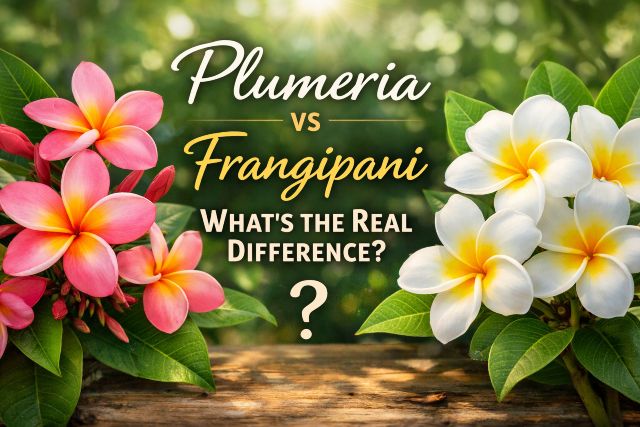
If you’ve ever stood in front of a Plumeria and wondered, “Wait… is this the same thing as a Frangipani?” trust me, you are not alone. I remember the first time I came across the word Frangipani, and I honestly thought it was some exotic cousin of Plumeria. Turns out, that confusion is actually very common because both names refer to the same plant. Yes, really. Same plant, just two different names depending on where you live.
Let’s unpack this in a simple and friendly way so you’ll never mix them up again.
What is Plumeria?
Plumeria is the official botanical name of the plant. If you pick up any gardening book or search through botanical databases, you will always find the plant listed under Plumeria.
It belongs to the Apocynaceae family and is native to tropical regions like Mexico, Central America, and parts of the Caribbean. These are the classic tropical flowers you see in Hawaiian leis, with their soft and sweet fragrance that somehow smells like a mix of vanilla, citrus, and warm butter.
Whenever you hear someone call it Plumeria, they are usually referring to the formal side of the plant world.
What is Frangipani?
Frangipani is the common name. You’ll hear it more in Australia, Southeast Asia, Pacific islands, and even some parts of the Middle East.
It is the same plant. Not a variety. Not a hybrid. Not a cousin.
Just the everyday name that people use.
The word “Frangipani” has an interesting history though. It actually comes from an Italian noble family named Frangipani. They created a perfume that smelled like these flowers, and eventually people started associating the plant with the fragrance.
So the name didn’t come from the plant. It came from a perfume. I love how random and poetic that is.
So are Plumeria and Frangipani the same?
Yes. One hundred percent the same plant.
Plumeria = scientific name
Frangipani = common name
Every time you see “Plumeria plant” and “Frangipani tree,” it is still the same species.
This is like saying:
-
“Garbage” vs “Trash”
-
“Corriander” vs “Cilantro”
-
“Aubergine” vs “Eggplant”
Just different names for the same thing depending on where you live.
Why do two different names exist?
Because of language, culture, and history.
Different regions adopted different nicknames.
Here’s how it is usually used around the world:
United States
People say Plumeria most of the time.
Australia
Almost everyone calls them Frangipani.
Hawaii
People say Plumeria, especially because of its cultural use in leis.
Southeast Asia
People say Frangipani because the name entered the region through colonial influence.
Caribbean regions
Plumeria is more common because the plant grows naturally there.
This is why gardeners online always end up asking whether they are different plants. Everyone is using a different name for the same thing.
Cultural meanings of Plumeria or Frangipani
What I love about this plant is that it carries different symbolic meanings depending on the country.
Hawaii
It represents positivity, new beginnings, and warm welcome.
People wear it behind the ear to show relationship status.
India
The plant is often found in temples and symbolizes devotion.
Southeast Asia
It is sometimes planted near cemeteries and associated with spirits.
A bit spooky but fascinating.
Pacific Islands
It is a symbol of beauty and femininity.
Even though the plant is the same, the meaning changes depending on the culture. That’s one of the things that makes it so interesting.
Popular types people call Plumeria vs Frangipani
Although the plant is the same, people often associate certain varieties with one name more than the other.
For example:
When people say “Plumeria,” they often mean:
-
Plumeria rubra
-
Plumeria obtusa
-
Plumeria stenopetala
These are popular in American and Hawaiian gardens.
When people say “Frangipani,” they often mean:
-
Plumeria rubra in Australia
-
The classic white and yellow tropical variety
-
The smaller ornamental forms found near temples in Southeast Asia
Again, these are the same species, just culturally grouped.
Care tips that apply no matter what name you use
Since Plumeria and Frangipani are the same plant, their care is exactly the same. Here are the basics.
Sunlight
They love full sun. Give them at least 6 hours of bright light.
Watering
Water deeply but let the soil dry out between watering sessions.
They absolutely hate wet feet.
Soil
A fast draining mix works best. Something like:
-
cactus mix
-
perlite
-
coarse sand
If you don’t want to mix your own soil, a ready made fast draining cactus or succulent mix works perfectly. I’ve had great results with this one from Amazon.
Feeding
Use a fertilizer with higher phosphorus to encourage blooms.
Winter care
If you live in a cold region, bring them indoors or keep them protected because they are not frost tolerant.
Final thoughts
Plumeria vs Frangipani is one of those topics that creates unnecessary confusion. Once you understand that they are literally the same plant with two different names, everything falls into place.
Call it Plumeria.
Call it Frangipani.
Call it the flower that smells like heaven.
It is still the same beautiful tropical plant that brings warm, exotic vibes to any garden.
Frequently Asked Questions
Are Plumeria and Frangipani different plants?
No. They are the exact same plant. Plumeria is the botanical name and Frangipani is the common name used in many regions like Australia and Southeast Asia.
Why does the plant have two names?
The scientific community adopted the name Plumeria, while the word Frangipani became popular because an Italian family created a perfume that smelled similar to the flowers. Over time different countries began using different names.
Which name is more correct: Plumeria or Frangipani?
Both are correct. If you want the scientific name, use Plumeria. If you are talking casually or you live in Australia, people will say Frangipani. It depends on the region and personal preference.
Do Plumeria and Frangipani have different care requirements?
No. Since they are the same plant, their care is identical. They need full sun, fast draining soil, deep watering with drying periods, and protection from cold weather.
Do they look different depending on the name?
Not really. Some people think Frangipani refers only to the white and yellow variety, but that is not accurate. All varieties including red, pink, peach, and rainbow types fall under the same plant species.
Do Plumerias grow in Australia?
Yes. They are extremely popular in Australia and are mostly called Frangipani there. You will see them in gardens, beaches, and city landscapes.
Do Plumerias have a strong fragrance?
Yes. Plumeria blossoms are known for their sweet, warm fragrance. Some varieties smell like vanilla, others like citrus, and some have a rich creamy scent.
Can you grow Plumeria indoors?
You can start them indoors, but they perform best outdoors in bright sunlight. Indoors they need a sunny window and well draining soil to avoid root rot.
Is Plumeria poisonous to pets?
The sap can be irritating if ingested or if it touches the skin. It is not deadly, but it can cause stomach upset in pets and mild skin irritation in humans.
Why do some people associate Frangipani with spirits or cemeteries?
That is mostly a cultural belief from Southeast Asia. In some regions the plant was commonly planted near cemeteries, and people added stories around it. The plant itself is not harmful or spiritually negative.