
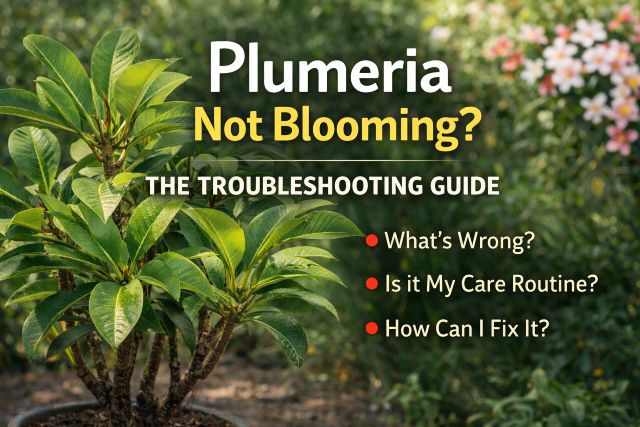
If your Plumeria looks perfectly healthy but still refuses to bloom, you’re not alone. I’ve been through this myself, and it can drive you crazy. You water it, you feed it, you check on it every morning like it’s a newborn, yet it still sits there with nothing but leaves. It almost feels like it’s testing your patience on purpose.
But here’s the thing. Plumeria is not a complicated plant. When it doesn’t bloom, there are only a handful of reasons behind it. Fix those, and the plant usually rewards you with flowers.
Let’s break everything down in the simplest and most practical way possible.
1. Lack of Direct Sunlight
This is the number one reason Plumeria refuses to bloom. Plumeria needs real, strong, direct sunlight for several hours a day. If it gets only morning light or filtered light, you’ll see leaf growth but no flower clusters.
If your plant is in a shaded area or behind a wall, fence, or large tree, blooming will almost never happen.
What you can do:
Move the plant to a spot where it gets at least six hours of direct sunlight. If you’re growing indoors or on a shaded balcony, consider supplementing with a grow light.
Here’s a grow light that works well without overheating the plant:
2. Poor Soil Mix
Plumeria roots need to breathe. If the soil is too dense or holds too much water, the plant goes into stress mode instead of bloom mode. Heavy garden soil or standard potting soil often stays too wet.
What works best is a fast draining mix. Something gritty and airy.
If mixing your own soil feels like too much work, I’ve had good luck with this ready to use cactus mix:
It drains quickly and helps prevent root rot, which is a huge bonus.
3. Wrong Fertilizer
This is the most common mistake I see. Many people use a general purpose fertilizer or something high in nitrogen, which encourages leaf growth, not flowers.
For blooms, Plumeria needs more phosphorus. A bloom booster or Plumeria specific fertilizer works better.
Feed the plant every few weeks during the growing season and ease off feeding once cooler weather arrives.
4. Overwatering
Plumeria needs water, but only when the soil is dry. Too much water suffocates the roots and completely shuts down flowering. In some cases, it may even cause stem rot.
One thing that helped me is using a simple moisture meter. It takes the guesswork out of watering and prevents overwatering:
If the meter reads moist, do not water. Plumeria prefers to dry out between watering sessions.
5. Recovery After Pruning
If you recently pruned your Plumeria, it may take a while before it blooms again. Plumeria blooms from the tips, and if you removed too many tips, the plant needs time to regrow new ones.
New branches usually need to mature for a season or two before they produce flower clusters. In this case, patience is the only solution.
6. The Plant Is Too Young
This is especially true for Plumeria grown from seeds. Seed grown plants often take three to five years to produce their first flower. Cuttings bloom faster, but they still need time to establish roots and settle into their new environment before blooming.
If you’re propagating your own cuttings, using rooting hormone can help speed up root development:
Faster rooting usually means earlier blooming.
7. Cold or Unstable Weather
Plumeria is a warm weather plant. If temperatures are too low, or if there are sudden swings between hot days and cold nights, the plant focuses on survival instead of blooming.
In cooler climates, warming the soil early in the season helps jump start the plant’s growth. A heat mat works surprisingly well for this:
This is especially useful if you keep your Plumeria in a garage or patio during early spring.
8. Not Enough Root Space
Plumeria does bloom in pots, but if the pot is too small, root growth gets restricted and blooming slows down. If you’ve had your plant in the same pot for several years, it may be time to go one size up.
Make sure the new pot has drainage holes and is not overly large. Plumeria blooms better when slightly root bound but not completely cramped.
9. Stress or Transplant Shock
If you recently repotted or relocated your Plumeria, it may pause blooming until it adjusts. The plant needs time to settle into its new environment.
Try to avoid moving it repeatedly during the growing season. Pick a good spot, let the roots settle, and the plant will bloom once it feels stable again.
Final Thoughts
A Plumeria that refuses to bloom can test your patience, but once you understand the main reasons, fixing them becomes easy. Focus on sunlight first, then check the soil, watering, and fertilizer. Most of the time, solving just one of these issues brings the flowers back.
Frequently Asked Questions
Are Plumeria and Frangipani the same plant?
Yes, Plumeria and Frangipani refer to the same plant. Plumeria is the botanical name while Frangipani is the common name used in many regions such as Australia and parts of Southeast Asia.
Why is my Plumeria not blooming?
Most Plumerias fail to bloom because of lack of direct sunlight, poor soil drainage, overwatering, or using a fertilizer that is too heavy in nitrogen. Fixing these issues usually restores blooming.
How much sunlight does Plumeria need to bloom?
Plumeria needs at least six hours of direct sunlight every day. Anything less will delay or completely stop blooming.
What is the best fertilizer to make Plumeria bloom?
A high phosphorus fertilizer works best for Plumeria blooming. Nitrogen focused fertilizers grow leaves but reduce flowering.
Does Plumeria bloom in pots?
Yes, Plumeria can bloom in pots as long as it gets enough sunlight, has fast draining soil, and is not overly root bound.
How long does it take Plumeria to bloom from seed?
Seed grown Plumeria can take three to five years to bloom. Plants grown from cuttings usually bloom sooner.
Can overwatering stop Plumeria from blooming?
Yes. Overwatering stresses the roots and prevents flowering. Plumeria needs the soil to dry out between waterings.
Can cold weather stop Plumeria from blooming?
Cold temperatures slow growth and stop bloom development. Plumeria blooms best in warm and stable weather.
Should I prune my Plumeria to help it bloom?
Pruning does not force blooming. In fact, if you prune too much, the plant may skip blooming for a season while new tips grow and mature.
Is it normal for Plumeria not to bloom after repotting?
Yes. Repotting causes temporary stress and the plant may pause blooming until it adjusts to its new soil and container.