

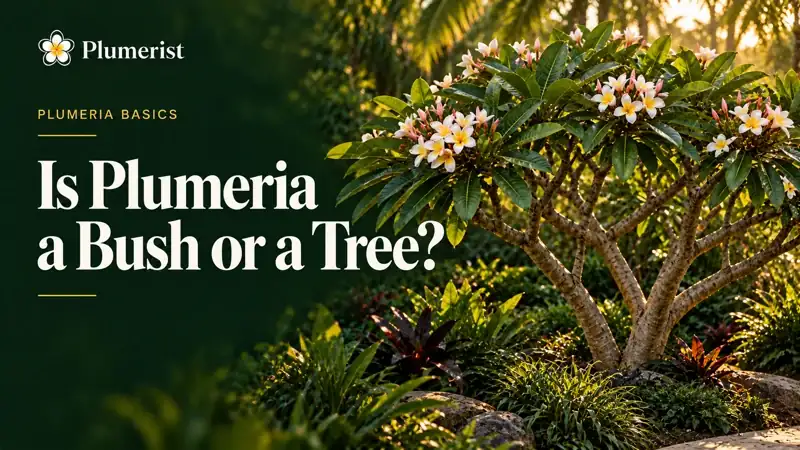
A plumeria bush is really just a plumeria tree kept small on purpose. The plant is naturally a small tree, not a true shrub. Pruning, species choice, and container life decide whether yours ends up bush shaped or tree shaped.
What Makes a Plumeria Bush Different From a Plumeria Tree
Every plumeria starts life the same way: a single stem pushing up from a cutting or a seed. Left alone, that stem thickens into a trunk and branches out overhead. Nothing about the plant forces it to stay short.
A plumeria bush happens when growth gets redirected low and wide instead of tall. Pruning early and often is the main trigger. Species also plays a real role, since some naturally branch closer to the ground than others.
Species That Lean Shrubby on Their Own
Plumeria obtusa and Plumeria pudica both branch low without much help. Pudica in particular throws multiple stems from near the base and rarely forms one dominant trunk. That habit is why it gets sold and planted as a plumeria shrub more often than other species.
Plumeria obtusa branches a bit higher than pudica but still stays fuller and rounder than most rubra cultivars. Growers who want that shrub shape from day one often start with one of these two species. It saves years of pruning compared to fighting a naturally upright plant into shape.
Species That Lean Toward Tree Form
Plumeria rubra, the species behind most classic lei colors, tends toward a single trunk and an upright habit. Left unpruned, it wants to become a small tree with a rounded canopy overhead. That is the plant most people picture when they hear the word plumeria at all.
Rubra can still be kept shrub sized with early, consistent pruning. It just takes more ongoing effort than starting with pudica or obtusa. Growers pick Plumeria rubra anyway because it carries the widest range of colors and cultivars by far.
Climate Changes the Equation Too
Warm, humid, frost free climates push plumeria to grow fast and tall for most of the year. In that setting, an unpruned plant reaches tree size much sooner than the same cultivar in a marginal climate. Growers in Hawaii or South Florida often fight height, not the reverse.
In cooler regions with a short growing season, growth naturally slows and stays more compact without any real effort. A plumeria wintered indoors for months out of the year simply has less time each season to push upward. That alone keeps many container plants bush sized by default.
Species Habit at a Glance
| Species | Natural habit | Effort to keep as a bush |
|---|---|---|
| Plumeria pudica | Low, multi stem shrub | Low, mostly natural |
| Plumeria obtusa | Compact, rounded small tree | Moderate |
| Plumeria rubra | Upright single trunk tree | Higher, needs regular pruning |
This is a rough guide, not a rule. Individual cultivars within rubra vary quite a bit in how eagerly they branch on their own.
How Long Before You See the Shape Take Hold
Training a young plant into either shape is faster than reshaping an older one. A first year cutting can be steered toward bush or tree form within its first two growing seasons. An established tree with years of upright growth takes longer to convert, often several seasons of hard pruning.
Patience matters more than technique here. Plumeria responds to pruning slowly compared to fast growing shrubs, since each cut waits for the next warm season to push new branches. Growers who expect an instant transformation usually end up disappointed the first year and thrilled by year three.
Common Mistakes When Shaping Either Form
The most common mistake is pruning at the wrong time of year. Cuts made during active summer growth heal fine, but cuts made right before a cold snap can invite rot at the wound. Late winter or very early spring, just before new growth starts, is the safer window.
The second common mistake is inconsistency. Pruning hard one year and then ignoring the plant for three seasons undoes most of the shaping work. A light touch up most years beats one aggressive cut every so often.
How to Train a Plumeria Bush Shape
Start pruning young, ideally within the first year or two of growth. Cutting the main stem back forces the plant to push out several side branches instead of one tall leader. Each of those branches can be topped again the following season to keep multiplying growth points.
The goal is a low, wide framework rather than height. My guide to pruning plumeria for more branches covers the exact cuts and timing. Container growers get an extra assist here, since roots confined to a pot naturally slow overall size too.
How to Train It the Other Direction, Into Tree Form
Training toward a tree just means doing less, not more. Skip early pruning and let one main stem run upward without interruption. Remove only low side shoots that compete with that main trunk in the first couple of years.
Once the trunk reaches the height you want, topping it will still force branching up top, just like it would lower down. From there, the plant develops a rounded canopy on its own. Most established plumeria trees you see in yards followed exactly this hands off path.
Does Size Stay Small Forever, or Is Pruning Ongoing?
Keeping any plumeria shrub small is not a one time job. New growth pushes upward every season, so the shape needs occasional touch ups to hold. Skip pruning for a few years and even a shrub trained plant will start reaching for tree form again.
Containers help slow that drift but do not stop it completely. My full guide to mature size expectations covers realistic size ranges by species and setting. For a plant that stays genuinely compact with minimal upkeep, our guide to size control pruning walks through the maintenance schedule.
Can You Grow a Plumeria Hedge?
Yes, and this is one case where the shrub versus tree question has a clear real world answer. Plumeria pudica is regularly planted as a flowering hedge or screening row in warm climates. Its habit of branching low and dense from multiple stems makes it suit that job far better than rubra ever could.
A pudica hedge still needs occasional shaping to stay even, but far less than trying to hedge a naturally tree form species. If a dense flowering screen is the goal, pudica is the far easier starting point. My guide to plumeria pudica covers its care and habit in full.
The Plumerist toolkit
The gear we would buy if we were starting over.
As an Amazon Associate, Plumerist earns from qualifying purchases.
Frequently Asked Questions
Is a plumeria bush the same plant as a plumeria tree?
Yes. There is no separate bush species. A plumeria bush is simply a plumeria tree that has been pruned, or naturally grows, in a low and wide shape instead of a tall single trunk form.
Which plumeria species stays smallest as a shrub?
Plumeria pudica generally stays the shrubbiest with the least effort, followed closely by Plumeria obtusa. Plumeria rubra can be trained the same way but needs more consistent pruning to hold that shape over time.
How is a plumeria shrub different from just a small plumeria?
A plumeria shrub usually means multiple low branches spreading from near the base rather than one trunk. A small plumeria could simply be a young tree form plant that has not grown tall yet, with no bush shaping involved at all.
Does keeping plumeria as a bush hurt its blooming?
No, and it can actually help. Bushier plants often carry more branch tips, and each mature tip is a potential bloom cluster. More branching from early pruning tends to mean more flowers once the plant matures.
Can a plumeria tree be turned back into a bush later?
Yes, though it takes a hard pruning cut back to a much lower framework. The plant will respond with new low growth the following season. It will not happen instantly, and it usually costs a bloom cycle while the plant recovers.