

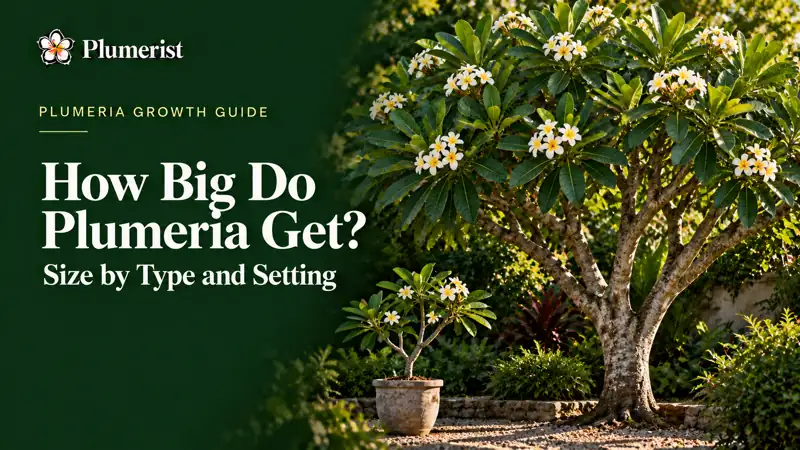
How big do plumeria get? A standard landscape plant can become a broad small tree, while a compact selection or managed container plant may remain much smaller. The label needs to describe the actual species or cultivar, not just “plumeria.”
For a useful reference, mature Plumeria rubra is commonly listed around 20 to 25 feet tall in warm landscape settings. That is not a promise about your patio plant. Nor is it a hard ceiling for every member of the genus.
How big do plumeria get in a landscape?
UF/IFAS’s Sarasota landscape reference lists Plumeria rubra at 20 to 25 feet tall. A separate Orange County plumeria guide gives a broader 6 to 25 feet for height and spread, depending on species and cultivar. These are different descriptions, not competing predictions for one identified plant.
Species, cultivar, growing conditions and maintenance all influence the result. A low spreading plant can occupy substantial space without being especially tall. Measure width as carefully as height.
| Plant or setting | Useful expectation | What to verify |
|---|---|---|
| Standard rubra in a suitable landscape | Potential for a substantial broad canopy, not a permanently small patio shrub. | Documented mature height and spread of the actual selection. |
| Compact named cultivar | May have shorter growth and a different overall form. | Mature examples and provenance rather than the word dwarf alone. |
| Established container plant | Size changes with habit, roots, care and pruning. | Current dimensions, stability and the next winter move. |
| Young rooted cutting | Starting height includes the original piece of stem. | Root development and identity, not height as a measure of age. |
| Plant kept indoors | Available light and space can constrain good growth. | Whether it is healthy and supported, rather than merely short. |
Why there is no dependable height by age table
A newly rooted cutting may start much taller than a seedling of the same calendar age. A plant can also spend months resting or recovering. Treating all of those as equal starting points makes an age chart misleading.
A claim that every five year old plant should be a particular height needs defined conditions and a shared starting size. Those details are rarely supplied. Do not use such a chart to diagnose a healthy compact plant as stunted.
Track your plant instead. Measure from the medium surface to the highest living tip, using the same reference each time. Record pruning and whether the plant was in active growth.
The growth rate guide covers the separate question of yearly development. Mature size describes a possible long term footprint. It does not tell you how much every plant must add this season.
A pot changes management, but does not set a fixed ceiling
Container growing can limit roots and make seasonal movement possible. It does not ensure that every plant stops at four, six or eight feet. A tall canopy can outgrow the doorway even while its roots remain in the same pot.
Do not deliberately keep a plant chronically stressed to make it fit. Poor roots, inadequate light and dehydration are not useful substitutes for a suitable cultivar. A manageable healthy plant is the objective.
The container planning guide treats root space, drainage, stability and mobility together. Choose a setup you can actually manage. A heavier decorative planter can solve one tipping problem while creating a moving problem.
A partly buried pot also needs a plan for roots escaping through openings. It may not lift as easily as it did at planting time. Review that arrangement before relying on an emergency winter move.
Measure the whole moving envelope
For a plant that comes indoors, note the widest part of the canopy, total height and combined carrying weight. Measure the route too. Include gates, steps, turns, door openings and the protected destination.
The total height for moving includes the container below the medium surface. A six foot stem is not the same as a six foot object on a trolley. Handles, wheels and thresholds also affect clearance.
| Measurement | Check it against | Reason |
|---|---|---|
| Canopy width | Narrowest point and turning space on the route. | Branches may not pass through the same opening as the pot. |
| Total height | Doorway, ceiling and safe handling position. | Tipping a large plant can damage brittle branches. |
| Filled weight | Suitable equipment and safe help. | Dry empty pot weight is not the moving load. |
| Base and canopy balance | Wind exposure and stable placement. | Height alone does not describe tipping risk. |
Check these before the plant becomes hard to handle. If the route no longer works, change the plan early. Do not count on bending mature branches through a narrow opening.
A simple canopy clearance calculation
Suppose a documented mature canopy is expected to spread about 20 feet. A roughly centered canopy would extend about 10 feet from the trunk on each side. This is an illustrative geometric calculation, not a measured forecast for your tree.
If a path must remain clear, its usable width needs to sit outside that assumed canopy footprint. Add appropriate access for care and local conditions. A trunk placed four feet from a path does not provide ten feet of crown clearance.
Real plants are not perfect circles and may lean or grow unevenly. Buildings, neighboring plants and pruning change the outline. Use the calculation to expose a spacing problem, then assess the actual site.
Canopy width is also not a root survey or a guarantee about clearance from pipes and foundations. Do not derive an underground safety distance from this example. Seek site specific advice when structures or utilities constrain planting.
Choose habit before planning repeated pruning
Ask the seller about mature growth habit and the plant’s origin. Is it a cutting or graft from a named selection, or a seedling? A seedling carrying a parent’s name is not automatically a clone of that parent.
The variety and cultivar overview explains the naming distinction. Use the compact plumeria guide when a smaller habit is central to your choice. Neither a young small pot nor a high price establishes dwarf genetics.
Pruning removes existing height and branch length, but it creates wounds and removes potential flowering tips. Regrowth may change width as well as height. It does not necessarily produce the same number of new branches at every cut.
Use the size control guide for the maintenance decision. If a large tree needs repeated severe reduction to fit its location, a different plant or location may be more practical. Constant rescue pruning should not be the only plan.
Keep climate and flowering in perspective
A mild long growing season and a short seasonal setup offer different opportunities for growth. Cold protection remains necessary where exposure is unsuitable. A plant being smaller in a cooler region does not make it safely hardy there.
The winter care reference covers protection and activity. Match routine care to the plant rather than trying to force extra size. The care guide is the reference for that ongoing routine.
Size questions
How big do plumeria get indoors?
There is no universal indoor maximum. Genetics, roots, light and pruning still matter. Plan the growing space around the identified plant and monitor its actual development.
How big do plumeria get before they bloom?
There is no height that guarantees flowers. Propagation history, maturity, cultivar and conditions matter. A taller cutting is not automatically more established or closer to a dependable bloom.
Does a small container plant mean it is a dwarf?
No. It may be young, recently pruned or constrained by its care. Verify a named compact selection through reliable provenance rather than appearance alone.
The Plumerist toolkit
The gear we would buy if we were starting over.
As an Amazon Associate, Plumerist earns from qualifying purchases.