

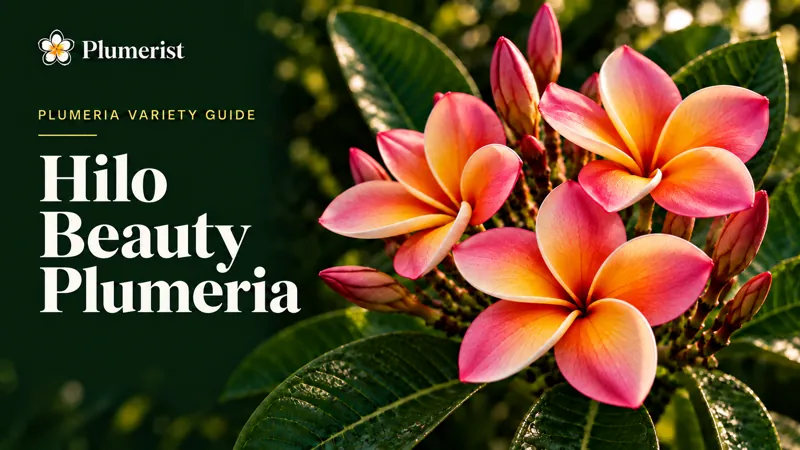
Hilo Beauty plumeria is a Plumeria rubra cultivar registered with the Plumeria Society of America as PSA number 132. Its flowers open a deep, glossy maroon red.
The fragrance is spicy and grows stronger as each bloom ages. Growers rank the color among the darkest and longest lasting in the genus.
The tree also carries a long list of alternate trade names. That causes real confusion at the point of sale. Nurseries have sold what appears to be the same clone as Dakota’s Curling Red, Burgundy Special, Black Red, Aussie Black Red, Red Esther, and Hi Lo Beauty.
A few sellers even list it as Black Garnet, though that connection is less certain. That naming mess is common with dark red plumeria. Subtle color shifts are hard to describe in a short product listing.
If you want the documented PSA 132 clone specifically, do not rely on the name alone. Ask the seller for the registration number. A clear source photo helps too, since colors shift under different lighting.
A PSA registration number is not a guarantee of quality. It only confirms a description was filed with the society at some point.
Plenty of unregistered plumeria are just as good. The number simply gives buyers one extra way to check that a listing matches the true clone.
What Hilo Beauty Plumeria Looks Like
The flowers measure roughly 3 inches across. Petals are wide and elliptical with softly rounded tips. Reddish brown banding runs across the front and back of each petal, deepening the overall color.
The center glows a strong red instead of the pale yellow throat common on lighter cultivars. Hilo Beauty plumeria blooms hold their color and shape for an unusually long time once cut. That keeping quality is part of why lei makers and collectors keep returning to it.
The scent starts mild on a fresh bloom. It turns noticeably spicier as the flower matures on the tree. Few other cultivars build fragrance this way instead of simply fading.
Growth habit is upright rather than spreading. Branching stays tight along the main trunk lines.
A healthy young tree can add close to 24 inches of height in a strong season. Mature specimens eventually form a taller, narrower canopy than many spreading rubra types.
Bloom season follows the typical rubra pattern, running from late spring through early fall in warm climates. Container grown trees in cooler regions may bloom for a shorter stretch. Flower clusters tend to be moderate in size rather than the huge trusses seen on some heavier blooming cultivars.
Hilo Beauty Plumeria vs the Houseplant of the Same Name
Search results for Hilo Beauty sometimes surface Alocasia Hilo Beauty, a variegated aroid houseplant with silver veined leaves. The two plants share nothing except a name borrowed from the same Hawaiian town.
One is a flowering tropical tree. The other is a shade loving foliage plant entirely unrelated to it botanically.
Fragrant, long lasting blooms are the goal here, not heart shaped indoor foliage. If your search leads to that instead, you have the wrong plant.
This cultivar is sold as bare cuttings or rooted starts for outdoor and container growing. It is not marketed as a houseplant.
Strengths Growers Report
- Exceptional keeping quality once flowers are cut for leis or arrangements.
- Fragrance that builds rather than fades as the bloom matures on the tree.
- Color depth that few other rubra cultivars reach without going fully black.
- Reliable, consistent bloom color across seasons once the tree is established.
- A compact flower size that suits leis and small arrangements equally well.
Weaknesses Worth Knowing
Hilo Beauty plumeria has a genuine downside for propagation. Its tight branching leaves fewer long, mature cutting sections to work with.
Growers consistently report it as harder to root than average. Expect a lower success rate and a longer wait for roots to form.
Rust remains a risk too. Nearly every Plumeria rubra cultivar is susceptible to the fungus in humid climates, and this one is no exception. Very dark blooms can also bleach slightly under intense, all day direct sun.
Factor the slower propagation timeline into the price before buying. A cutting that takes longer to root ties up growing space and patience either way.
How It Compares to Other Dark Cultivars
| Trait | Hilo Beauty | Typical black toned cultivars |
|---|---|---|
| Color depth | Deep glossy maroon red | Near black in low light |
| Fragrance | Spicy, builds with age | Varies, often milder |
| Rooting difficulty | Above average | Often above average as well |
Collectors chasing the darkest possible flower often stack this cultivar up against the darkest toned plumeria cultivars before deciding. Anyone who wants a wider survey of reds may prefer to start with the wider red plumeria lineup instead. Scent hunters comparing options across the board can also check which cultivars are bred mainly for their perfume.
Care Notes and Availability
This cultivar needs the same fundamentals as any rubra plumeria. It wants full sun, well draining soil, and a dry dormant season in winter. For the complete routine, see the baseline care routine every plumeria needs.
Its Hawaiian origins also tie it to the island blooms tied to Hawaiian identity. Several other named cultivars share that same regional history.
Rooting runs slower than average here. Starting from a rooted start instead of a bare cutting can save a season of frustration for newer growers.
If you take on a bare cutting anyway, follow cutting technique that actually affects rooting odds. It matters more here than with easier varieties.
Availability generally runs through specialty plumeria nurseries and cutting sellers rather than big box garden centers. Stock tends to move seasonally through the summer growing months.
The Plumerist toolkit
The gear we would buy if we were starting over.
As an Amazon Associate, Plumerist earns from qualifying purchases.
Frequently Asked Questions
Is Hilo Beauty plumeria hard to find?
It’s less common than mainstream pink or yellow cultivars, but not rare. Specialty plumeria nurseries and cutting sellers carry it fairly regularly, especially through summer.
Why does this variety have so many different names?
The dark red plumeria trade grew up independently across different regions and growers. Several distinct sounding names ended up attached to what is likely a single clone.
Is it the same plant as Alocasia Hilo Beauty?
No. The two share only a name borrowed from the Hawaiian town of Hilo. One is a flowering tree, and the other is an unrelated houseplant grown for its leaves.
Does the color fade in strong sun?
Growers report some bleaching of the darkest tones under intense, all day direct sun. Light afternoon shade in hot climates can help preserve the deepest maroon color.
Is this cultivar fragrant?
Yes, and its spicy scent grows more noticeable as each flower ages on the tree. Many lighter cultivars fade instead of building fragrance this way.