

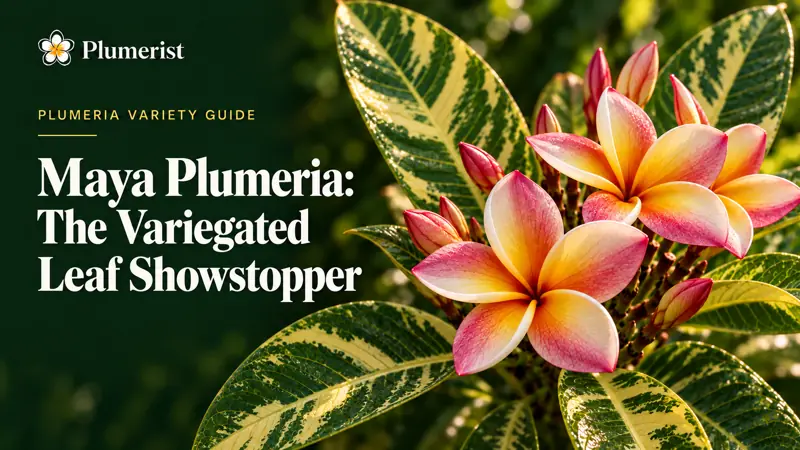
Maya variegated plumeria is a Thai bred Plumeria rubra cultivar grown mainly for its leaves. Each leaf carries its own splash of pale green, white, and gold over a dark green base. No two leaves match exactly, and that is the whole appeal.
The flowers are a real bonus on top of the foliage. Here is what Maya variegated plumeria actually looks like. I will also cover what it costs you in growth speed, and how to stop the variegation from fading away over time.
What Maya Variegated Plumeria Looks Like
The leaves are the real star here. A dark green base gets marbled with pale green, white, and a warm gold or ochre tone.
The pattern shifts from leaf to leaf on the same plant. Reddish petioles add contrast against all that pale variegation.
The flowers themselves are bright pink with a golden yellow center. They run about 3 inches across, with the sweet fragrance typical of the genus.
You may also see this plant sold under the name Anyamani in some regional listings. That naming overlap is worth knowing, so you do not assume you found a rarer, different cultivar.
Why Maya Variegated Plumeria Grows So Slowly
Variegated tissue has less chlorophyll than solid green tissue. Chlorophyll converts light into energy, and large white or pale patches simply cannot photosynthesize as well as plain green leaves.
That is the real, documented reason variegated plumeria grows more slowly than a solid green cultivar. It is basic plant biology, not a marketing story, and it applies to Maya just like any other variegated plant.
Slow growth means slower multiplication for nurseries too. That is the main reason well variegated Maya cuttings stay pricier and harder to find than an average named cultivar.
The Reversion Problem
Variegated plumeria can revert to solid green, and Maya is no exception. Growers report it happens most often on stressed plants, especially ones dealing with low light or inconsistent watering.
The mechanism is simple enough. Normal green cells grow faster than the mutated variegated cells. A reverted branch can eventually outcompete the rest of the plant if you let it grow unchecked.
The fix is routine maintenance. Prune out any branch that reverts to solid green as soon as you spot it. That single habit keeps the plant putting its energy into variegated growth instead of plain green shoots.
Size, Habit, and Bloom Trade Offs
Maya stays small to medium sized for a plumeria. Its slow growth actually works in your favor here, keeping it manageable in a pot for years longer than a vigorous solid green cultivar would allow.
Growers commonly report lighter bloom counts while a young Maya is still establishing itself. The plant seems to put its early energy into leaf growth first, with flowering picking up as the tree matures.
That trade off is worth knowing going in. If heavy, immediate bloom output matters more to you than foliage, weigh that trade off carefully. A solid green cultivar will likely outperform Maya on flower count in its first few years.
Honest Strengths and Weaknesses
- Strength: genuinely unique foliage, with no two leaves patterned exactly alike.
- Strength: still produces the classic sweet scented pink and yellow bloom on top of the leaf show.
- Weakness: slower growth means a smaller plant for your money next to a solid green cultivar.
- Weakness: a real risk of reversion under stress, which takes ongoing attention to manage.
- Weakness: cold sensitive below 50 degrees, so container life is standard outside the tropics.
Growing Maya Variegated Plumeria
Give it strong, direct light for most of the day. Weak light tends to push the plant toward duller variegation and a higher chance of reversion.
Plant it in fast draining soil, the same as any other cultivar. My guide to routine care covers watering and feeding basics in full.
Because it struggles below 50 degrees, most growers outside true tropical climates keep it in a pot. My plumeria in containers guide covers sizing and drainage.
My growing plumeria indoors guide is worth reading too, since this cultivar often needs to come inside for winter.
Propagating Maya Plumeria
Maya roots reasonably well from a cutting despite its slow overall growth rate. The trick is choosing a cutting with strong, stable variegation, not one already showing solid green patches.
My plumeria cuttings guide walks through the process. A cutting is also the only reliable way to get a true Maya, since a seed grown plant will not match the parent.
What to Check Before You Buy
Look closely at the actual cutting or plant photo before ordering. A weak or barely variegated cutting can still grow into a mostly green plant, even if the parent tree looked spectacular.
Ask whether the specific cutting came from heavily variegated wood or from a branch that had already started reverting. That single question can save you a long wait for foliage that never quite shows up.
Maya vs Other Rare and Collector Cultivars
Maya regularly comes up on lists of sought after plumeria. My rare plumeria guide explains why collectors chase variegated foliage the same way others chase unusual bloom colors.
If you like the pink and yellow bloom but want a faster growing plant, look at solid green options instead. My pink plumeria guide covers a similar flower color, and you skip the reversion risk entirely.
The Plumerist toolkit
The gear we would buy if we were starting over.
As an Amazon Associate, Plumerist earns from qualifying purchases.
Frequently Asked Questions
What makes Maya plumeria special?
Its variegated leaves. Each one shows a different splash of pale green, white, and gold, on top of a normal, sweet scented pink and yellow bloom.
Why does Maya variegated plumeria grow so slowly?
Variegated leaf tissue has less chlorophyll, so it produces less energy than solid green tissue. That slows down growth for the whole plant.
Can Maya plumeria revert to a solid green plant?
Yes. Stress from low light or inconsistent watering can trigger reversion. Unchecked green growth can eventually take over the plant.
Who bred Maya variegated plumeria?
Records do not document a named breeder or an introduction year. It is consistently described as a Thai cultivar, though a specific origin story beyond that is not documented anywhere I could confirm.
Is Maya plumeria cold hardy?
No. It struggles below 50 degrees Fahrenheit. Most growers outside the tropics keep it in a container and bring it in for winter.
Maya earns its reputation honestly. The foliage on Maya variegated plumeria is genuinely one of a kind, but you pay for it with slower growth and a bit of extra vigilance against reversion. It rewards patience rather than instant results.
For the full lineup of named cultivars, my variety index is the place to keep browsing.