

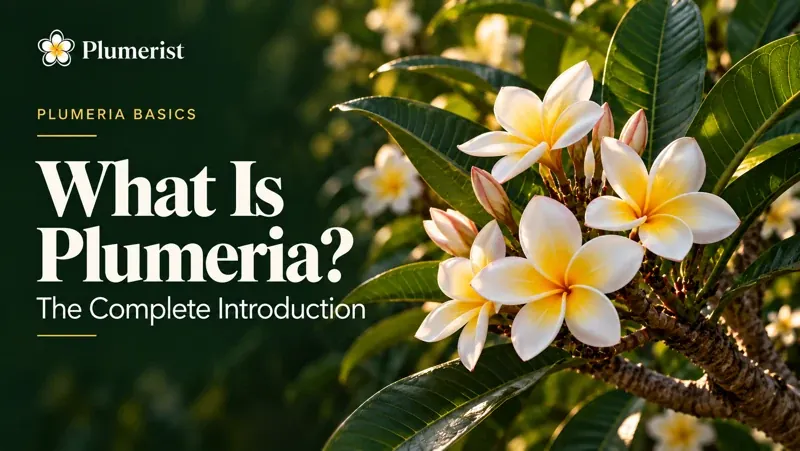
What is plumeria? It is a genus of tropical flowering shrubs and small trees, also commonly called frangipani. The familiar waxy flower is one part of the plant, not a separate kind of orchid or hibiscus.
Many garden plumerias are grown for their flowers, fragrance and branching shape. They can differ substantially in size, foliage and scent. A label that says only plumeria leaves several useful questions unanswered.
What is plumeria in botanical terms?
Plumeria belongs to Apocynaceae, the dogbane family. Kew’s current genus record places its native range in Mexico, northern South America and the Caribbean. Its familiar association with Hawaii does not make it native there.
That record currently lists 18 accepted species entries, including a named hybrid. Older gardening references often give a different count. Classification changes, so a fixed claim that the genus always contains eleven species is misleading.
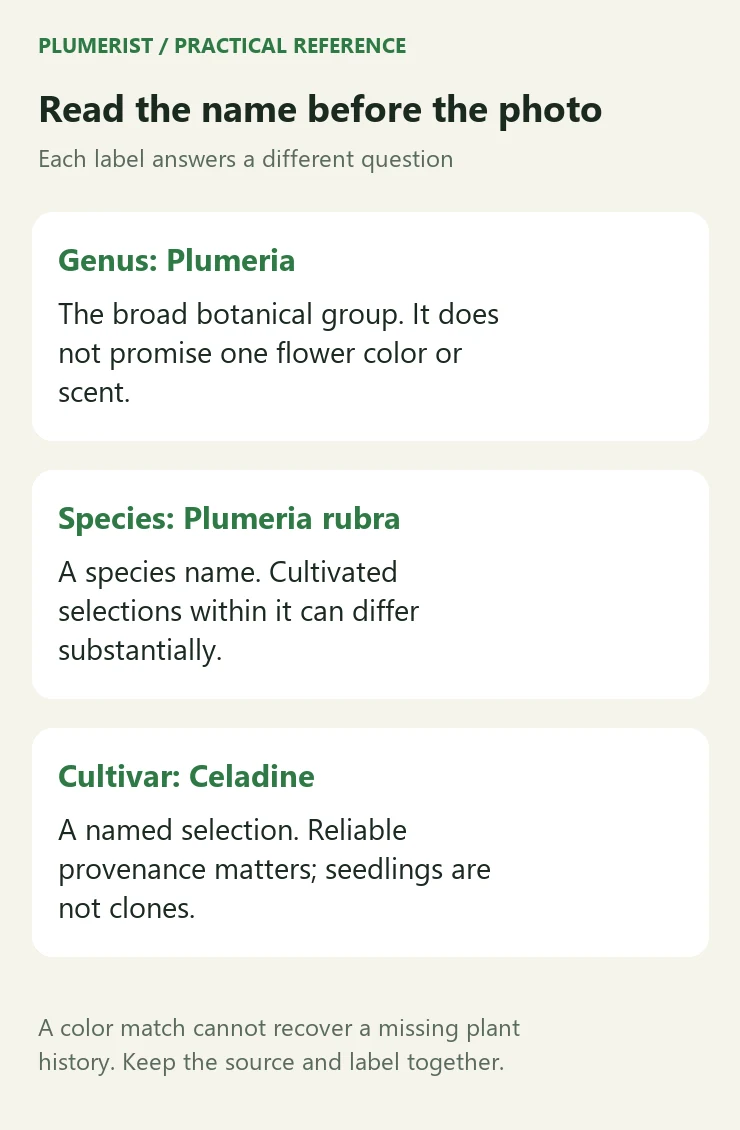
You do not need to memorize the list to choose a plant. You do need to distinguish a genus name from a species and a named cultivated selection. Those levels tell you different things.
| Name on a label | What it means | What it cannot promise |
|---|---|---|
| Plumeria | The genus. | A particular flower, size or scent. |
| Plumeria rubra | A species name. | That all its garden selections are red or identical. |
| A cultivar name, such as Celadine | A named cultivated selection. | Authenticity without reliable plant provenance. |
| Seedling of a named plant | A plant raised from that parent’s seed. | A clone with the parent’s exact traits. |
| No identification or NOID | The plant’s precise identity is unknown. | That a photo can supply the missing provenance. |
The species and cultivar overview explains the wider collection of garden types. Keep the name attached to the plant when buying or propagating. A written history is more useful than trying to identify it from one flower later.
Recognize the flower and the plant together
A typical flower has a narrow tube expanding into overlapping petal lobes. Five are usual, although cultivated forms can vary. The rounded or more furled outline depends on the plant.
Flowers develop in clusters toward branch ends. Leaves also gather near the tips, while older branch sections may look comparatively bare. The branches are thick and succulent, but can break under rough handling.
Look at that whole arrangement rather than using a yellow throat as a universal identification test. Several unrelated flowers can share the same colors. The plumeria and hibiscus comparison shows more useful structural differences.
Wisconsin’s plumeria reference illustrates variation in leaf shape, plant habit and flowers. Those differences help explain why two genuine plumerias may look unlike each other. They do not automatically identify a particular cultivar.
Plumeria, frangipani and the Hawaiian connection
Frangipani is a common name for these plants. Plumeria is the botanical genus name and is also used in ordinary speech. Neither word identifies a single flower color.
Common names can vary between places and sellers. A botanical name helps when comparing plants or asking a nursery about care. It is especially useful when a trade name could refer to more than one selection.
Plumerias are widely grown in Hawaii and used in lei making. They are introduced ornamentals there, rather than native Hawaiian plants. The Hawaiian flower guide separates that association from botanical origin and the official state flower.
What to expect from flowers and fragrance
Many plumerias are scented, with descriptions ranging from sweet floral to citrus or spice. Strength and perceived notes differ. A colorful flower photograph cannot tell you what the plant will smell like.
The scent description guide explains those comparisons. Smell a correctly identified flowering plant when you can. Do not buy a color alone as a guarantee of a particular perfume.
A cluster can have several flowers at different stages. One bloom fading does not mean the entire cluster has finished. Equally, a plant pictured in flower is not guaranteed to bloom continuously in every home.
Can you grow it where you live?
Start with cold protection, useful light and available space. Plumeria is commonly grown outdoors in suitable warm climates and moved seasonally in containers elsewhere. A roof or garage is not automatically warm enough during a cold event.
Check the actual protected destination before the plant becomes large. Branch width, pot weight and doorway access all matter. The container planning reference helps assess the complete setup.
Do not use a mature landscape tree as the model for an unrooted cutting. Rooting status changes what water the plant can use. A warm leafy plant also needs different care from one resting without leaves in cool conditions.
The ongoing care guide owns that routine. Feed appropriately during active growth, account for nutrients already present and avoid trying to force flowers with extra products. A first plant does not need a shelf full of bloom remedies.
Deciduous does not mean dead
Many commonly grown plumerias lose leaves as conditions change. Others retain more foliage in suitable warmth. Species, cultivar and the growing setup affect that behavior.
Leaf loss therefore needs context. Compare the season, temperature, root moisture and remaining tissue. Do not diagnose every bare branch as dead, or every seasonal change as harmless.
A leafless resting plant generally uses less water than an actively growing leafy one. That is not a universal instruction to withhold all water and light from every young or protected plant. Keep the care decision tied to actual activity.
Seeds, cuttings and cultivar identity
Seedlings are new genetic individuals. They can differ from their parents in flower traits and other characteristics. A packet naming the parent does not establish that its seedlings will reproduce a named cultivar.
Cuttings and grafts preserve material from the selected plant. Reliable identification still depends on where that material came from. A mislabeled cutting remains mislabeled after rooting.
A flowering cutting may not yet have functioning roots. Ask whether a purchased plant is rooted rather than judging by its buds. That distinction affects both care and how much uncertainty you are taking on.
Handle the sap sensibly
Damaged plumeria tissue releases milky sap that can irritate skin and eyes. Protect yourself when pruning or handling broken material. Do not puncture a stem simply to see whether sap appears.
Fragrance and use in floral decoration do not establish food safety. Keep plant material away from children or pets likely to chew it. The plumeria safety guide explains exposure concerns without treating every contact as the same event.
Questions about the plant
What is plumeria used for?
It is grown as an ornamental and used for floral decoration, including leis. The intended use affects selection: garden form, fragrance and handling quality are different criteria. An attractive flower need not excel at all of them.
What is plumeria compared with frangipani?
They commonly refer to the same group of plants. The botanical name becomes more precise when a species or cultivar is added. Check that fuller identity when comparing care or buying a plant.
Is every white flowered plumeria Plumeria alba?
No. Other species and many cultivars can have white flowers. Color alone cannot establish a species or a named cultivar.
The Plumerist toolkit
The gear we would buy if we were starting over.
As an Amazon Associate, Plumerist earns from qualifying purchases.