

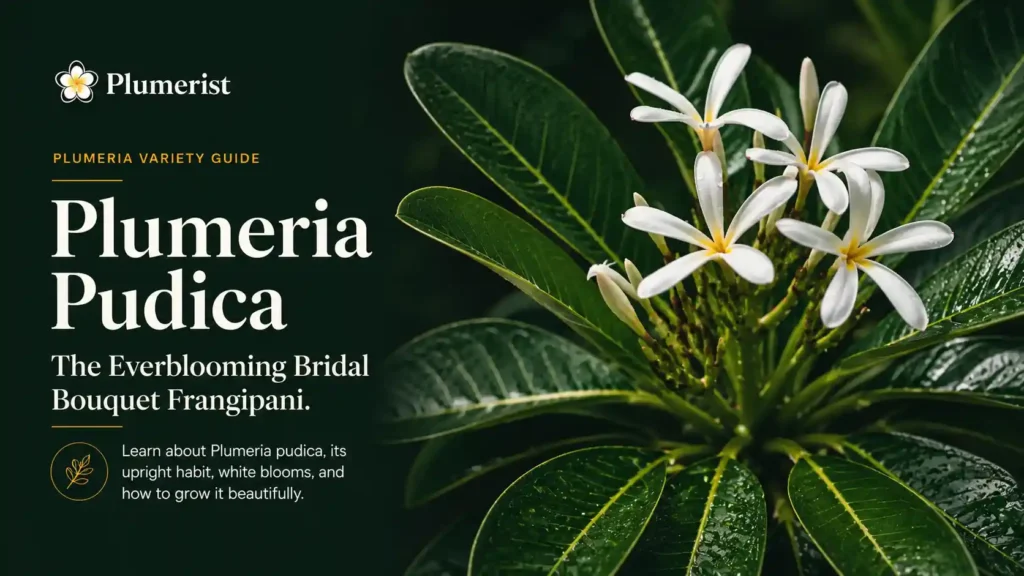
Most plumeria guides describe a plant with long pointed leaves, a heavy sweet perfume, and a bare stick winter. Plumeria pudica ignores basically all of that.
This is the rebel of the family. It has weird and wonderful fiddle shaped leaves, it stays green all year, and it pumps out clean white flowers almost nonstop. The one catch? Those flowers barely smell like anything. But for a lot of people, especially anyone after a low fuss flowering shrub, that’s a trade well worth making.
You’ll almost always see pudica sold as Bridal Bouquet, and once you understand what it does and doesn’t do, it turns out to be one of the easiest plumeria to love. Let me break it down.
Plumeria Pudica at a Glance
| Thing | The short answer |
|---|---|
| Species | Plumeria pudica, family Apocynaceae (the dogbane family) |
| Also called | Bridal Bouquet, fiddle leaf plumeria, wild plumeria |
| Native to | Panama, Colombia, and Venezuela |
| Leaves | Fiddle or spoon shaped, glossy, and evergreen |
| Flowers | Bright white with a small yellow center, barely any scent |
| Bloom season | Exceptionally long, nearly year round in warm climates |
| Mature size | Compact shrub or small tree, roughly 10 to 13 ft |
| Hardiness | Tender: USDA zones 9b to 11, protect from frost |
What Is Plumeria Pudica?
Plumeria pudica is one of the true plumeria species, and it’s easily the most distinctive looking of the whole bunch. It’s part of the same dogbane family (Apocynaceae) as the rest, but it hails from a little further south than most, being native to Panama, Colombia, and Venezuela.
The name is a fun one. Pudica is Latin for bashful or modest, which honestly suits a plant that quietly does its own thing, staying green and blooming away without the dramatic seasonal show the others put on.
In the trade you’ll nearly always find it labeled Bridal Bouquet, thanks to those big clusters of pure white flowers. You’ll also hear fiddle leaf plumeria and wild plumeria tossed around. Same plant. And if you’re still a bit fuzzy on the whole plumeria versus frangipani thing, I cleared it up in plumeria vs frangipani.
How to Identify Plumeria Pudica
Honestly, pudica is the easiest plumeria to identify, because one look at the leaves gives it away instantly.
The leaves are fiddle shaped. This is the dead giveaway, and nothing else in the genus looks anything like it. Instead of the long pointed or rounded leaves of other plumeria, pudica has quirky, glossy, dark green leaves shaped like a fiddle or a spoon, narrow through the middle and wider toward the end. Once you’ve seen them, you will never mistake this plant again.
It stays evergreen. Like obtusa, pudica hangs onto its leaves and stays green through the year in a warm climate, skipping the bare stick winter that the deciduous types go through.
The flowers come in big white clusters. Pudica blooms are bright white with a small yellow eye, and they show up in generous bunches, which is exactly why it earned the Bridal Bouquet name.
The Tradeoff: Nonstop Blooms, But No Scent
Time for the honest part, because pudica has one clear downside you really want to know before you buy.
The flowers have almost no scent. This is the big trade with pudica. While a fragrant white plumeria can perfume a whole yard in the evening, pudica is nearly scentless. If a knockout fragrance is your top priority, this one will let you down, and you’d be happier with a strongly scented white instead. My white plumeria guide covers the fragrant options.
But it blooms almost nonstop. Here’s the flip side, and it’s a big one. Pudica makes up for the missing scent by flowering for an incredibly long season, often close to year round in a warm, frost free spot. Where a deciduous plumeria gives you a few months of flowers, pudica just keeps going and going. For sheer flower power over time, it’s genuinely tough to beat.
So the deal is simple: you trade fragrance for nonstop blooms and lush evergreen foliage. Plenty of people happily make that swap.
Where Pudica Fits Among the Species
Here’s how pudica stacks up against the other three plumeria you’re most likely to run into:
| Species | Leaves | Evergreen? | Flowers | Fragrance |
|---|---|---|---|---|
| Plumeria pudica | Fiddle or spoon shaped | Yes | White | Barely any |
| Plumeria rubra | Long, pointed | No | Every color | Strong |
| Plumeria obtusa | Rounded, glossy | Yes | White and pink | Yes |
| Plumeria alba | Long, narrow | No | White | Very strong |
The quick way to place pudica: if the leaves look like little fiddles or spoons, it’s pudica, end of story. No other plumeria comes anywhere close to that look.
Why Pudica Is a Landscaper’s Favorite
So who is pudica actually for? Landscapers absolutely love it, and here’s why.
It’s fast growing and evergreen, so it fills in quickly and stays green all year, which makes it fantastic for hedges, privacy screens, and foundation plantings. It stays fairly compact and shrubby rather than towering, so it slots into smaller spaces. And because it flowers almost constantly with very little effort, you get a shrub that is basically always in bloom without much fuss from you.
Add in that the lack of fragrance is a total non issue for most landscape uses, and you’ve got one of the most practical, low maintenance flowering plants for a warm climate garden. If you want constant white blooms on a plant that looks good the whole year, pudica is a seriously great pick.
How to Care for Plumeria Pudica
Good news, pudica care is the same core plumeria routine, with the evergreen tweaks you’d expect.
Sun. Full sun, six hours minimum and more is better. It’ll flower at its best in a bright, open spot.
Soil. Fast draining, always. A gritty, sharp draining mix keeps the roots happy. Pudica likes a slightly acidic soil, but honestly drainage is the part that really matters. My best soil for plumeria guide has the recipe.
Water. Water deep, then let the top few inches dry out before the next round. Since pudica stays evergreen and blooms nearly year round, it wants steadier moisture than a deciduous plumeria that shuts down for winter, so don’t leave it bone dry for long. Full breakdown in plumeria water requirements.
Feeding. Because it flowers almost constantly, pudica really benefits from regular feeding through the growing season with a high phosphorus bloom fertilizer. My feeding plumeria notes have the schedule.
Warmth. Like the other evergreen plumeria, pudica wants warmth and doesn’t have a deciduous plant’s cold survival trick, which brings us straight to the one warning.
The One Warning: Pudica Hates Cold
The catch with pudica, same as the other evergreen types, is cold. It’s tender and won’t tolerate frost, doing best in warm zones (roughly 9b to 11) and starting to sulk as things drop toward the low end.
If you live somewhere with frost, grow pudica in a pot so you can move it, and bring it into a warm, bright spot before the first cold snap. Since it stays evergreen, treat it more like a tender houseplant over winter than a plant you can leave outside to go dormant. My winter care routine walks through it. Just remember pudica needs the gentler, warmer version.
Growing Plumeria Pudica From Cuttings
Like every plumeria, pudica grows easily from cuttings, which is the reliable way to get more of it. Take a cutting a foot or two long, let the cut end dry and callus over for a couple of weeks so it won’t rot, then pot it up in fast draining mix. It roots readily and grows fast, so you’ll be filling out that hedge in no time. Full steps in how to grow plumeria from cuttings.
Is Plumeria Pudica Toxic?
Quick and important heads up: like the rest of the genus, pudica has a milky white sap that can irritate skin and eyes and is toxic if eaten. Pudica in particular often gets flagged as one to keep well away from pets and kids, so wear gloves when you prune it and plant it somewhere sensible. More on the pet side in whether plumeria is toxic to dogs.
What Does Plumeria Pudica Symbolize?
With a name that means bashful and a reputation as the Bridal Bouquet, pudica leans toward themes of modesty, purity, and quiet devotion, which fits those clean white flowers perfectly. Plumeria as a whole carry rich meaning across Hawaii and Asia, and I unpacked all of it in plumeria meaning and symbolism.
Frequently Asked Questions
Is Plumeria pudica fragrant? Barely, and this is its one real downside. Pudica flowers have very little scent, unlike the strongly perfumed white and colored plumeria. You grow this one for nonstop blooms, not for fragrance.
Is Plumeria pudica evergreen? Yes. In warm climates it stays green all year instead of dropping its leaves like the deciduous types, which is a big part of why it’s such a popular landscape plant.
Why is Plumeria pudica called Bridal Bouquet? Because of its big clusters of pure white flowers, which really do look like a bridal bouquet. The near constant blooming only adds to the effect.
How do I identify Plumeria pudica? The fiddle or spoon shaped leaves. Nothing else in the genus has them, so those quirky leaves are an instant giveaway.
How big does Plumeria pudica get? It’s on the compact side for a plumeria, usually around 10 to 13 feet as a shrub or small tree, and you can keep it smaller with pruning.
Is Plumeria pudica cold hardy? Not really. It’s tender and frost sensitive, best in USDA zones 9b to 11. In colder areas, grow it in a pot and overwinter it somewhere warm.
Bottom line, Plumeria pudica is the plumeria to grow when you want nonstop white flowers and a lush evergreen look and you’re not fussed about fragrance. Those fiddle shaped leaves make it a total standout, and the near endless blooming makes it a landscaper’s dream. Just keep it out of the frost, give it sun and sharp drainage, and it’ll flower for you almost all year. Want to see how it fits with the rest of the family? Head back to the full plumeria varieties guide, or explore the fragrant white plumeria options if scent is what you’re really after.