

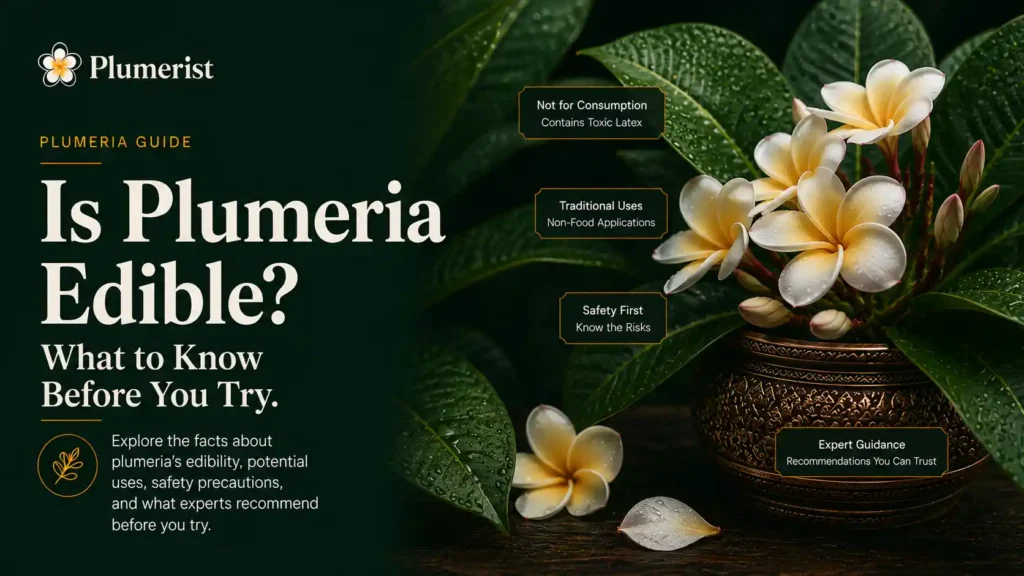
Plumeria flowers are so gorgeous and smell so sweet that it’s a fair question: can you actually eat them? Maybe you want to float one on a cocktail, toss petals in a salad, or you’re just worried because your kid or your dog took a curious nibble.
So let me give you the honest, no fluff answer, plus the important safety details you’ll want to know.
Is Plumeria Edible? Quick Answer
| Question | The short answer |
|---|---|
| Can you eat plumeria? | Not really. It’s grown for looks and scent, not for food |
| Is it toxic? | Mildly. All parts contain mildly toxic compounds |
| The main irritant | The milky white sap, which bothers skin, eyes, and mouth |
| If eaten | Can cause mild stomach upset and mouth or skin irritation |
| Pets and kids | Keep them from chewing on it, just to be safe |
The Short Answer: Don’t Eat It
Here’s the deal: plumeria is not a food plant. It’s grown purely for its beautiful, fragrant flowers, not for anything you’d put on a plate.
The plant contains mildly toxic compounds in all its parts, the leaves, stems, flowers, and especially that milky sap. It’s not the kind of deadly poison that lands you in the hospital from one bite, but it’s definitely not something you should be snacking on either. My honest advice? Enjoy plumeria with your eyes and your nose, and leave your mouth out of it.
Why Plumeria Isn’t Really Edible
The reason comes down to chemistry. Like a lot of plants in its family (the same family as oleander, for what it’s worth), plumeria contains mildly toxic alkaloids and a milky latex sap throughout the plant.
If someone eats part of a plumeria, the usual result is mild: think an upset stomach, some cramping, maybe mouth or throat irritation. It’s rarely serious in small amounts, but it’s genuinely unpleasant, and everyone reacts a little differently. Some people are more sensitive than others. So it’s just not worth the gamble for a flower that doesn’t even taste good.
The Milky Sap Is the Real Troublemaker
If there’s one part to be careful with, it’s the sap. When you snap a stem or a leaf, plumeria oozes a milky white latex, and that stuff is a known irritant.
On skin it can cause redness or a rash, especially if you’re sensitive to it. In your eyes it stings and irritates. And in your mouth it’s the same story. That’s exactly why I always tell people to wash their hands after pruning and avoid rubbing their eyes while working with the plant. If you’ve got sensitive skin, wearing gloves is a smart move.
But Wait, Aren’t Plumeria Used in Food Somewhere?
You might have seen this floating around, so let me address it honestly.
In a few cultures, the fragrant flowers do get used in limited ways, for example battered and fried into fritters, or dried and steeped as a folk remedy tea. So the flowers aren’t a deadly poison, and there’s a bit of traditional culinary and medicinal use out there.
But here’s the big caveat: this is niche, traditional, and done by people who know exactly what they’re doing, and the scientific evidence behind it is thin. It is not a green light to start eating flowers off your plant. Given the sap and the mild toxicity, I would not recommend experimenting with eating plumeria at home. If you ever want to try a culinary flower use, learn it properly from someone experienced, don’t wing it.
Is Plumeria Poisonous to Pets?
This is the version of the question I get most, usually from a worried dog or cat owner. The short version: plumeria is mildly toxic to pets too, mostly thanks to that sap, and a curious animal chewing on it can end up with drooling, an upset stomach, or mouth irritation. It’s generally not life threatening in small amounts, but it’s worth keeping pets from munching on the plant. I go into the full detail, and what to watch for, in my guide on whether plumeria is toxic to dogs.
If a pet or a child does eat a meaningful amount and seems unwell, it’s always safest to call your vet, doctor, or a poison control line for advice.
So What Is Plumeria Actually For?
Simple: enjoyment, not eating. Plumeria earns its place with those stunning, sweetly scented blooms. It’s the classic flower for Hawaiian leis, a favorite for perfume and decoration, and an absolute showstopper in a warm garden. If you want to know what makes them smell so good, or which types exist, check out the full plumeria varieties guide. Just admire it, don’t eat it, and you and your plumeria will get along great.
Frequently Asked Questions
Can you eat plumeria flowers? It’s best not to. They’re not a food plant and contain mildly toxic compounds. A few cultures use them in limited traditional ways, but it isn’t recommended to eat them casually at home.
Is plumeria poisonous to humans? Mildly. Eating parts of the plant can cause stomach upset and mouth or skin irritation, and the sap is an irritant. It’s not usually dangerous in small amounts, but it isn’t safe to eat.
Is the plumeria sap dangerous? The milky sap is a skin, eye, and mouth irritant. Wash your hands after handling the plant and avoid touching your eyes.
Is plumeria safe around pets? It’s mildly toxic to pets, so keep them from chewing it. See my plumeria and dogs guide for details.
Is frangipani the same as plumeria? Yes, two names for the same plant, so everything here applies to frangipani too. More in plumeria vs frangipani.
Bottom line, plumeria is a feast for your eyes and your nose, not your stomach. It’s mildly toxic, the sap is an irritant, and while a few cultures use the flowers in careful traditional ways, it’s not something to eat casually at home. Keep it away from curious pets and kids, wash up after pruning, and enjoy it for what it is: one of the most beautiful, fragrant flowers you can grow. Curious about the plant itself? Head to the plumeria varieties guide.