

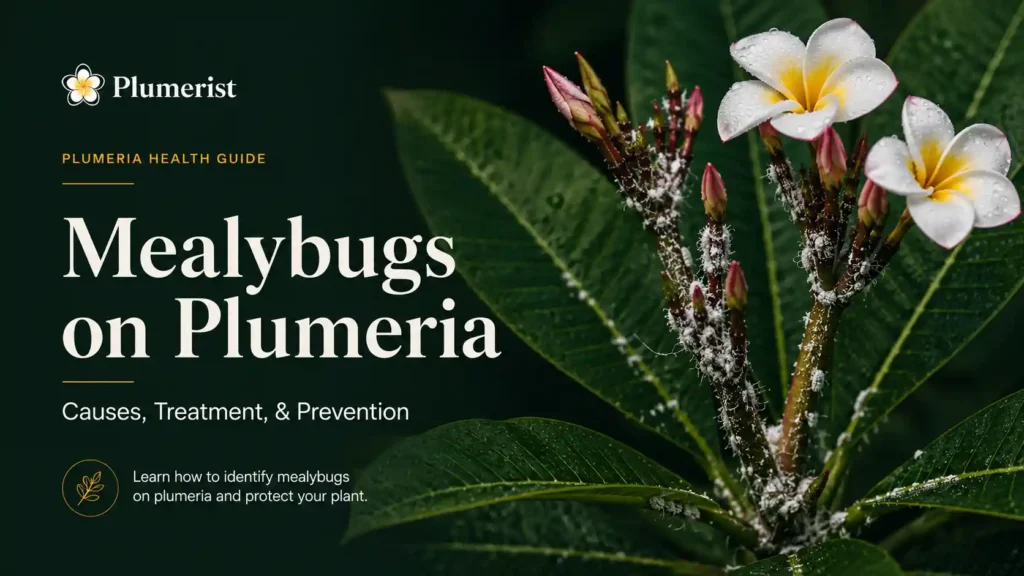
Mealybugs on plumeria usually appear as small insects covered in white wax, often around tender growth and protected joints. Before treating, look beneath that wax. Dried sap, whiteflies and some scale insects can create a similar first impression.
The goal is to find living pests, reduce their numbers and check for new activity. One spray rarely proves the problem is finished. Repeated inspection also helps prevent unnecessary damage from repeated chemical treatments.
Identifying mealybugs on plumeria
Most adult females have oval, segmented bodies with a waxy covering. They belong to the family Pseudococcidae. The white material is wax and sometimes an egg sac, not foam made by mixing sap with saliva.
Inspect leaf bases, folds in new growth and sheltered stem joints with a magnifier. Gently separate residue to see what is underneath. A white spot alone is not enough to identify an insect.
The UC IPM mealybug guide explains identification and common lookalikes. It also shows why protected colonies are hard to reach. Use the actual insect and damage pattern to guide treatment.
| What you find | What to check next |
|---|---|
| White wax around a visible oval insect | Look for segmented bodies and more colonies near leaf bases. |
| A crusty white mark near a wound | Check for dried latex rather than assuming every mark is a pest. |
| White insects that fly when disturbed | Compare with whiteflies, especially on leaf undersides. |
| Fine webbing and pale stippling | Inspect for spider mites. Mites do not produce honeydew. |
| Black coating on sticky foliage | Find the honeydew producing pest rather than treating the coating alone. |
Use the whitefly identification guide when adults fly from the leaves. For webbing and stippling, compare spider mite symptoms. Avoid treating all white residue with the same spray.
Mealybugs
White, cottony clusters in leaf joints and along the stems.
Monterey horticultural oil
Coat the clusters thoroughly; the oil smothers the insects and their eggs.
Check price on AmazonAs an Amazon Associate, Plumerist earns from qualifying purchases.
How an infestation affects the plant
Mealybugs feed on sap. Larger populations can weaken growth and contribute to distorted shoots or leaf drop. A small colony does not mean the tree is beyond recovery.
Honeydew can leave foliage sticky and support black sooty mold. Ants may visit the honeydew and interfere with beneficial insects. Check for ant activity while inspecting the colony.
Do not assume every yellow leaf comes from the insects. Root stress, watering and other pests may be involved too. Record where the insects are and whether the damaged area is spreading.
Start with removal and isolation
- Separate a movable infested plant from nearby plants. Inspect its neighbors before returning it to the group.
- Remove visible insects carefully. Prune a heavily infested small section only when that loss is reasonable for the plant.
- On sturdy growth, a directed water spray can reduce exposed insects. Avoid breaking tender tips or soaking a poorly draining pot.
- Check leaf bases, the pot rim, supports and protected joints again. A clean leaf surface does not prove hidden colonies are gone.
Keep a dated inspection note or photo. Look for living insects and fresh wax rather than judging by old marks alone. Continue monitoring after the plant first looks clean.
For severe problems on houseplants, UC IPM describes targeted dabbing with isopropyl alcohol at 70% or less. Test a small area first and watch for injury. Do not pour alcohol into the pot or mix it into an improvised spray cocktail.
Choose a treatment without mixing up product types
Insecticidal soap and horticultural oil are different products. Neither should be described as universally harmless to plumeria. Formulation, plant stress, heat and application method affect the risk of leaf injury.
Use a product labeled for the intended plant setting and pest. Follow its dilution, protective equipment, temperature and repeat treatment directions. A household dish detergent is not interchangeable with a labeled insecticidal soap.
Horticultural oil
The existing Monterey horticultural oil listing is an oil option, not a soap. Check the current label before buying or applying it. Contact treatments need adequate coverage and can miss sheltered insects.
Neem products
The existing neem product listing should also be checked against its current label. “Natural” does not mean it cannot injure a plant or affect beneficial insects. Do not apply more often merely because some wax remains visible.
Beneficial insects
Natural enemies can help outdoors, and unnecessary broad insecticide use can disrupt them. Buying live ladybugs is not a promise of indoor control. Do not expect released insects to clear a room’s plants overnight and leave through an open window.
Those are existing affiliate links, retained for reference. The appropriate choice depends on confirmed pest identity and the label. A purchase is not the first step when the white material has not been identified.
Why mealybugs on plumeria keep returning
Protected insects and newly emerging young can remain after an apparently successful treatment. Nearby plants or infested material can also provide a source. Check the whole group rather than increasing spray strength.
Inspect new plants before introducing them to your collection. Look at leaf bases and growing tips, not just open flowers. Avoid unnecessary nitrogen feeding that encourages excess tender growth.
If decline continues without visible insects above ground, ask for help with diagnosis. Some mealybugs feed around roots, but root damage also has other causes. Do not repeatedly uproot a plant without a reason.
When to change the plan
Stop and reassess if leaves burn after treatment. Do not add a second product to counteract the first. Follow the label and seek local extension advice if the plant or pest remains uncertain.
Persistent mealybugs on plumeria need a monitoring plan, not a promise of instant eradication. Keep treatment notes and compare fresh growth over time. Once no living pests remain, continue checks before returning the plant to a crowded collection.
The Plumerist toolkit
The gear we would buy if we were starting over.
As an Amazon Associate, Plumerist earns from qualifying purchases.