

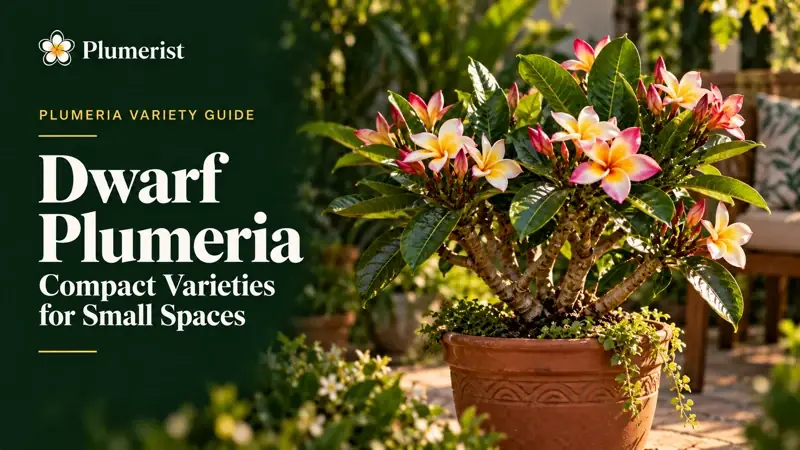
A tag that says dwarf plumeria does not always mean what buyers assume it means. Some plants carry genuine dwarf genetics and stay compact for life. Many others are just ordinary varieties that happened to be small at the nursery.
Nothing guarantees they will stay that way.
What True Dwarf Plumeria Actually Means
A genuine dwarf plumeria grows slowly and stays compact even with years of good care. The defining trait is growth rate, not just current size. A young ordinary plumeria can look just as small as a true dwarf before either one has had time to mature.
This distinction matters most when buying online, where a photo alone cannot prove which type you are getting. Asking for the specific cultivar name is the safest way to know what you are actually paying for.
Dwarf Singapore Pink
Dwarf Singapore Pink is a compact form of the evergreen obtusa and one of the most reliably true dwarfs on the market. It rarely adds more than six to eight inches of growth per year even under good conditions. Flowers run about two and a half inches across, smaller than standard obtusa blooms.
Size reports vary depending on where it grows. Many gardeners keep it around four feet tall in a container for years. The same cultivar planted in the ground can eventually reach ten feet or more.
Slow growth, not a hard size ceiling, is the trait that actually stays consistent across growing conditions.
Dwarf Deciduous
Dwarf Deciduous stands out for its flowers rather than its overall size. The blooms run four to five inches across, among the largest of any dwarf type, with a bright white petal and a small golden center. It still grows compactly and suits container life well.
Its deciduous habit means it drops leaves and rests through winter, unlike some evergreen dwarf types.
Divine
Divine is prized for its branching habit more than anything else. A mature plant only about two feet tall can carry forty or more growing tips. That density gives it a full, bushy look that larger plumeria rarely achieve at any size.
Growers consistently report Divine as one of the slowest growing named cultivars available. That slow growth explains both its compact shape and its higher price at specialty nurseries.
Realistic Size Expectations
Even a true dwarf plumeria is not miniature the way a dwarf citrus or a bonsai might be. Most stay three to six feet tall in a container over many years. Planted in the ground in a warm climate, the same plant can eventually grow taller than that ceiling suggests.
Our guide to how big plumeria get covers size expectations across the whole genus, dwarf and standard types alike.
Dwarf vs Just Pruned Small
Three different plants often get called dwarf in casual conversation. The first is a true dwarf cultivar with slow genetics built in. The second is a regular variety kept small through pruning and root restriction.
The third is simply a young plant that has not had time to grow yet. All three can look similar in a nursery pot. Only the first one stays reliably compact without ongoing pruning effort.
Propagating Dwarf Cultivars
Dwarf plumeria cuttings can be slower to root than standard varieties. The same slow growth that keeps the plant compact also slows callus formation. Many growers graft a cutting onto more vigorous rootstock instead.
Grafting speeds up establishment while keeping the dwarf growth habit of the top growth. If you start from a plain cutting rather than a grafted plant, expect rooting to take longer than it would with an ordinary rubra cutting.
Why Dwarf Cultivars Cost More
Named dwarf cultivars typically cost more than standard seedlings at nurseries. Slow growth means a nursery holds the plant longer before it reaches sellable size, which adds to production cost. Limited propagation success from cuttings pushes prices higher still for the most sought after names like Divine, sometimes by a wide margin.
Bloom Expectations, Honestly
Growers are candid that some dwarf cultivars bloom shyly compared to larger varieties. Smaller plants sometimes need an extra year or two of maturity before flowering reliably. This tradeoff is worth knowing before you buy one expecting instant flowers.
Once established, most dwarf types do flower well, just often with smaller clusters than a full sized tree produces.
Where Dwarf Labels Mislead Buyers
Plenty of listings use the word dwarf loosely for any small, young, or heavily pruned plumeria. A regular variety kept small through container life or repeated pruning is not the same as a genetic dwarf. Our guide to keeping plumeria small covers that pruning approach directly.
If a listing calls a plant dwarf without naming a specific cultivar like the ones above, treat that claim with some skepticism. Ask the seller for the cultivar name and check its growth habit before assuming it stays small.
A Naturally Compact Alternative
If a bushy, low growing look matters more than the dwarf label itself, the pudica profile is worth considering. It is a different species entirely, not a dwarf cultivar of rubra or obtusa. It naturally stays shrubby and branches low without any special pruning.
Which Dwarf Cultivar Fits Your Space
Pick Dwarf Singapore Pink if year round evergreen foliage and reliable compact habit matter most. It handles container life well and stays predictable in most climates.
Pick Dwarf Deciduous if flower size matters more than overall plant size, since its blooms rival some full sized varieties. Expect it to go leafless for part of the year.
Pick Divine if a dense, bushy silhouette is the priority over flower count. Its heavy branching makes it look mature at a small scale, though it comes at a higher price than the other two.
Growing Dwarf Plumeria in Containers
Dwarf types are excellent container candidates precisely because their slow growth means less frequent repotting. Our guide to thriving in a container covers pot sizing and soil that apply just as well to dwarf cultivars.
Their compact size also makes some dwarf types reasonable candidates for bringing indoors during cold months, a topic covered in the indoor care guide.
The Plumerist toolkit
The gear we would buy if we were starting over.
As an Amazon Associate, Plumerist earns from qualifying purchases.
Frequently Asked Questions
What is the smallest true dwarf plumeria?
Divine is among the most compact named cultivars, often staying around two feet tall while producing dozens of branching tips.
Does dwarf plumeria stay small forever?
Not necessarily in the ground. Dwarf simply means slower growth, and some dwarf cultivars still reach considerable size over many years when planted outdoors.
Do dwarf plumeria varieties bloom less than regular ones?
Some do bloom more shyly, especially while young. Most flower reliably once established, though clusters can be smaller than on a full sized tree.
Is every small plumeria for sale a true dwarf?
No. Many listings use the word dwarf loosely for any young or pruned plant. A named dwarf cultivar is the only reliable guarantee.
Are dwarf plumeria good for containers?
Yes. Their slow growth means less frequent repotting, which makes most dwarf cultivars well suited to long term container life.
Do dwarf plumeria varieties smell different from full sized ones?
Not inherently. Scent depends on the specific cultivar’s genetics, not on plant size, so a dwarf can smell just as strong as a full sized tree.